
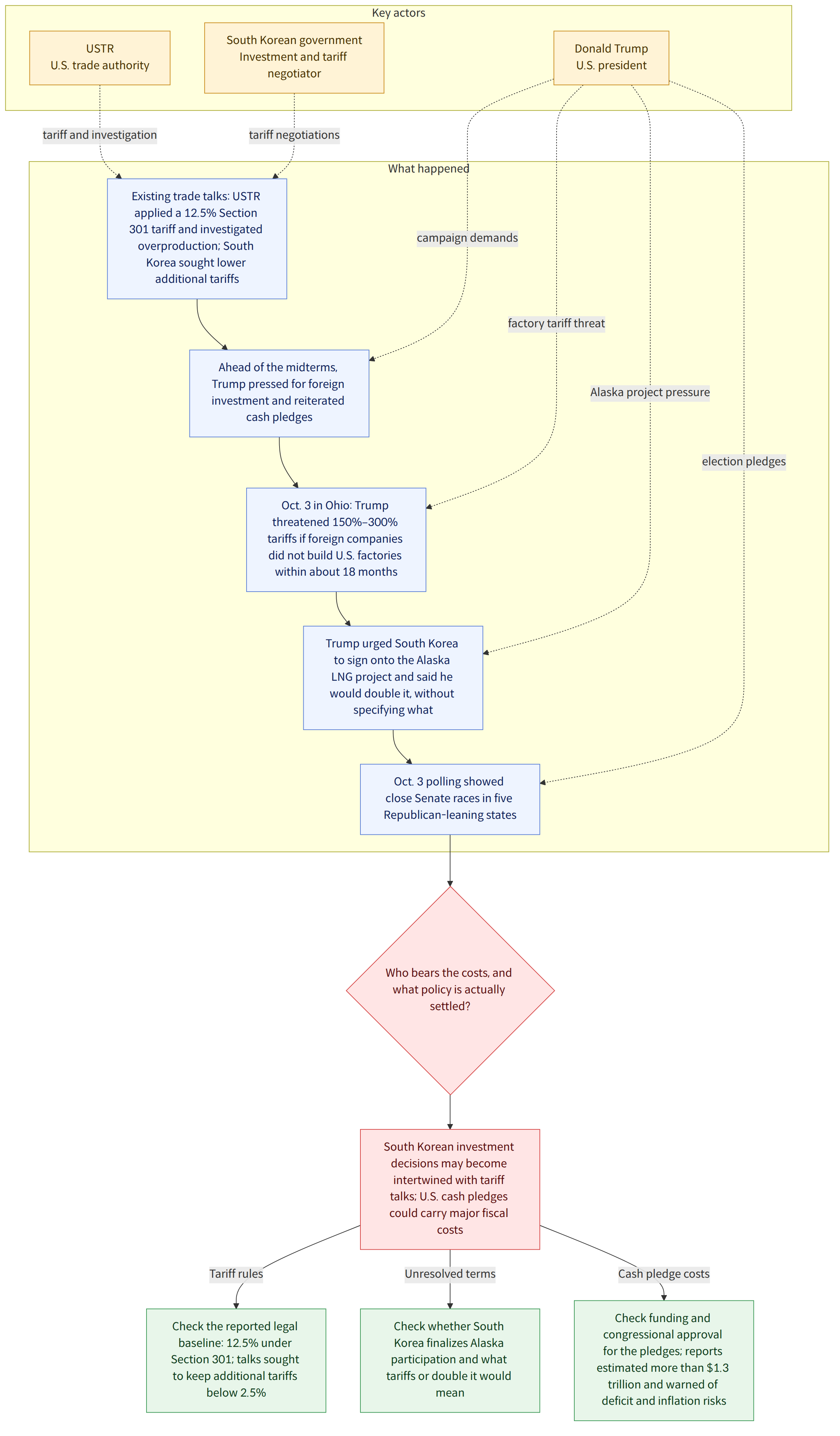
Ahead of the November midterm elections, U.S. President Donald Trump has made a series of demands for investment in the United States and cash pledges. At a rally in Ohio on October 3, he said he would impose tariffs of 150% to 300% if foreign companies did not build factories in the United States within about a year and a half. Regarding the Alaska gas development project, for which the South Korean government has not finalized its participation, he urged South Korea to sign and said he would “double it.” Around the same time, he also reiterated pledges of checks for seniors and cash payments to American adults.
Background and context
The tariff remarks go beyond a simple trade slogan: they are pressure to tie foreign companies’ investment decisions to building factories in the United States. According to reports, the Trump administration has threatened tariffs of several hundred percent on China or particular products, but has never actually imposed tariffs of that magnitude on a specific country. The remarks therefore should be understood as a threat that costs could rise if companies do not invest, not as confirmation that tariffs have been set.
The issue concerning South Korea is the Alaska liquefied natural gas (LNG, natural gas cooled into liquid form for transportation) development project. President Trump announced that South Korean investment funds would be put toward the project, but the South Korean government has not finalized its participation. President Trump said that if South Korea did not sign soon, he would “double it,” but did not specify what he would raise. One report interpreted the remark as appearing to refer to a tariff increase, but no actual measure has been decided.
The pressure is also tied to existing trade negotiations. One report said that the Office of the United States Trade Representative (USTR; 미 무역대표부) had imposed a 12.5% tariff on South Korea under Section 301 of the Trade Act (무역법 301조), was conducting an additional investigation related to overproduction, and that the South Korean government was negotiating to bring additional tariffs below 2.5%. Another report explained that South Korea’s investment pledge to the United States is linked to tariff reductions, and that whether participation in the Alaska project is a way to fulfill that investment pledge is an issue between the two countries.
The state of the election race has also been cited as a backdrop to the remarks. Alaska is traditionally a strong Republican state, but some polls showed Democratic candidate Mary Peltola ahead of Republican incumbent Senator Dan Sullivan. In a New York Times/Siena poll released on October 3, Democratic Senate candidates were leading or in close races within the margin of error in five Republican-leaning states: Texas, Alaska, Ohio, Iowa and Kansas. This reflects the state of the race at the time of the poll, not the election results.
What this news means
For South Korean companies and the government, the risk may grow that investment decisions and tariff negotiations will become intertwined. This is because the U.S. president announced how investment funds would be used before South Korea had finalized its participation in the project, urged it to sign, and raised tariffs. However, the reports do not establish what tariffs would apply or when if South Korea does not invest, or what “double it” refers to. It is important to distinguish uncertain statements of pressure from confirmed policy measures.
For example, if a South Korean company is considering an investment decision related to exports to the United States, it may need to assess the profitability of the investment separately from the tariff terms set in government-to-government negotiations. In particular, because neither participation in the Alaska project nor the scale and terms of any investment have been finalized, it is difficult to treat the president’s announcement as a final decision by the South Korean government.
For U.S. voters, the key questions are how the cash pledges would be funded and whether Congress would approve them. President Trump wrote that he would immediately begin sending $90 checks to more than 20 million seniors to help pay their Medicare (메디케어) premiums, and also promised a “Trump dividend” (‘트럼프 배당금’) of $5,000 to every American adult if Republicans retain majorities in both the Senate and the House. Reports estimated that the two policies would require more than $1.3 trillion in funding, could increase the fiscal deficit and inflation, and would be difficult to get through Congress. But whether the money will actually be paid and whether the plans will be approved have not yet been established.
The appeal to vote also stands out. President Trump has previously claimed that early voting and voting by mail are used for election fraud, but in this video he urged people to vote early, by mail or on Election Day. The coexistence of his earlier claims about voting methods and this appeal to vote shows that his messaging has changed during the election campaign. This alone does not tell us how voter behavior or the election results will change.
Differences in how the reports presented the story
Both reports said that Trump called for foreign companies to build factories in the United States and that South Korea’s participation in the Alaska project has not been finalized. However, they covered the details of the investment pledge differently. One report divided the $350 billion investment pledge into $150 billion for shipbuilding cooperation and $200 billion for strategic investment, and said South Korea was in the final stages of reviewing the project. The other reports did not discuss this investment structure in detail.
The context of the “double it” remark also needs to be distinguished. One report said President Trump did not specify what he would double, adding that the remark appeared to mean a tariff increase. Another report also cited a separate statement that South Korea would be charged more if it did not want the project. There is no basis for concluding that the two statements refer to the same measure.
What is confirmed and what remains unknown
Confirmed facts
- President Trump said he would impose tariffs of 150% to 300% if foreign companies did not build factories in the United States within about a year and a half.
- The South Korean government has not finalized its participation in the Alaska gas development project.
- President Trump said he would “double it” if South Korea did not sign soon, but did not specify what he was referring to.
- President Trump pledged $90 checks for seniors and $5,000 payments for adults.
- Polls were reported showing Democratic Senate candidates leading or in close races in five Republican-leaning states.
What remains unknown
- It is not known what “doubling” means or whether it will lead to an actual tariff measure.
- It has not been confirmed whether the cash pledges will receive congressional approval or result in actual payments.
- The outcomes of the state Senate races in the November midterm elections and the number of seats Republicans will hold in the House and Senate have not been determined.
What readers should check
- It is worth checking whether the South Korean government has made a final decision on participation in the Alaska project and the terms of any investment.
- It is worth following the results of the USTR’s additional investigation and how the rate of any additional tariffs is resolved in negotiations with the South Korean government.
- It is safest not to treat the U.S. cash-payment pledges as confirmed assistance until congressional approval and a decision to make actual payments are established.
References
- Other coverage consulted: hani.co.kr
- Other coverage consulted: m.koreaherald.com