

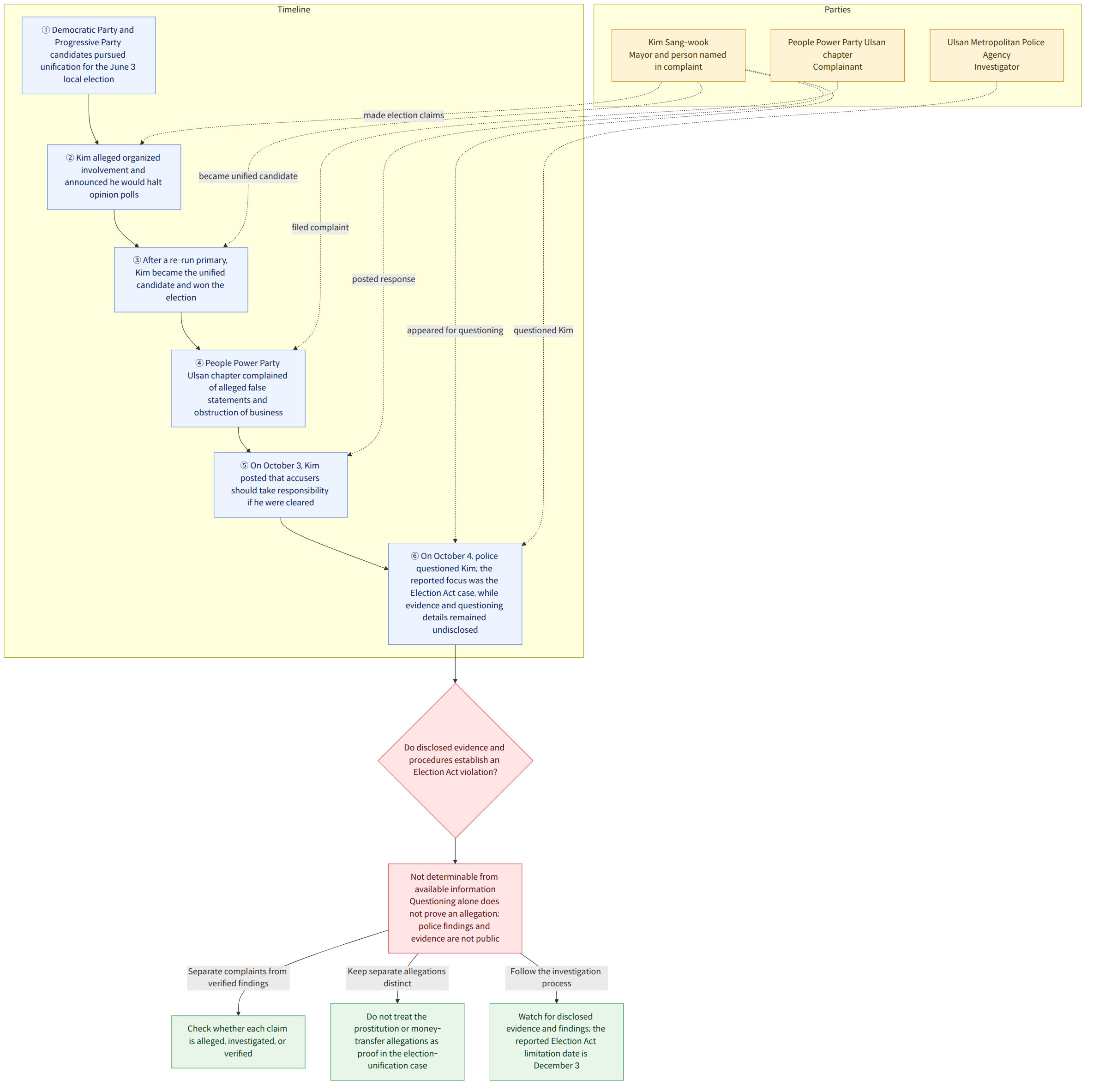
Ulsan Mayor Kim Sang-wook was questioned at the Ulsan Metropolitan Police Agency (울산경찰청) on October 4 in connection with a complaint alleging violations of the Public Official Election Act (공직선거법) and other offenses. Kim arrived at about 8 a.m. and left the agency at about 11:20 a.m. This was his first time appearing before police for questioning as a person named in a complaint. Afterward, he denied all the allegations, saying, “I explained everything fully because I can provide an adequate explanation for all of it.”
The questioning means that claims made during the election process, along with responses to those claims, have entered the police investigation stage. However, the fact that someone has been questioned does not in itself establish that any allegation is true. What Kim said in the questioning and what materials police reviewed have not been made public.
Background and context
During the unification of the Democratic Party of Korea (더불어민주당) and Progressive Party (진보당) candidates for Ulsan mayor in the June 3 local elections, Kim claimed there were signs of organized involvement by certain groups and announced that he would halt the opinion polls. He later became the unified candidate after a re-run primary and won the election. Claims and statements made during this process are the background to the current Public Official Election Act case.
The Ulsan chapter of the People Power Party (국민의힘 울산시당) filed a complaint against Kim, alleging false statements and obstruction of business, on the grounds that he had presented organized involvement as fact even though it had not been confirmed. The questioning was reportedly focused on the Public Official Election Act case, whose statute of limitations expires on December 3. This is the reported focus of the questioning; what police actually examined has not been made public.
The complaints involving Kim are not limited to this matter. He was also the subject of a complaint over allegations that he engaged in prostitution in the Philippines while working as a lawyer. An article also mentioned allegations that people involved had given money to a particular person to suppress the allegations ahead of the election. The Ulsan chapter of the People Power Party reiterated these allegations at a recent press conference. These, too, are matters reported as complaints and claims, not conclusions confirmed as fact.
After the questioning, Kim said, “There are many baseless claims that don’t even make sense.” He said that if he had done anything wrong, he should be punished, but that if he were cleared of wrongdoing, those who had spread false claims and incited people should bear political responsibility. In a Facebook post on October 3, he also wrote that if the police investigation found no wrongdoing, the politicians who raised the allegations should resign their seats and retire from politics, and the media that had amplified and reproduced the allegations should issue a formal apology. He did not disclose the details of his statements or the specific areas on which the questioning focused.
What this news means
For Ulsan residents, what matters more than the back-and-forth over the complaints is the evidence and procedures on which the investigation’s findings will be based. Whether the allegations raised during the election process are true and whether the way they were publicized could give rise to legal liability are separate questions that must be examined individually. The information currently available is not enough to determine which side is right.
Discussion of accountability in local politics should also be kept separate from the investigation’s findings. Mayor Kim has said that politicians and media outlets that raised the allegations should be held responsible if he is cleared of wrongdoing, but that is the position of a party to the matter. Treating either the complaint’s contents or the response as established fact before investigators issue a decision or a court rules could blur the line between allegations and verified facts.
For example, when considering claims made during the election, citizens may find it useful to distinguish whether a claim is part of a complaint, has been verified in an investigation, or has been met with a response from the person concerned. In particular, allegations of prostitution and money transfers, and the Public Official Election Act case concerning the candidate-unification process, involve different claims and alleged offenses. The progress of an investigation into one allegation should not be taken as establishing the truth or falsity of another.
Relevant procedures and support information
A report to law enforcement (고발) is a procedure through which someone who is not a victim or otherwise entitled to file a formal complaint can inform investigative authorities of a suspected crime. According to an in-house legal guide, a formal complaint or report can be made verbally or in writing to a prosecutor or judicial police officer; if it is made verbally, a record must be prepared. The filing of a report can prompt an investigation, but does not itself mean that an offense has been proven or that punishment has been decided. (L1)
After an investigation, a prosecutor may decide not to bring the case to trial by issuing a non-prosecution disposition. Non-prosecution dispositions include several types, such as a finding of no suspicion, a suspension of indictment, and a lack of prosecutorial authority, each with different grounds and effects. The guide says that a complainant or reporting party who wishes to challenge a non-prosecution disposition would generally file an appeal, followed by a petition for adjudication. It gives the deadlines as 30 days from the date notice of the disposition is received to file an appeal, and 10 days from the date notice of the appeal’s dismissal is received to file a petition for adjudication. However, procedures may vary depending on the party’s status and any applicable exceptions, so anyone who receives formal notice should check the relevant laws and deadlines. (L2)
The final disposition in this case and who may use which procedures have not yet been made public. The procedures above are therefore general information on what to check if a non-prosecution disposition is issued in a case involving a report; they do not predict how this case will proceed. (L1, L2)
What is known and what remains unknown
What is known
- Ulsan Mayor Kim Sang-wook was questioned at the Ulsan Metropolitan Police Agency on October 4 as a person named in a complaint.
- Kim denied all the allegations and said he had explained himself fully; the details of his statements were not disclosed.
- The Ulsan chapter of the People Power Party filed a complaint against Kim, alleging that he had publicized claims of organized involvement in the candidate-unification process as if they were true.
- The police questioning was reportedly focused on the Public Official Election Act case, whose statute of limitations expires on December 3.
What remains unknown
- What specific statements were made during the police questioning and what evidence was confirmed.
- The investigation’s findings and final dispositions in each complaint, including the Public Official Election Act case.
- What specific materials the complainants submitted to support each allegation.
What readers should check
- When reading follow-up reports, distinguish between “a complaint was filed,” “someone claimed,” “the investigation confirmed,” and “a disposition was issued.”
- If the investigation results in a non-prosecution disposition, the available challenge procedures and deadlines may vary depending on the status of the parties, such as whether they are formal complainants or reporting parties. Check the reasons for the disposition and the date on the notice.
- The reported December 3 statute-of-limitations deadline and the police investigation’s findings are separate matters to verify. Current reporting does not allow the final disposition or investigation results to be determined in advance.

















