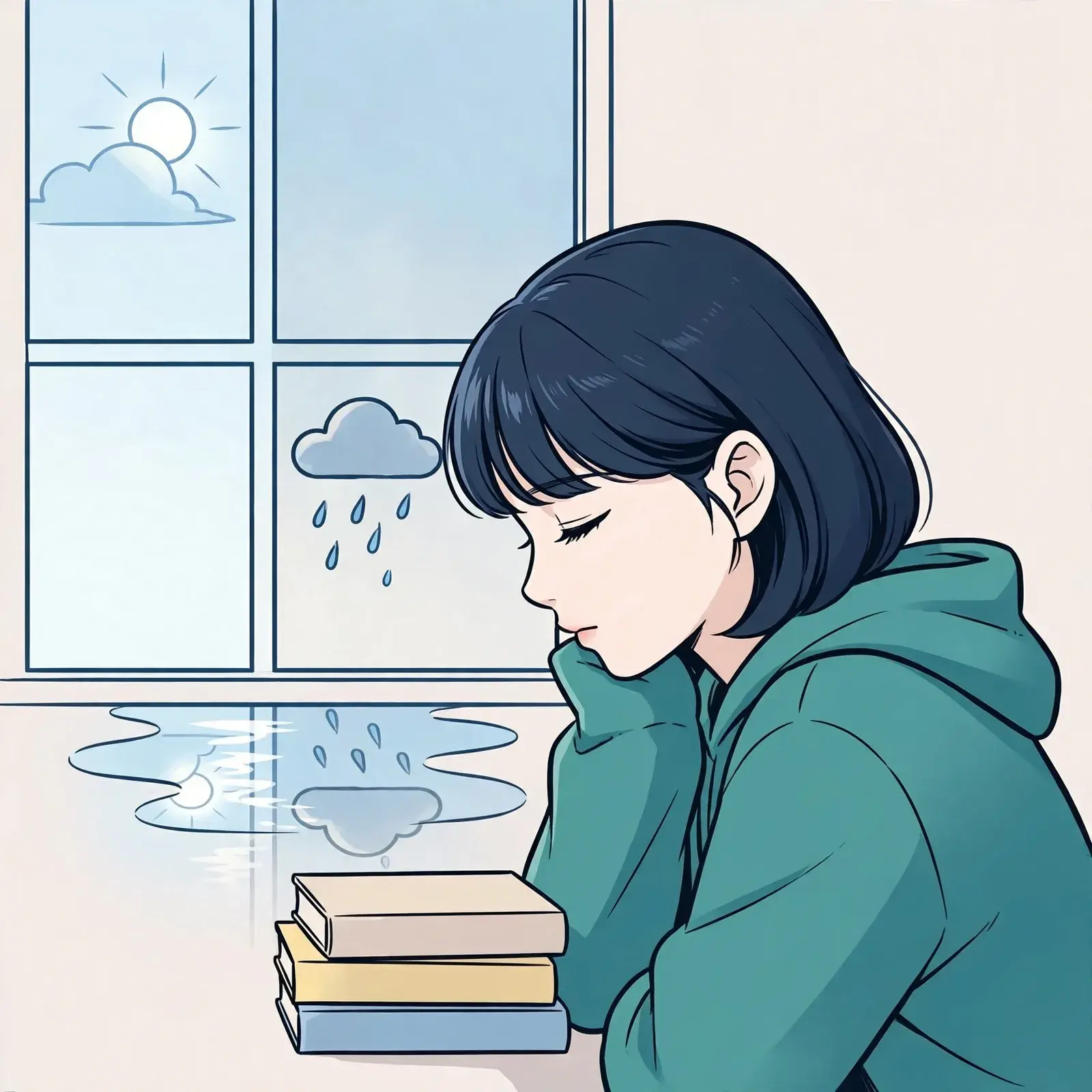
The contradictions we learn to live with
At a recent book event, a writer was asked: “What contradictions do you carry with you?” The question followed a discussion about adulthood and the uneasy compromises that come with it. Children may struggle to understand how someone can love a chick as a living creature and still enjoy eating chicken; adults, by contrast, often learn to accept that such conflicts can exist side by side.
That ability to live with contradiction is not necessarily a sign of indifference. It can reflect the fact that people make choices within circumstances they did not create, while still trying to decide what they believe is right. The challenge is to notice the gap between our values and our habits without pretending that the gap does not matter.
The goal is not to become perfectly consistent overnight. It is to remain honest about where we fall short and keep looking for ways to narrow the distance between our actions and our principles.
Climate concern in an energy-hungry life
The writer’s first example is the climate crisis (the long-term disruption of Earth’s climate, largely driven by human activity). They worry about climate-related disasters and the way vulnerable countries can face severe consequences, even as economic and technological development continues. The expansion of artificial intelligence and data centers raises particular questions because digital services depend on physical infrastructure, electricity, and electronic equipment.
Yet concern about those costs can coexist with ordinary routines that also use energy and resources. The writer describes sitting in air conditioning with an iced coffee while using a smartphone built with advanced memory chips and semiconductors. None of those choices, taken alone, explains the climate crisis—but together they make clear how easily people can benefit from systems they also criticize.
This is one reason personal responsibility can feel so complicated. A person may want cleaner energy and lower emissions, but still depend on a car, a phone, or a temperature-controlled home because those things are woven into work and daily life. Recognizing that dependence does not erase the need for change; it can help make the problem more concrete than a distant argument about consumption.
Small choices do not solve a systemic problem
A reusable cup or a decision to switch off an air conditioner cannot, by itself, reverse global warming. Large-scale changes in energy production, transport, manufacturing, and public policy also matter. But small actions can still express a person’s priorities—and, when repeated across communities, they can help make different expectations feel normal.
The important distinction is between using a modest action as proof of innocence and treating it as one imperfect step. Carrying a reusable bottle does not cancel out every other impact a person has. It can, however, be a reminder to stay engaged rather than deciding that no effort is worthwhile because no individual can do everything.
Eula Biss and the discomfort of ownership
In Having and Being Had, American writer Eula Biss considers the contradictions of living as a financially comfortable intellectual within capitalism (an economic system in which businesses and property are largely privately owned). She reflects on inequality and the violence of financial arrangements while also buying a home, paying a mortgage, thinking about retirement investments, and making choices as a consumer with personal tastes.
The book does not present these details simply to accuse Biss of hypocrisy. Instead, they show how people can question an economic system while still having to make a life inside it. Housing, savings, work, and family security are not abstract concepts: they shape where someone can live, how they plan for old age, and what opportunities their children may have.
That tension is especially visible when moral debates meet financial realities. Criticizing the unequal distribution of wealth does not automatically remove the need to pay rent or plan for retirement. Acknowledging that fact is not the same as saying the system is fair; it is a way of describing the limits and pressures under which people act.
Marx’s ideals and his family’s social position
Biss also turns to Karl Marx, the philosopher and political economist whose ideas became central to critiques of capitalism. She recounts that Marx used inherited money to buy a larger home and relied on his friend Friedrich Engels for financial support. The account also describes Marx’s concern that his daughters might struggle to find suitable marriages or be forced into domestic service if the family did not appear respectable by middle-class standards.
“Marx would not work as a ‘wage slave,’ and he knew what that meant for his daughters. They would have to find good marriages or work as servants. So Marx made a show of bourgeois life: his daughters took lessons in art, riding, and music, and the family held dances in their new home.”
The point is not that Marx’s criticism of class relations becomes meaningless because his private life was complicated. Rather, the story shows how social expectations and family responsibilities can pull people toward the very status markers they might question in theory. A person can oppose an unequal system and still worry about whether their children will be safe, respected, or able to live comfortably within it.
Virginia Woolf’s unfinished promise of a room
Virginia Woolf is widely associated with the argument that women need “a room of one’s own”—a private space and enough financial independence to write and think freely. Her work challenged the limits placed on women’s lives and creative opportunities. Yet Biss also recounts Woolf’s disparaging remarks about her maid, Nellie, and the fact that Woolf eventually dismissed Nellie while she was receiving medical care.
The contrast is painful because the demand for a room of one’s own can be understood more broadly: who gets privacy, security, and the freedom to pursue a life beyond service to others? Woolf could make a powerful case for women’s independence while failing to extend the same care to a woman who worked in her household. The contradiction does not disappear simply because Woolf’s writing was important.
Why flawed figures still matter
It is tempting to respond to examples like these by deciding that influential thinkers were frauds, or by using their failures to dismiss the values they argued for. But that approach can obscure the more difficult lesson: people may see an injustice clearly in one part of life and remain blind to it in another. Admiration need not require treating a writer or philosopher as morally flawless.
The same applies to ordinary readers. Measuring ourselves against the imagined perfection of historical figures can become another way to avoid useful reflection. A more honest question is not whether we are entirely free of contradiction, but whether we can recognize the people affected by our choices and take responsibility where we have room to act.
Staying engaged without claiming innocence
Biss’s examples invite readers to consider a distinction between being imperfect and giving up on what is right. People can admit that they benefit from arrangements they criticize, listen to those who bear greater costs, and support changes that make fairer choices more accessible. This does not guarantee a clean conscience or a simple solution, but it keeps moral attention alive.
That attention can lead to practical questions: Where does the energy we use come from? Who performs the labor behind the products we buy? What does financial security depend on, and who is excluded from it? Questions like these connect private habits to wider systems without pretending that every person has equal power to change them.
The writer’s closing example is deliberately modest: perhaps they cannot bring themselves to turn off the air conditioner, but they can try to carry a reusable cup. The gesture is not offered as a cure for climate change or a declaration of innocence. It is a small, visible attempt to keep a value present in daily life.
We may never escape contradiction entirely. But we can remember what we believe is right, acknowledge the distance between belief and behavior, and keep trying to make that distance smaller.
That may be a more realistic measure of ethical living than perfection. It asks people to resist both self-congratulation and despair: neither a small good deed nor a personal failure has to settle the whole question. The work is ongoing—recognizing the compromises we inherit, making the choices we can, and refusing to let imperfection become an excuse for indifference.