
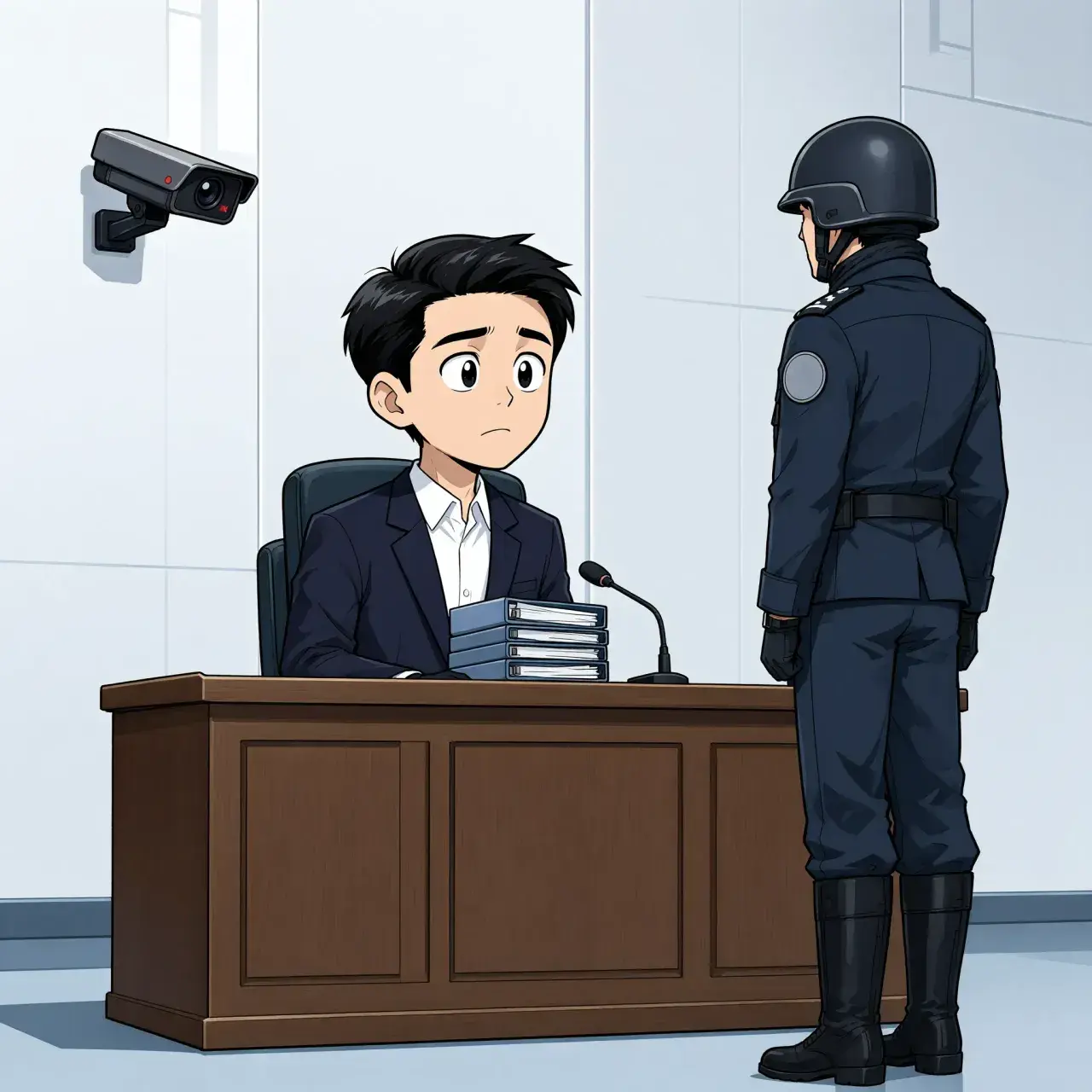
At the appeal trial of former President Yoon Suk Yeol and others on charges of being the ringleader of an insurrection, the defense team presented CCTV footage from the Presidential Office (대통령실) executive office and large reception room on the day of the Dec. 3 emergency martial law declaration, reconstructing how it was declared. The defense argued that the Cabinet meeting had been prepared in advance and that martial law met the requirements for a lawful declaration. Former President Yoon also said that declaring martial law at 10 p.m. was a choice intended to reduce harm to the public. The footage and explanations are claims and materials presented at the appeal trial; the court’s assessment has not been confirmed.
Background and context
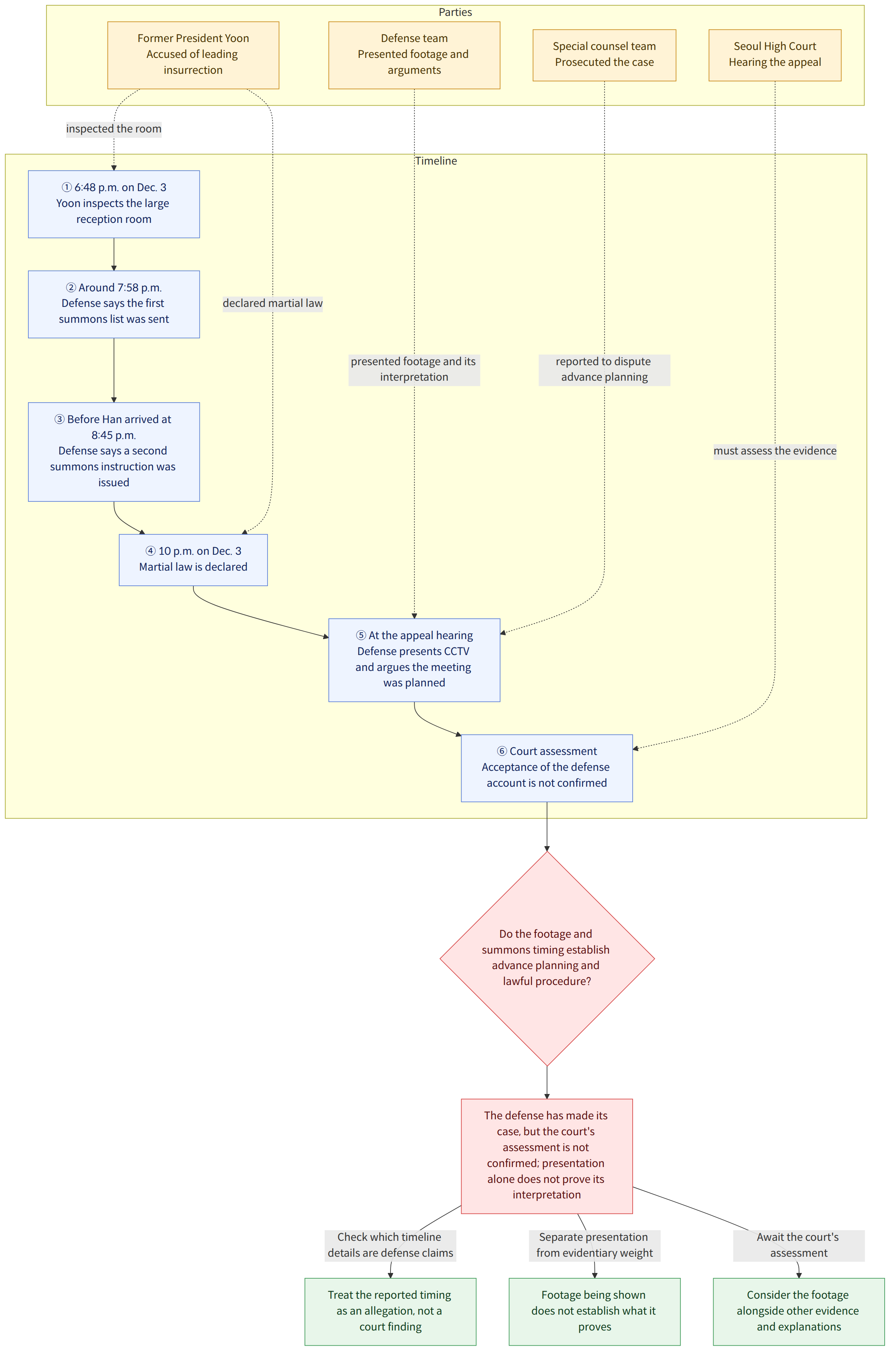
The hearing was held on the 17th of last month before Criminal Division 12-1 of the Seoul High Court (서울고법). The defense team presented CCTV footage showing former President Yoon inspecting the large reception room at around 6:48 p.m. on the day of the declaration, explaining that it indicated he had checked the space in advance for a Cabinet meeting. The point was that inspecting the large reception room, rather than the executive office, supported the claim that there had been a plan from the outset to hold a Cabinet meeting.
The timing of the summons to cabinet members was also raised as an issue. The defense argued that the list of cabinet members for the first summons was sent to Kim Jeong-hwan, the former chief of protocol at the Presidential Office, at around 7:58 p.m., and that a second instruction to summon members was issued before former Prime Minister Han Duck-soo arrived at the executive office at 8:45 p.m. It cited this timeline to counter the claim that the summons had been made at Han’s suggestion.
According to reports, the defense said the special counsel team had argued that, without an initial plan to hold a Cabinet meeting, only the six cabinet members needed to meet the quorum for declaring martial law were going to be summoned. However, reports on this hearing do not confirm the special counsel team’s detailed rebuttal or the court’s assessment of the CCTV footage. The defense’s account of the timing of the summons should therefore not be treated as an established fact or as a fact accepted by the court.
Former President Yoon argued that declaring martial law earlier could have caused greater confusion by coinciding with the evening commute, and that he declared it at 10 p.m. to reduce harm to the public. He said his meeting at a safe house in Samcheong-dong with former Defense Minister Kim Yong-hyun and others lasted 15 to 20 minutes, and explained that its purpose was to urge them to maintain the minimum level of order needed to prepare for a possible emergency. Regarding a document seeking cooperation with martial law that included orders to cut electricity and water to media outlets, the defense denied that there had been advance planning and argued that former President Yoon did not know the specific details.
What this news means
The issue at the hearing is not only what scenes appear in the footage. The court must also consider whether those scenes are consistent with the account that the Cabinet meeting was prepared in advance, when and under what circumstances the summons instructions were actually issued, and how much those circumstances matter in assessing the purpose and procedure of the martial law declaration. The defense has presented the CCTV footage and the sequence of events as support for its claim that martial law was lawful, but it is not yet known whether the court has accepted that claim.
In a criminal trial, whether evidence can be used and how strongly it supports a fact are separate questions. The mere fact that footage was presented in court does not establish either the parties’ interpretation of it or the conclusion that interpretation is intended to prove. This distinction is important when considering this hearing as well.
For example, even if CCTV shows someone inspecting a meeting space and summons instructions were issued before or after that scene, the footage alone does not automatically determine the purpose of summoning the Cabinet or the legality of the martial law declaration. The court’s assessment of the footage alongside other materials and the parties’ explanations remains to be seen.
The article also covered first-instance sentences handed down to commanders during the martial law operation. Yeo In-hyung, former chief of the National Defense Counterintelligence Command (국군방첩사령부), was sentenced to 18 years in prison; Lee Jin-woo, former chief of the Capital Defense Command (국군수도방위사령부), to 15 years; and Park An-su, former Army Chief of Staff (육군참모총장), to 10 years. These sentences concern their respective first-instance judgments and cannot be taken as a preview of the appeal court’s ruling on former President Yoon and the others.
Related legal and support information
According to an internal legal guide, issues in an appeal may include violations of law, errors of fact, and excessive or inadequate sentencing. Since the CCTV footage and the circumstances surrounding the summons to the Cabinet were raised at this hearing, readers should focus on what evidence is linked to each claim and what significance the appeals court assigns to that evidence. General information about appeal procedures does not, however, provide details about filing deadlines or the parties’ procedural circumstances in this particular case.
Another distinction emphasized in the evidence guide is between admissibility and probative value. Admissibility refers to whether evidence may be used in court; probative value refers to how strongly it supports the alleged facts. The fact that CCTV footage was presented in court does not establish that its contents have been conclusively interpreted, and this report does not establish whether there was any dispute over how the footage was obtained or whether it was admissible.
Even if a case proceeds to the Supreme Court after an appeal ruling, the issues that can be considered are limited. The legal guide says it is difficult to raise new issues before the Supreme Court if they were not raised during the appeal. However, the information currently available does not establish what steps will follow in this case or who may challenge the appeal ruling, and on what grounds.
What is confirmed and what remains unknown
Confirmed facts
- At the appeal hearing, the defense team presented CCTV footage from the Presidential Office executive office and large reception room on the day of the martial law declaration.
- The defense argued that the Cabinet meeting had been planned in advance, citing footage of an inspection of the large reception room and the timing of the summons to cabinet members.
- Former President Yoon said the 10 p.m. declaration and the meeting at the safe house were intended to minimize harm to the public and maintain order.
- Regarding the document seeking cooperation with martial law, the defense argued that there had been no advance planning and that former President Yoon had not known its specific contents.
- Three military commanders, including former Commander Yeo In-hyung, received first-instance sentences of 18, 15 and 10 years in prison, respectively.
What remains unknown
- How the appeals court will assess the CCTV footage and the defense team’s explanations.
- What evidence the court will rely on in assessing the parties’ claims about the circumstances surrounding the summons to the Cabinet and the purpose of the martial law declaration.
- When the appeals court will issue its final ruling on the charges of being the ringleader of an insurrection against former President Yoon and the others.
What readers should look for
- In coverage of subsequent hearings, distinguish the defense team’s claims from the court’s assessments. It is important not to treat the fact that footage was released or presented in court as the court’s conclusion.
- The times given for summoning cabinet members and for former Prime Minister Han’s arrival are the defense team’s account. Readers can check whether subsequent reports add other evidence or opposing arguments.
- General information about appeal procedures and the assessment of evidence is not a substitute for legal advice about a specific case. Anyone who needs information about deadlines or procedures in an actual case should consult official notices in that case and guidance from a qualified legal professional.

















