
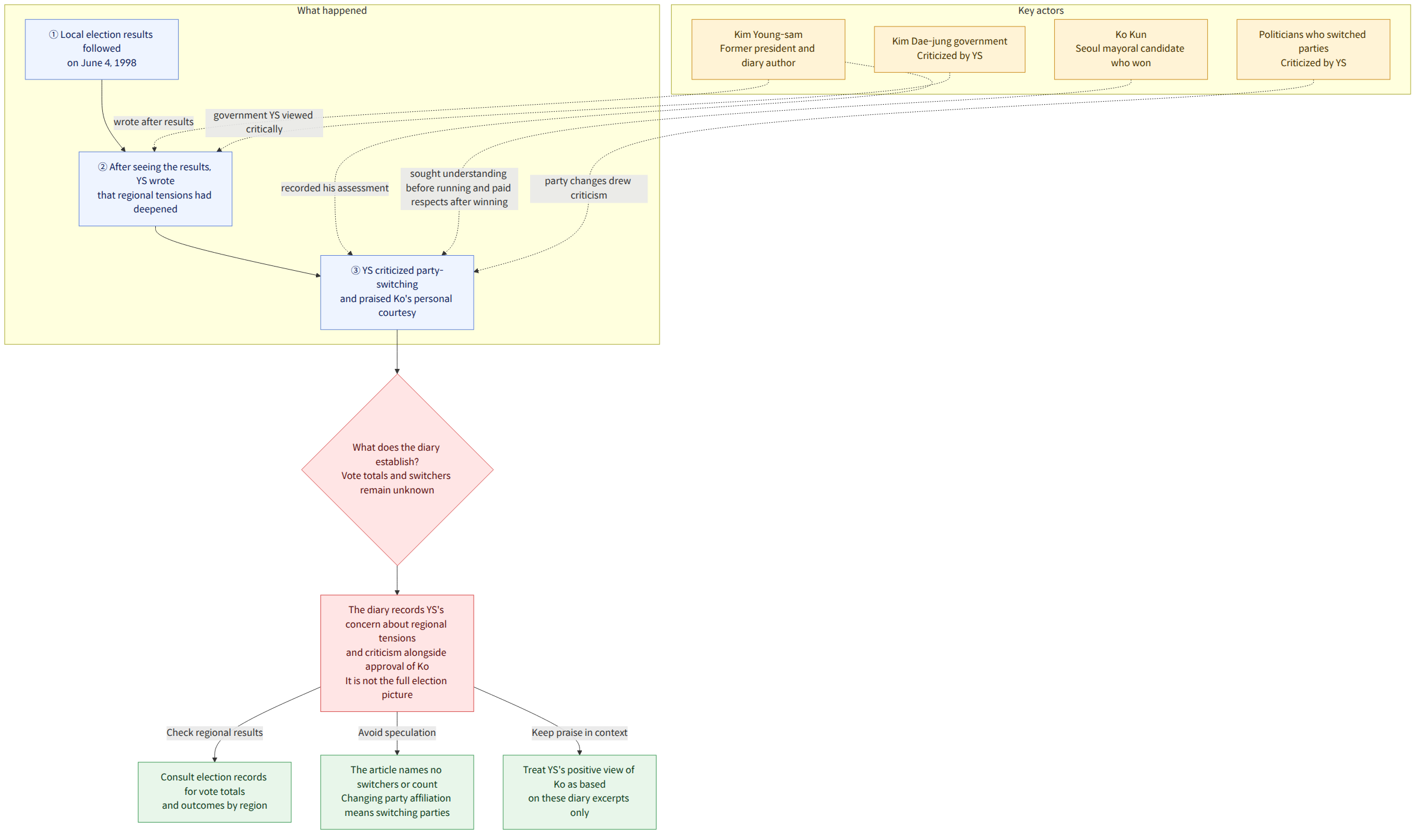
After seeing the results of the local elections on June 4, 1998, former President Kim Young-sam (YS) wrote in his diary that regional tensions between Yeongnam and Honam had deepened. Critical of the Kim Dae-jung government, he also expressed displeasure with those who switched to the ruling party to run for office. However, he spoke positively of Ko Kun, who ran as the Seoul mayoral candidate for Kim Dae-jung’s National Congress for New Politics (국민회의) and won, noting that Ko had sought his understanding before running and paid his respects after winning.
Background and context
In the diary excerpts presented in the article, YS described the Kim Dae-jung government’s actions as problematic and wrote, “People are even saying that Gyeongsang Province is guilty and Jeolla Province is innocent.” This reflects YS’s critical view of the situation at the time; it is not a statistic that substitutes for the election results themselves.
After seeing the results of the local elections on June 4, 1998, he wrote, “The divide between Yeongnam and Honam has deepened more than ever.” The article says he went on to write of those who switched to the ruling party to run for office: “It is truly beyond me what politics is, or how so many people can become traitors.”
Changing party affiliation means that a politician switches from one political party to another. This passage shows that YS judged not only the election results but also the political choices people made in the course of running for office. However, the article does not name the people he was referring to or say how many there were.
What this news means
What this diary shows is YS’s assessment of the political situation after the election, rather than the full picture of the election at the time. His writing reveals both concern about tensions between regions and criticism of politicians who changed party affiliation. It is therefore important to distinguish the views recorded in a personal diary from the actual vote totals and election outcomes in each region.
His assessment of Ko Kun shows that the same standard was not applied uniformly to everyone. YS spoke positively not only of Ko’s record as prime minister during his own presidency, but also of Ko’s actions: Ko came to seek his understanding before becoming the Seoul mayoral candidate and visited to pay his respects after winning. In other words, the diary excerpts presented in the article show criticism of political choices alongside approval of personal courtesy.
For example, if a reader wanted to use this account to explain the election results in different regions at the time, YS’s diary alone would not be enough to determine who received how many votes in each region. The article does not provide specific vote totals or numbers of winners.
Confirmed facts and what remains unknown
Confirmed facts
- The article says YS viewed the Kim Dae-jung government critically.
- YS is reported to have written in his diary, “People are even saying that Gyeongsang Province is guilty and Jeolla Province is innocent.”
- YS wrote that the divide between Yeongnam and Honam had deepened after the local elections on June 4, 1998.
- YS criticized those who switched to the ruling party to run for office, while speaking positively of Ko Kun because he had sought YS’s understanding before running and paid his respects after winning.
What remains unknown
- The article does not give vote totals or election results by region for Yeongnam and Honam in the 1998 local elections.
- The article alone does not establish who the candidates YS criticized for switching party affiliation were or how many there were.
- It is difficult to determine from this material alone whether the views expressed in the diary represented the views of politicians or voters more broadly at the time.
What readers should check
- Read YS’s assessment of regional tensions separately from the actual election results. To verify vote totals and election outcomes by region, consult election records separately.
- The article does not identify the people who “switched party affiliation to run for office” or state how many there were, so it is more accurate not to speculate about their names or numbers.
- The positive assessment of Ko Kun is based on the diary excerpts presented in the article. Take care not to extend it into a claim that it represents all of YS’s political assessments.