
Background and context
Inferences based on purchase history connect what users buy with their interests or lifestyle traits. The article gave examples such as inferring that someone has a cat if they buy a lot of cat litter, or guessing that someone is prone to acne if they buy a lot of products for acne-prone skin.
Even when users know their shopping experience is personalized, seeing a list of inferences about themselves all in one place can feel different. When relatively familiar information, such as interests, appears alongside descriptions about the body that could feel private, the existence of those inferences can become more apparent.
The article’s author said Amazon had inferred that they take photographs, enjoy collectible card games and are invested in the Apple ecosystem. Colleagues said their inferred interests included vinyl records and ceramics, and that Amazon had determined they valued natural materials and comfort in home decor and clothing. These examples show that a list of inferences can include not only hobbies and preferences but also descriptions users might not expect.
What this news means
The important point for users is that the article explains how to directly check what Amazon has inferred about them. Looking at the list can show how interests or traits associated with purchases are represented. However, the fact that information appears on the list does not, by itself, show that the inference is accurate or reveal the purposes for which Amazon uses that information or how widely it uses it.
For example, if a user buys a lot of cat litter, Amazon might infer, as in the article’s example, that they have a cat. This is an example of a possible inference, not a claim that Amazon actually made that determination about a specific user. @fangirlinmegan also said she thought the description about her may have come from buying “scrunch-butt leggings.” The article did not present that cause as a confirmed fact.
What is confirmed and what remains unknown
Confirmed facts
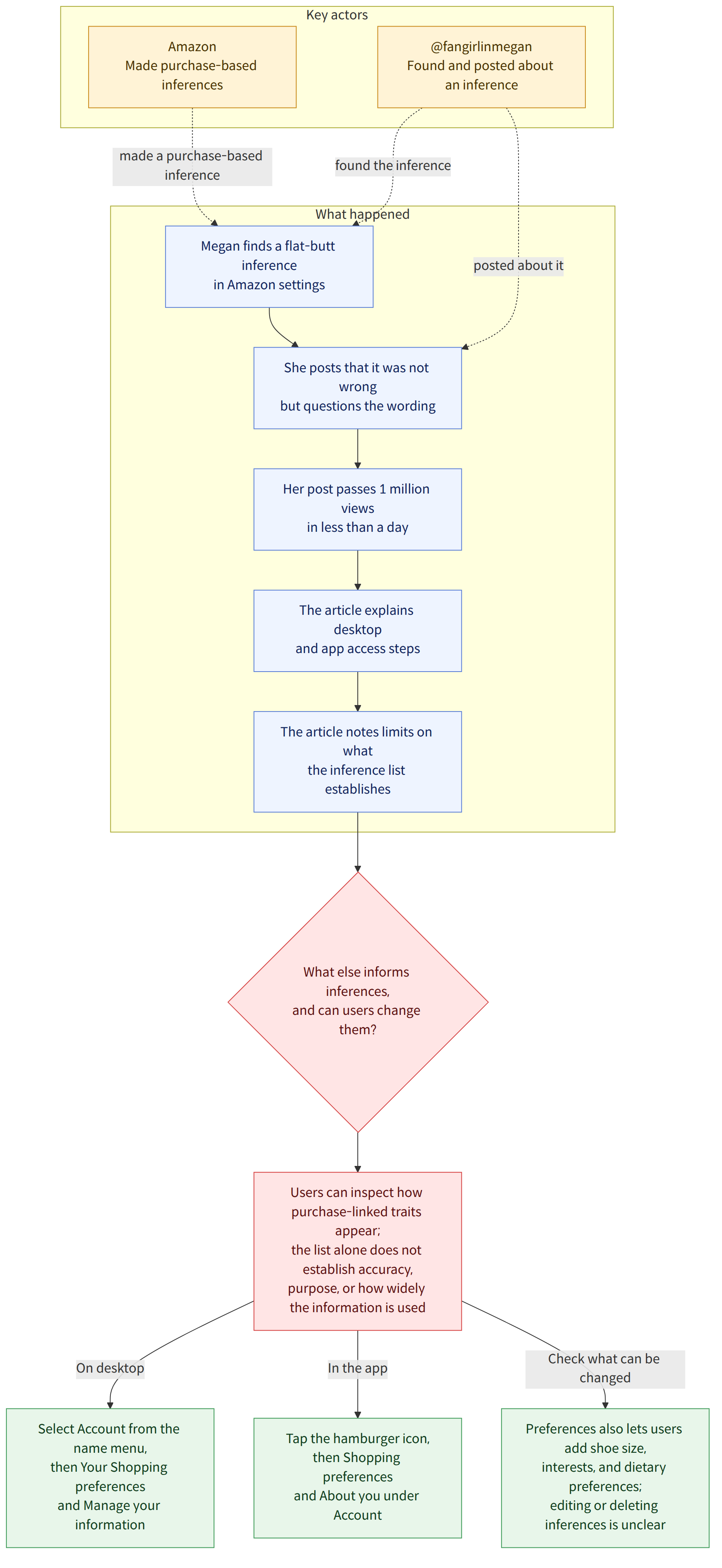
- @fangirlinmegan found that Amazon had classified her as having a “flat butt” in the list of inferences in Amazon’s settings.
- She posted that the inference was not wrong, but questioned whether it needed to call her out like that.
- The post surpassed 1 million views in less than a day.
- The article explained how to view inferred information on desktop and in the mobile app.
What remains unknown
- What data or criteria, beyond purchase history, does Amazon use to infer traits about users?
- Can users edit or delete inaccurate or sensitive inferences?
- For what purposes does Amazon use these inferences besides advertising or product recommendations?
What readers can check
- On desktop, select “Account” from the name menu in the upper-right corner of the screen, then select “Your Shopping preferences.” On the page, click “Manage your information.”
- In the mobile app, tap the hamburger icon in the bottom menu, then select “Shopping preferences” and “About you” under “Account.”
- In “Your Shopping preferences,” you can also add information such as shoe size, interests and dietary preferences. However, the article does not establish how information entered directly by users is distinguished on screen from inferred information, or whether inferred information can be edited or deleted.