
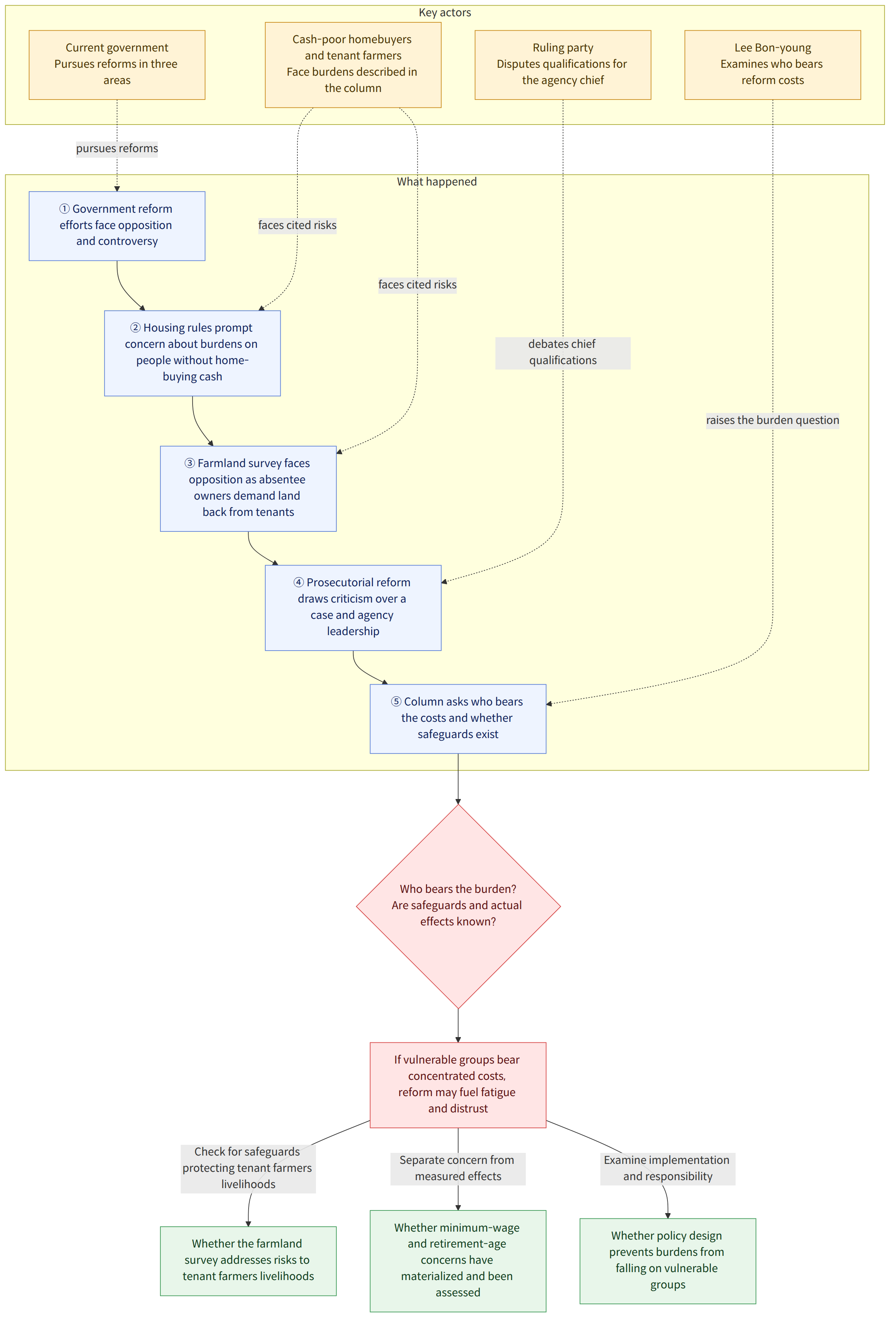
As opposition and controversy continue over the current government’s efforts to reform housing prices, farmland speculation and the prosecution, a column asks who actually bears the burden in the reform process. Reporter Lee Bon-young refers to these three areas, for convenience, as the “three major areas of reform” and points to the paradox that those assumed to benefit from reform may instead be harmed. The column focuses not only on the need for reform but also on how policies are designed and implemented.
Background and context
The column argues that reform takes place amid resistance from entrenched interests and the existing order, so simply raising a banner is not enough to achieve results. If a reform is poorly designed or its implementation plan is not carefully worked out, it can become mired in confusion or fail. The writer says the difficulties of reform should not be explained solely by the incompetence of those leading it or resistance from opposing forces; it is also necessary to examine whether losses are concentrated among vulnerable groups during the policy process.
On housing prices, the column describes people who lack the cash to buy a home protesting lending restrictions. It also recounts objections that suppressing housing prices in Seoul’s Gangnam district would drive up prices elsewhere, causing hardship for ordinary people. These examples show how assessments of reform can vary depending on who experiences the burden of regulation or price fluctuations, regardless of the policy’s goals.
In the area of farmland, the column reports that a comprehensive survey intended to uphold the land-to-the-tiller principle (경자유전 원칙)—the principle that those who farm the land should own it—is encountering difficulties amid opposition. It cites cases in which absentee landowners, ahead of the comprehensive farmland survey, demanded that tenant farmers return the land, saying they would farm it themselves. The writer notes that landlords also frequently evicted tenant farmers during the land reform after liberation.
On prosecutorial reform, the column says criticism followed the false closure of a murder and disappearance case involving the son of a serving police officer, prompting complaints about who would protect vulnerable people, including women. It also mentions controversy over the launch of the Serious Crimes Investigation Agency (중대범죄수사청) and infighting within the ruling party over the qualifications of its inaugural chief. The writer argues that when controversies over reform continue, it is necessary to examine where responsibility and the burden of policy lie.
What this news means
The question raised by the column goes beyond whether readers agree with the aims of reform. Its concern is that if costs or risks are concentrated on vulnerable groups during implementation, it is also necessary to ask whether safeguards are in place to reduce that burden. The writer warns that if the paradox of reform recurs, the very name “reform” could become a source of fatigue and distrust.
This issue is not limited to housing prices, farmland and the prosecution. The column explains that raising the minimum wage brings concerns about the burden on small-business owners and reduced employment, while extending the retirement age prompts objections that young people’s job opportunities may shrink. The column, however, does not provide information on the extent to which these concerns have actually materialized or how the effects of the policies have been assessed. It is important to distinguish between the existence of concerns and their actual effects.
For example, if a comprehensive farmland survey is underway, one could consider not only whether it establishes the actual state of farmland ownership and use, but also how it addresses the risk that tenant farmers may actually lose their livelihoods. This is a hypothetical scenario based on an example cited in the column; the original text does not say what, if any, measures the government has prepared to address it.
A remark by former U.S. President Barack Obama also supports the column’s concern. He was quoted as saying that one of the difficult tasks in a democracy is to expect long-term results or to address now the costs of inaction that will be paid decades later. The writer argues that reform should be designed and implemented carefully to prevent the paradox of vulnerable people being harmed, with a focus on the long term rather than short-term political gain or avoiding criticism.
What is confirmed and what remains unknown
What is confirmed
- The column refers, for convenience, to housing prices, farmland speculation and the prosecution as the current government’s “three major areas of reform.”
- It describes opposition to housing loan restrictions and fluctuations in prices across different regions.
- It cites a case related to the comprehensive farmland survey in which a tenant farmer was asked to return the land.
- It reports criticism over the false closure of a case, controversy over the launch of the Serious Crimes Investigation Agency and infighting within the ruling party over the qualifications of its inaugural chief, all in connection with prosecutorial reform.
What remains unknown
- What detailed plans and schedules are being followed for reforms involving housing prices, farmland and the prosecution.
- The current progress and policy effects of the comprehensive farmland survey and prosecutorial reform.
- What specific measures the government has prepared to prevent harm to vulnerable groups during the reform process.
What readers can check
- When reviewing policy announcements, readers can look beyond the goals and check who bears the costs and risks, and whether the burden is concentrated on vulnerable groups in particular.
- It is worth distinguishing between the fact that concerns or opposition have been raised and the fact that actual harm has occurred, and checking whether evidence of policy effects has been presented.
- When following developments in farmland surveys or prosecutorial reform, readers can check whether specific measures to prevent and remedy harm have been disclosed alongside the implementation schedule.