
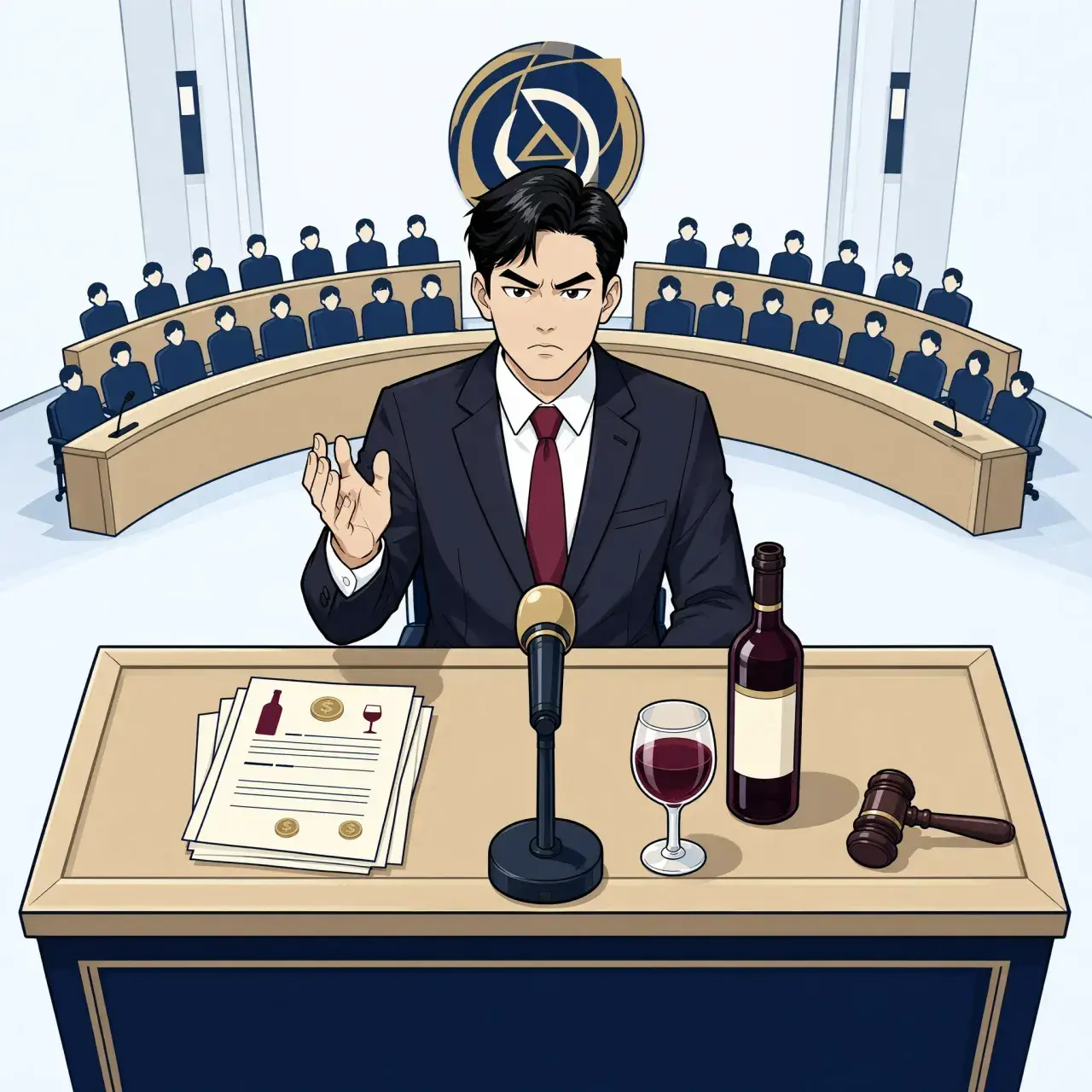
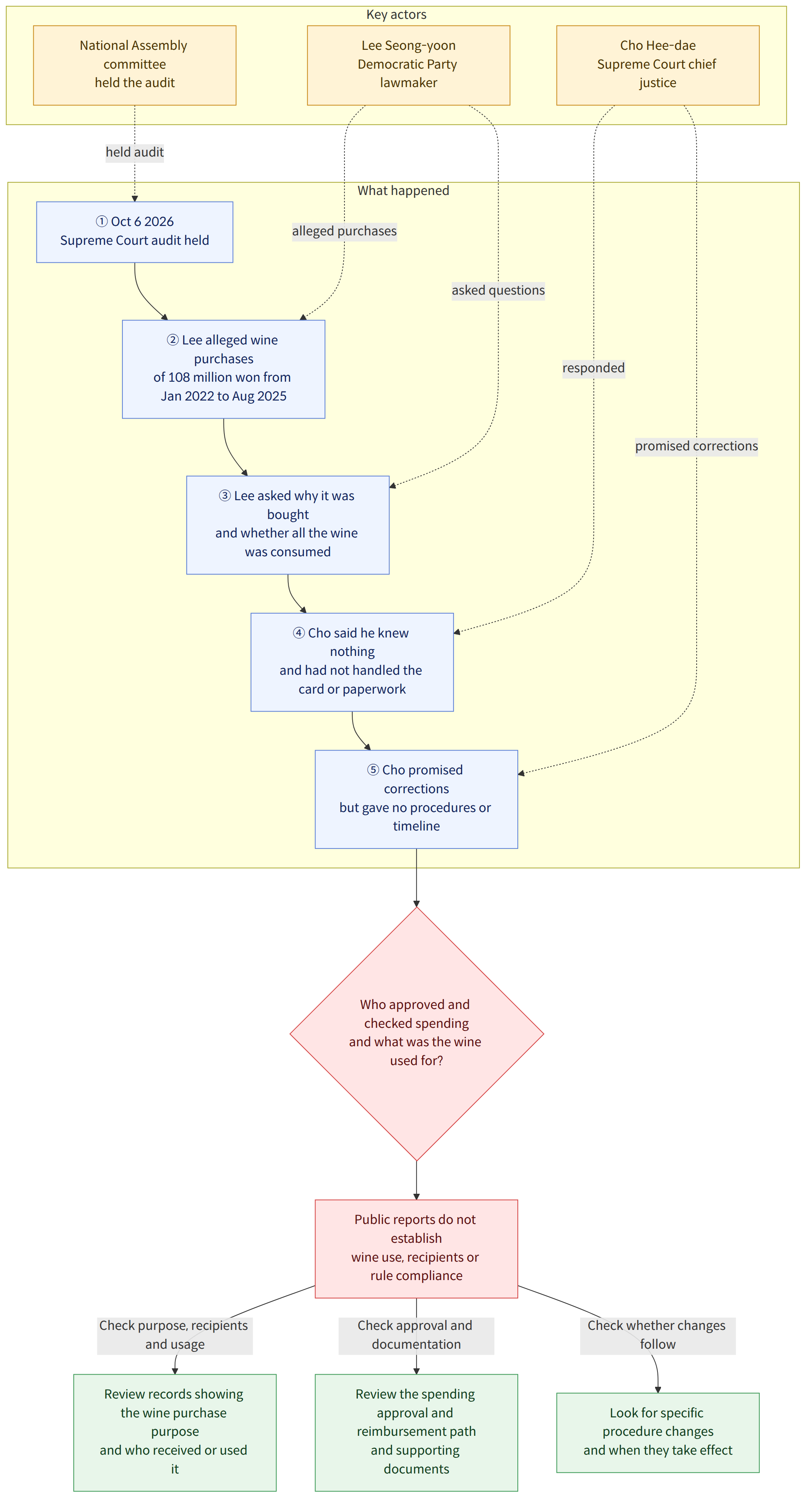
On October 6, 2026, Supreme Court Chief Justice Cho Hee-dae appeared before the National Assembly Legislation and Judiciary Committee (국회 법제사법위원회) for an audit of the Supreme Court and other bodies. Lee Seong-yoon of the Democratic Party of Korea (더불어민주당) said 108 million won worth of wine had been purchased using the Supreme Court’s official-duty expenses from January 2022 to August 2025, and asked whether all the wine had been consumed and why it was purchased. Cho said he does not drink and that the heads of the three branches of government do not buy alcohol themselves.
Cho said he had not personally paid with the official-duty expenses card or handled the paperwork, and that he had learned of the matter for the first time at the hearing. He said he would make corrections to ensure the same thing did not happen again.
Background and context
Official-duty expenses are used to carry out an institution’s work. The central issue in this controversy is not only the allegation that wine was purchased, but also the purposes and procedures under which the budget was spent, and who checked and managed the expenditures. The issue has drawn attention because official-duty expenses are public funds, and citizens should be able to verify how they were spent and who was responsible.
Lee said that the places where Cho had meals were mainly near the Supreme Court and the official residence in Hannam-dong, and cited prices of 75,000 won for sushi omakase, 65,000 won at a Korean set-menu restaurant and 180,000 won at a hotel restaurant. Cho replied that he had gone only to encourage people and did not know about the budget allocation, spending or those meal costs. Regarding the expensive meals, he explained that members were reluctant to get together often, so they would meet occasionally and wanted to eat food they had not tried before. He said he was sorry to the public.
It is important to distinguish between the amount of purchases cited by the lawmaker and the detailed records of actual spending. Publicly available reports relay questions and answers about the amount spent on wine and the meal prices, but do not say what events the wine was used for, who received it or whether the related spending complied with the rules. The alleged amount alone therefore does not establish that the spending was improper; conversely, Cho’s statement that he knew nothing about it does not resolve questions about management responsibility.
What this news means
First, responsibility for spending may not be settled solely by whether someone personally used the card. To assess the scope of responsibility, it is also necessary to establish who handled the spending and who held final approval and oversight responsibility, as well as how the purpose and supporting documentation for each expense were checked. Cho said he did not know about the budget allocation or spending, but the reported information does not show the specific approval and reimbursement path for the wine purchases.
Second, whether the promise to “make corrections” leads to actual change remains to be seen. Cho said he would ensure that this did not happen again, but did not say what procedures would change or when. Specific disclosure of the purchase purposes, recipient and usage records, and spending approval and review processes would make it possible to assess whether the promise was kept.
For example, if a citizen wanted to check whether a particular wine purchase was used at an official event, they would need to review not only the purchase record but also the event’s purpose, records of who received or used the wine, and payment and settlement documents. This is a hypothetical illustration of how to verify the matter; it does not mean those records have actually been made public or that a particular use has been confirmed.
Points reported differently
Reports on the questions about wine purchases and meal costs said Cho replied that he knew nothing about the use of official-duty expenses. Answers differed on a separate issue concerning cash encouragement payments to Supreme Court justices. Cho said he was not involved in the matter, which emerged in a regular audit by the Board of Audit and Inspection (감사원): the Court Administration Office (법원행정처) had paid the justices an average of 2 million won a month in cash for more than three years. However, according to other reports, Court Administration Office Chief Noh Gyeong-pil subsequently revised the answer, saying that the final decision on the payments was made by the chief justice.
These encouragement payments are a separate matter from the wine purchases and meal costs. The conflicting answers about the payments should not be treated as confirmation of responsibility for the wine spending, but they do underscore the need to clarify the relationship between operational spending and final decision-making in public institutions.
The ruling and opposition parties also clashed at the hearing over whether the chief justice should leave the room. Members of the People Power Party (국민의힘) called for Cho to leave after his opening remarks, but Legislation and Judiciary Committee Chair Seo Young-kyo refused. Seo suspended the speaking rights of lawmakers Kim Tae-gyu and Park Hyeong-su. Apart from the facts about the spending, this episode shows that a broader confrontation was also unfolding over how the National Assembly should question the judiciary about its accountability and obtain answers.
What is confirmed and what remains unknown
Confirmed facts
- Supreme Court Chief Justice Cho Hee-dae appeared at a National Assembly Legislation and Judiciary Committee audit on October 6, 2026.
- Lee Seong-yoon said that 108 million won worth of wine had been purchased using official-duty expenses from January 2022 to August 2025.
- Cho said he does not drink, did not know about the budget allocation, spending or meal costs, and would make corrections.
- Lee cited meal venues and prices, and Cho said the meals were intended to encourage members before apologizing to the public.
- Cash payments of encouragement money to Supreme Court justices were discussed in connection with the Board of Audit and Inspection’s regular audit, and reports gave conflicting accounts of whether the chief justice was involved.
What remains unknown
- Where was the purchased wine actually used, and who received it?
- What are the itemized details of the wine purchases and meal costs, and were the official-duty expense rules followed?
- What specific corrective measures did Cho promise, and when will they be implemented?
- What procedures governed the operational spending and final decisions on the encouragement payments?
What readers should look for
- In any follow-up disclosures, readers can check whether records are provided for each purchase, including its date, amount, purpose, recipient or use, and supporting settlement documents.
- It is worth checking whether Cho’s promise to make corrections led to specific procedural changes or new review methods, and whether an implementation date was disclosed.
- The encouragement payments are a separate matter from the wine spending. Readers should examine the audit findings and the Court Administration Office’s revised answer separately to distinguish decision-making authority from responsibility for carrying out the spending.
References
- Other coverage consulted: chosun.com
- Other coverage consulted: hani.co.kr

















