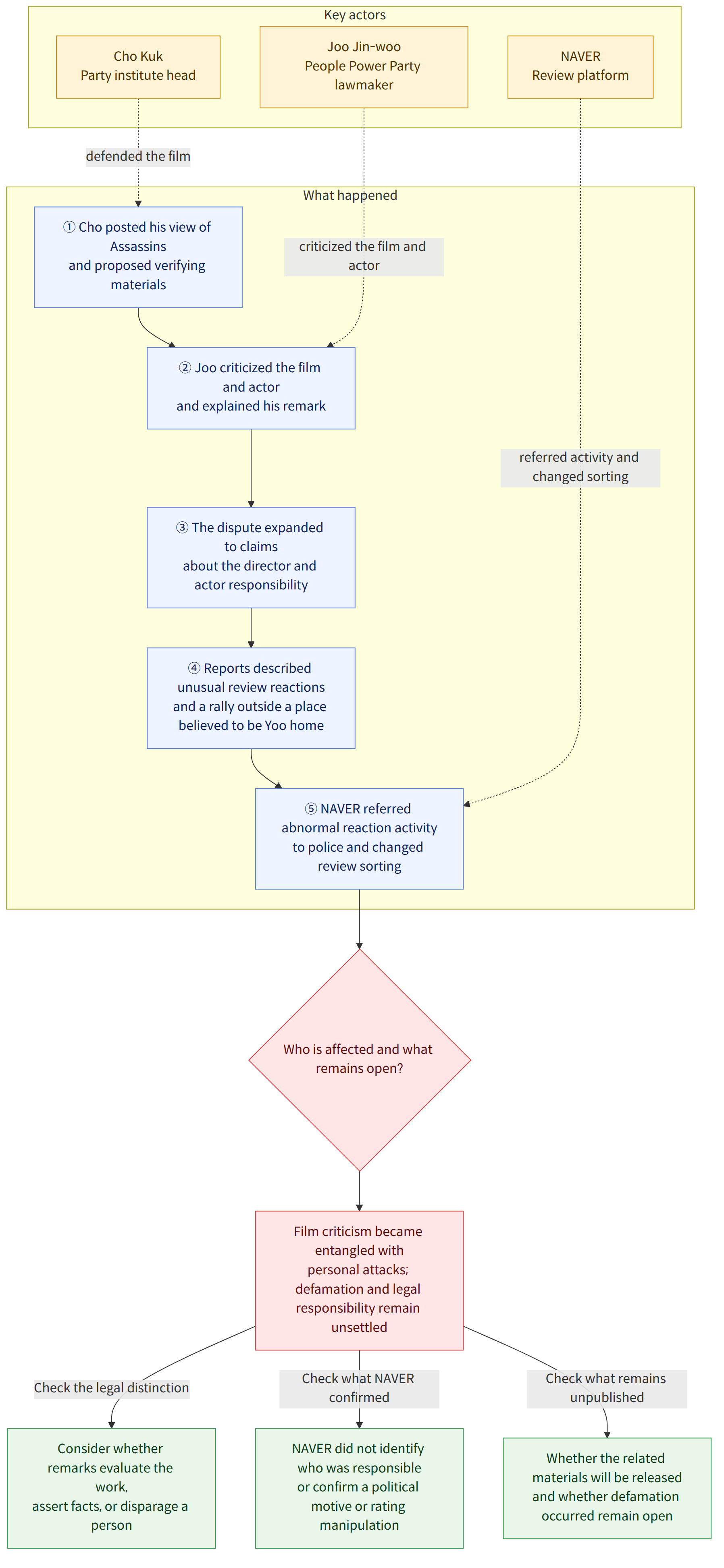
On October 4, 2026, Cho Kuk, head of the Innovation Policy Research Institute of the Cho Kuk Innovation Party (조국혁신당 혁신정책연구원), posted his impressions and views on Facebook after watching the film “Assassins.” He expressed condolences, calling the shooting death of Yuk Young-soo a tragedy, while arguing that the film neither endorses Mun Se-gwang’s actions nor mocks the deceased’s death. Cho also said the film was not a matter that could incur legal liability, but that is his view, not a court ruling or a settled legal conclusion.
The debate went beyond a dispute over the film’s historical interpretation. Cho criticized Rep. Joo Jin-woo of the People Power Party (국민의힘), saying that Joo had described actor Yoo Hae-jin’s face as having a “North Korean look.” Joo explained that the expression meant siding with North Korea. Reports also mentioned unusual activity involving online review reactions and a rally outside a place believed to be Yoo’s home, intertwining criticism of the work with personal attacks and questions about freedom of expression and reputation.
Background and context
The film is based on the 1974 shooting of Yuk Young-soo. One report said the official investigation at the time concluded that Mun Se-gwang had acted on North Korean orders, and reported that the film uses fictional investigators to tell a story that raises suspicions about possible involvement within the Park Chung-hee government or intelligence agencies. The report said the filmmakers had stated that the film was fiction and was not intended to establish a new historical conclusion.
Cho said the film covers the circumstances of the incident, the investigation’s findings at the time, and questions that have been raised. He said its 131 minutes flew by, thanks to a story combining fact and fiction and the actors’ performances. He also compared it to “JFK,” a film that raises questions about the assassination of U.S. President John F. Kennedy. Cho added that it vividly portrays press censorship by the Korean Central Intelligence Agency (중앙정보부) during military dictatorship and journalists’ struggle against it.
By contrast, criticism of the film developed into claims that it distorted history and insulted Yuk Young-soo’s family. Park Won-seok, a former lawmaker from the Justice Party (정의당), wrote that President Park Chung-hee appeared only briefly in one or two scenes outside the opening scene featuring his Liberation Day address, with no dialogue or close-ups. Park explained that the film sought to portray an era of censorship, control, and violence through questions and gaps in the investigation’s findings at the time. This is Park’s interpretation and does not, in itself, settle the debate over the film’s historical accuracy.
What this news means
One distinction to make in this controversy is between criticism of the film’s content and expressions targeting an individual involved in the film. Rep. Joo argued that the phrase “North Korean look” meant siding with North Korea, and asserted that the film’s director and Yoo Hae-jin also bore responsibility. In contrast, Jin Jung-kwon, a professor at Dongyang University (동양대), criticized attacks on actors and critics and said they should stop. Cho and Park also took issue with the remarks directed at Yoo. The exchange among political figures raises the question of where the boundaries of film criticism lie when differences of opinion over a film’s interpretation expand into attacks on an actor’s appearance and political leanings.
Reports about online activity should also be read carefully, without jumping to conclusions about who was responsible or what the activity involved. According to one report, NAVER (네이버) found abnormal “mechanical abuse” of its positive and negative reaction features for film reviews, referred the matter to police, and changed the default review sorting method from “most liked” to “newest.” However, NAVER did not identify who was responsible or whether there was a political motive, and it did not say that the film’s ratings themselves had been manipulated. It therefore cannot be broadly stated that coordinated rating manipulation was confirmed.
For example, if readers see a public post criticizing a particular actor, they need to consider the context: whether the words are an evaluation of the work, an assertion of specific facts, or an expression that disparages the person. The legal issues may differ depending on whom the words target and whether the post is publicly accessible to other users. The fact that an expression is harsh does not, by itself, establish legal liability.
Relevant laws and support information
According to the in-house legal guide L1, the key question in defamation is whether specific facts capable of lowering a person’s social standing were publicly disclosed; in the case of insult, the issue is whether contempt was expressed without asserting specific facts. Publicity means that the information is in a state where an unspecified number or a large number of people can perceive it. Even a statement made to just one person can raise an issue if the speaker was aware that it could be passed on and accepted that risk, so the post’s audience settings and how it was shared must also be considered.
In assessing defamation, the wording and surrounding context are considered as a whole, including whether the expression is fact or opinion, whether the person targeted can be identified, and whether the expression is specific enough to lower that person’s social standing. Defamation may also be at issue when true facts are stated. However, the guide explains that an act falling under Article 307, Paragraph 1 of the Criminal Act (형법) may not be punishable under Article 310 of the Criminal Act when it concerns true facts and is solely in the public interest. It is also important to distinguish defamation through publications and similar means, which requires an intent to defame and is not covered by Article 310 of the Criminal Act.
For online posts, the assessment considers together whether many users could see them, whether they state facts, whether there was an intent to defame, and whether the expression served the public interest. Accordingly, the fact that Cho argued the film “is not something that entails legal liability” is not enough to determine whether the film or any post is legally liable. The reports provided do not indicate whether an actual defamation complaint was filed concerning the film or related posts, or whether there was a legal ruling.
Differences in how reports described the events
Reports differ in their timing and descriptions of the rally outside Yoo Hae-jin’s home. One report relayed Cho’s claim that a far-right group had announced plans to hold a rally. Another reported that about 50 people gathered on a Sunday outside a house in Seoul believed to be Yoo’s home. The latter figure was an unofficial police estimate cited by the local report. The reports about an announced rally and an actual gathering should therefore be distinguished.
NAVER’s actions concerning reviews were also described in detail in reports. It was reported that NAVER found abnormal activity involving its review reaction features and referred the matter to police, but neither the responsible parties nor a political motive has been identified. There has also been no confirmation that the film’s ratings were manipulated, so an investigation into activity involving the review reaction features should not be treated as the same fact as a claim of rating manipulation.
What is confirmed and what remains unknown
Confirmed
- On October 4, Cho Kuk publicly shared his impressions after watching the film and proposed releasing relevant materials held by state institutions and publicly verifying them.
- Former lawmaker Park Won-seok also posted about the film on the night of October 3, explaining its portrayal of characters and its themes.
- Rep. Joo Jin-woo explained that the phrase “North Korean look” meant siding with North Korea and argued that the film and actor bore responsibility.
- One report said NAVER referred abnormal activity involving its review reaction features to police. NAVER did not identify the people responsible, a political motive, or whether the ratings had been manipulated.
Still unknown
- The reports provided do not establish whether the People Power Party issued a separate official position or how the party responded to Cho’s claims.
- It is not known whether an actual defamation complaint was filed or whether a court issued a ruling regarding the film or related expressions.
- It is not known whether Cho’s proposal to release and publicly verify related materials, including the warhead, will be pursued.
- The reports alone do not establish who engaged in the abnormal activity involving review reactions or why.
What readers should check
- When quoting or sharing a film or a politician’s remarks, distinguish claims from confirmed facts, and check the surrounding context and the post’s audience settings.
- If concerned about possible defamation or insult, consider whether specific facts were stated, whether the target can be identified, whether the expression could be spread, and whether it served the public interest and what its purpose was. The actual assessment may depend on the full context.
- Check subsequent official announcements and verified reporting to see whether the release of related materials or legal proceedings move forward. The information currently provided does not say whether public verification will proceed or whether there has been an actual legal ruling.
References
- Crimes Against Reputation: A Guide to Defamation and Criminal Insult
- Other coverage consulted: hani.co.kr
- Other coverage consulted: m.koreaherald.com