
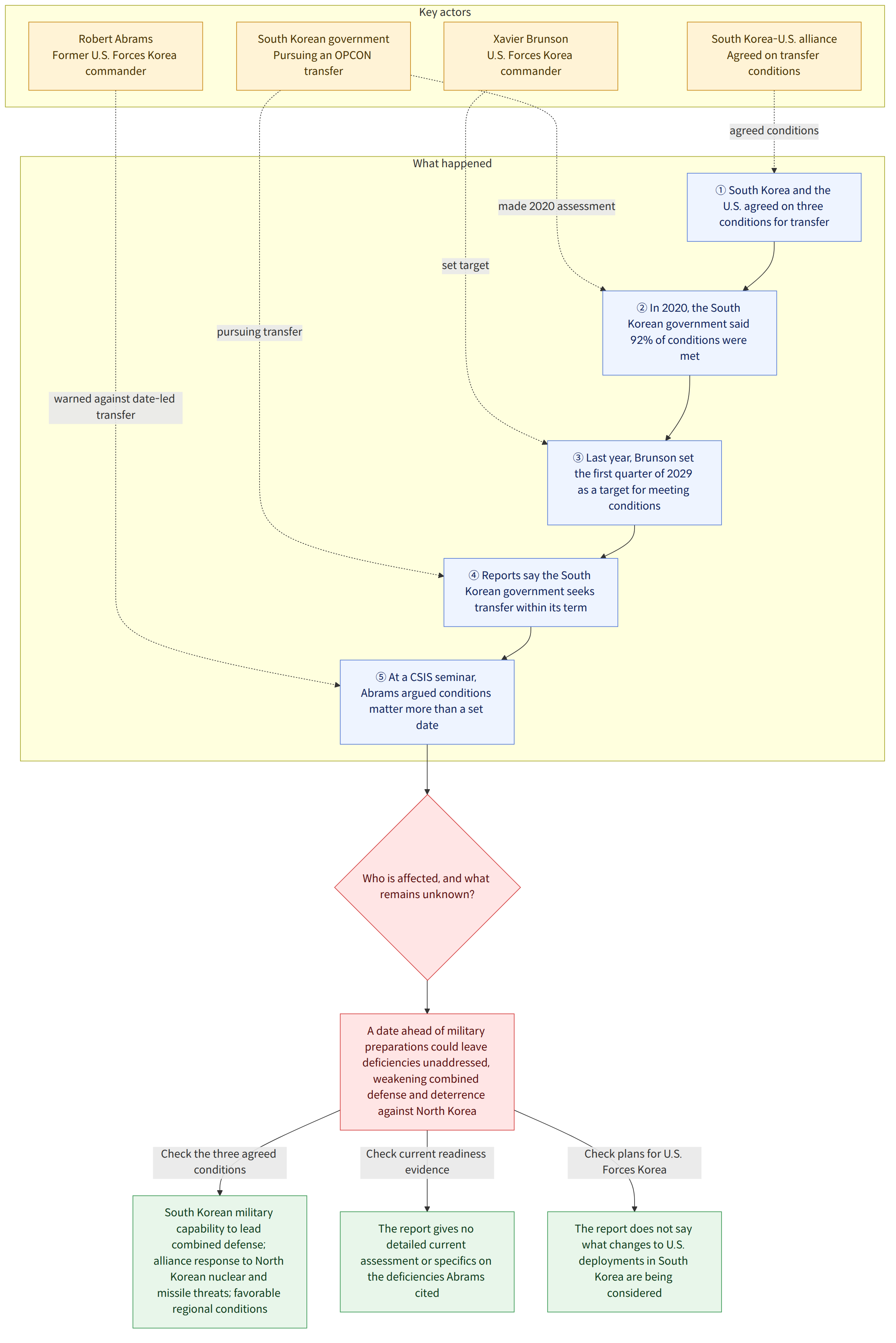
Robert Abrams, former commander of U.S. Forces Korea (주한미군), said at a seminar at the Center for Strategic and International Studies (전략국제문제연구소, CSIS) in Washington, D.C., on the 5th that meeting the conditions for transferring wartime operational control (OPCON) matters more than adhering to a set timetable. He warned that arbitrarily setting a date before the conditions are met could leave operational deficiencies in the South Korean military unaddressed, weakening deterrence against North Korea and defense capabilities. The pace of the transfer and the level of preparedness have become points of contention amid reports that the Lee Jae-myung administration is pursuing a transfer within its term and internally believes it could be completed as early as next year or the year after.
Background and context
OPCON is the authority to direct military operations during wartime. South Korea and the United States have agreed on three conditions for the transfer: South Korea must have the military capabilities to lead combined defense; the alliance must be able to respond comprehensively to North Korea’s nuclear and missile threats; and conditions on the Korean Peninsula and in the region must be conducive to a stable transfer.
Abrams’s argument is that the process of meeting these conditions must be distinguished from the politically desired timing of the transfer. He said conditions-based planning was designed to strengthen combined defense and deterrence, and that transferring OPCON according to a timetable fundamentally increases risks. In other words, his warning is that setting a transfer date does not, by itself, mean military preparations are complete.
He also argued that the South Korean government’s statement that it had met 92% of the transfer conditions in 2020 was untrue, saying the figure at the time was far below 92%. He added that he was relatively certain many deficiencies remained in meeting the transfer conditions. However, the report did not specify the deficiencies he identified or the current assessment of them.
Regarding the target timing for the transfer, U.S. Forces Korea Commander Xavier Brunson set the first quarter of 2029 as the target for meeting the conditions at a congressional hearing last year. This target and reports that the South Korean government is pursuing a transfer within its term show that different timetables are under discussion. But a target date is not the same as confirmation that the conditions have actually been met.
What this news means
The transfer of OPCON could affect South Korea’s ability to lead combined defense, the South Korea-U.S. alliance’s response to North Korea, and the operations of U.S. Forces Korea. The risk Abrams emphasized is not the transfer itself, but the potential gap in defense that could arise if the timetable gets ahead of preparations and key capabilities are not yet in place. Conversely, his remarks alone do not establish the current level of South Korea’s preparedness. The report does not include detailed assessment data.
The debate also brings to light the tension between sovereignty and military preparedness. Abrams said he understood the desire to move quickly to secure sovereignty, while adding that, in his view, calls emphasizing sovereignty mean wanting a Korean-led military to act unilaterally. He added that such a move would mean ending the current bilateral cooperation process. This is his interpretation; his remarks do not confirm the South Korean government’s intentions or a policy agreed on by South Korea and the United States.
The issue of U.S. Forces Korea also needs to be considered separately. Abrams warned that the transfer of OPCON and the possibility of reducing U.S. Forces Korea could lead North Korea to miscalculate. He also said the United States has expressed its willingness to provide important but limited capabilities, and that signals are being sent that U.S. deployments in South Korea will change. The report, however, does not say what changes are being considered.
The three “misses” he mentioned—misunderstanding, miscalculation and mistake—show that the debate over the timing of the transfer is not limited to assessing military capabilities. His warning is that tensions could rise if the parties misjudge each other’s intentions or defensive posture. For example, if North Korea misinterpreted a signal that the transfer date had been moved up as a weakening of the South Korea-U.S. defense commitment, it could complicate efforts to manage tensions. This describes a possible scenario; it does not mean such a misunderstanding has actually occurred.
Related institutional and support information
The institutional benchmarks readers should check in this matter are the three conditions for the transfer agreed on by South Korea and the United States. The first is the South Korean military’s ability to lead combined defense; the second is the alliance’s ability to respond comprehensively to North Korea’s nuclear and missile threats; and the third is an environment on the Korean Peninsula and in the region conducive to a stable transfer. The report lists these conditions but does not explain the detailed criteria used to assess each one, who determines whether they have been met, or what process is used to make that determination.
Therefore, a target year or quarter for the transfer should be distinguished from a finding that the three conditions have been met. Abrams said the decision to transfer OPCON is made by politicians and diplomats, while commanders in the field should offer military advice to reduce risks and strengthen deterrence and defense. In his account, political decisions and military assessments have different roles, but this report alone does not provide details of the actual assessment procedures or decision-making process.
What is confirmed and what remains unknown
Confirmed facts
- Abrams said at a CSIS seminar on the 5th that meeting the conditions matters more than the timetable.
- The three conditions for the transfer of OPCON agreed on by South Korea and the United States are military capabilities, the ability to respond to North Korea’s nuclear and missile threats, and a stable environment on the Korean Peninsula and in the region.
- Reports say the Lee Jae-myung administration is pursuing a transfer within its term and internally believes it could be completed as early as next year or the year after.
- At a congressional hearing last year, U.S. Forces Korea Commander Brunson set the first quarter of 2029 as the target for meeting the conditions.
- Abrams warned that the transfer of OPCON and the possibility of reducing U.S. Forces Korea could lead North Korea to miscalculate.
What remains unknown
- What specific operational deficiencies remain in the South Korean military, and how are they currently assessed?
- What procedures and criteria do South Korea and the United States use to assess whether each transfer condition has been met?
- What changes to U.S. deployments in South Korea are being considered?
What readers should check
- When a target date for the transfer is announced, readers should check whether the status of each of the three conditions and the basis for its assessment are also made public.
- A former commander’s warning and the government’s policy judgment come from different speakers and are based on different grounds. It is important not to treat Abrams’s assessment as a confirmed joint judgment by South Korea and the United States.
- If changes to U.S. deployments in South Korea are mentioned, readers should distinguish between a decision that has been confirmed and a statement merely suggesting that changes are possible.
References
- Other coverage consulted: koreatimes.co.kr
- Other coverage consulted: en.yna.co.kr