
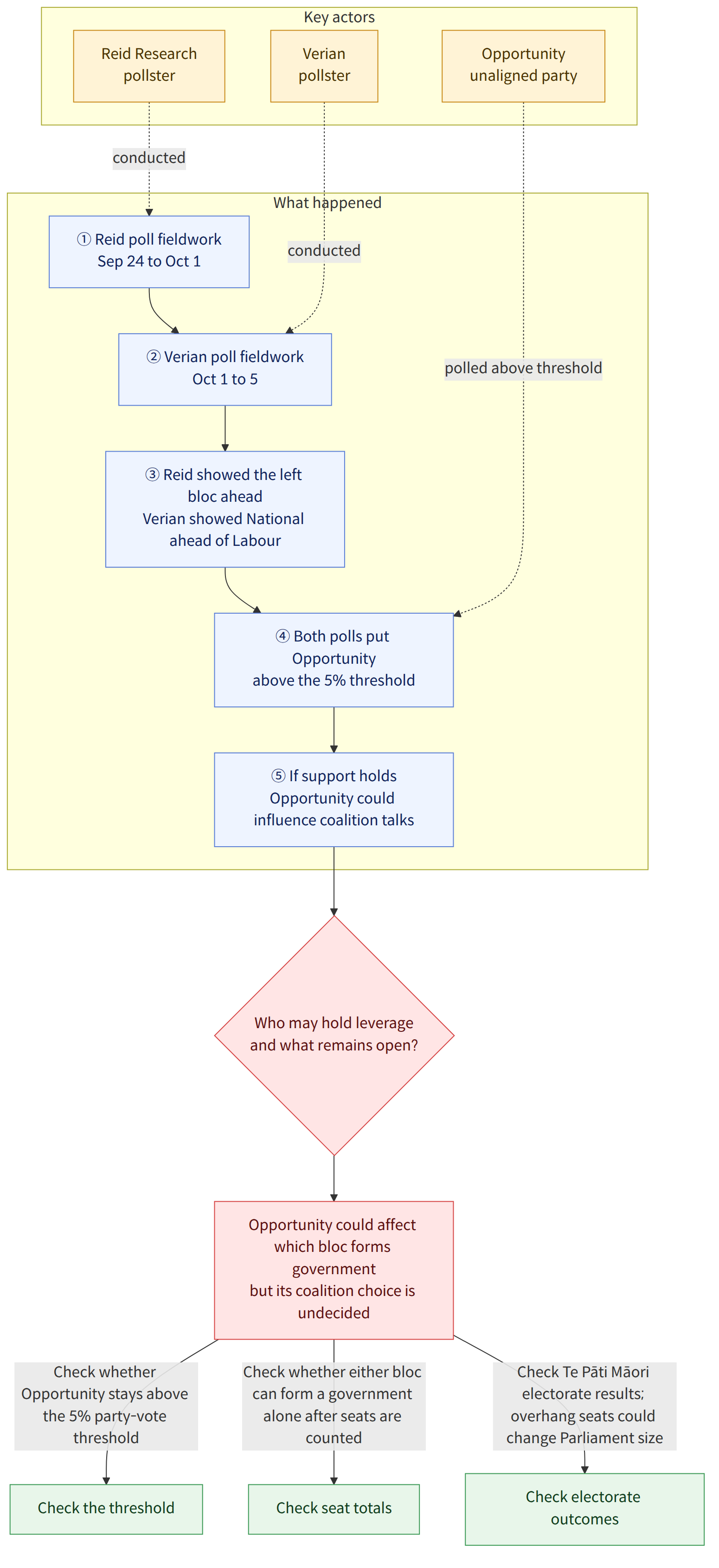
With a month to go before New Zealand’s general election, opinion polls showed differing results. In an RNZ-commissioned Reid Research poll of 1,000 eligible voters conducted from September 24 to October 1, combined support for Labour, the Greens and Te Pāti Māori (Māori Party) was 2.1 percentage points higher than for the National Party, New Zealand First and ACT. But in a TVNZ 1News-commissioned Verian poll of 1,001 people conducted from October 1 to 5, the National Party led Labour by 1 percentage point. Both polls showed Opportunity above the threshold for entering Parliament.
Background and context
In the Reid Research poll, support for Labour was 30.8%, down 1.8 percentage points from a poll in mid-August, while support for the National Party was 25.9%, down 3.2 points. The Greens, by contrast, rose 4.6 points to 14.8%. New Zealand First fell 1.3 points to 10.6%, while ACT rose 1.3 points to 9.0%.
Opportunity rose 0.2 points to 5.5%, and Te Pāti Māori fell 1.0 point to 2.0%. This was the first time the left-wing parties had led the right-wing parties in a Reid Research poll since the previous poll, when the right was ahead by 3.3 points. According to the article, it was also the first time the left had led since a Verian poll in mid-June.
In the Verian poll, the National Party was at 29% and Labour at 28%. The Greens recorded 16%, New Zealand First 10%, ACT 9%, Opportunity 7% and Te Pāti Māori 0.6%. Compared with the previous Verian poll, the National Party was up 1 percentage point, as were New Zealand First and Opportunity, while ACT was down 2 points. Labour and the Greens were unchanged.
The timing of the polls also matters when interpreting the results. In a Roy Morgan poll conducted from August 31 to September 27, the right bloc led the left by 10.5 percentage points. However, most of that poll’s fieldwork took place before the more recent Verian and Reid Research polls. It is therefore difficult to compare results from different polls as if they reflected the state of the race at the same time.
What this means
Opportunity is a party aligned with neither bloc and, according to the article, has edged above the 5% party-vote threshold. This is why the poll results have prompted analysis that Opportunity could hold the balance of power between the left and right if the results hold on election day. That is a possibility based on the assumption that the polls translate into actual votes and seats; it does not mean that the party’s participation in a post-election coalition has been decided.
A coalition is a way for multiple parties to form a government together. If Opportunity’s support remains above the threshold, either bloc may view the party’s choice as important to securing enough seats. For example, if the election result makes it difficult for either bloc to form a government on its own, whether Opportunity cooperates could affect government-formation talks. The actual result and the party it might work with are not yet known.
The polls also measured views of the party leaders. Prime Minister and National Party leader Christopher Luxon had a net favorability rating—the share of positive ratings minus the share of negative ratings—of –23.7. Of respondents, 53.3% rated his performance negatively and 29.6% positively. Labour leader Chris Hipkins had a net favorability rating of –3.6, with 38.7% rating him negatively and 35.1% positively.
The issues surrounding Opportunity show how policy and coalition prospects are intertwined. Luxon said he would not work with the party because of its land tax policy. In the Verian poll, 40% said the National Party should reconsider that position, while 33% said it should not. These are the views of poll respondents; they do not mean the National Party has changed its position.
The possibility of Te Pāti Māori winning electorate seats could also complicate calculations of the balance of seats between the blocs. According to the article, if the party wins five of the seven Māori electorates with about 1% of the party vote, it could gain four overhang seats. In that case, Parliament would grow from 120 seats to 124, and Te Pāti Māori would hold five seats, potentially helping the left bloc, the article explains. This, too, is a scenario based on a particular election outcome.
What differed between reports
The two latest polls differed in their party support figures and in the direction of support between the blocs. In the Reid Research poll, combined support for the left-wing parties was 2.1 percentage points higher than for the right-wing parties, while in the Verian poll the National Party led Labour by 1 percentage point. Opportunity’s support was also different: 5.5% in the Reid Research poll and 7% in the Verian poll.
The fact that poll results differ does not, by itself, show that either poll is wrong. The polls covered different periods and used different samples, and the materials provided do not include the margin of error for any of them. Roy Morgan found a 10.5-point lead for the right, but it is also important to note that most of its fieldwork took place before the two more recent polls.
What is known and what remains unknown
What is known
- In the Reid Research poll, combined support for left-wing parties was 2.1 percentage points higher than combined support for right-wing parties.
- In the Verian poll, the National Party was at 29%, Labour at 28%, and Opportunity at 7%.
- In both polls, Opportunity was above the 5% threshold for entering Parliament.
- Luxon said he would not work with Opportunity because of its land tax policy.
What remains unknown
- The actual vote shares and number of seats each party will win in the November 7 general election are not yet known.
- It has not been decided which bloc Opportunity will form a coalition with or cooperate with after the election.
- The materials do not provide the margins of error for the opinion polls cited in the article.
What readers should look out for
- When reviewing future polls, readers should check the polling organization and fieldwork dates, and take care when directly comparing results from different periods.
- Opportunity’s willingness to cooperate cannot be determined from its current level of support alone. Readers should check the parties’ official positions and government-formation discussions after the election.
- The balance of seats could change depending on how many electorate seats Te Pāti Māori wins. After the election, readers should therefore look at electorate results and the final seat count as well as party-vote shares.
References
- Other coverage consulted: theconversation.com