
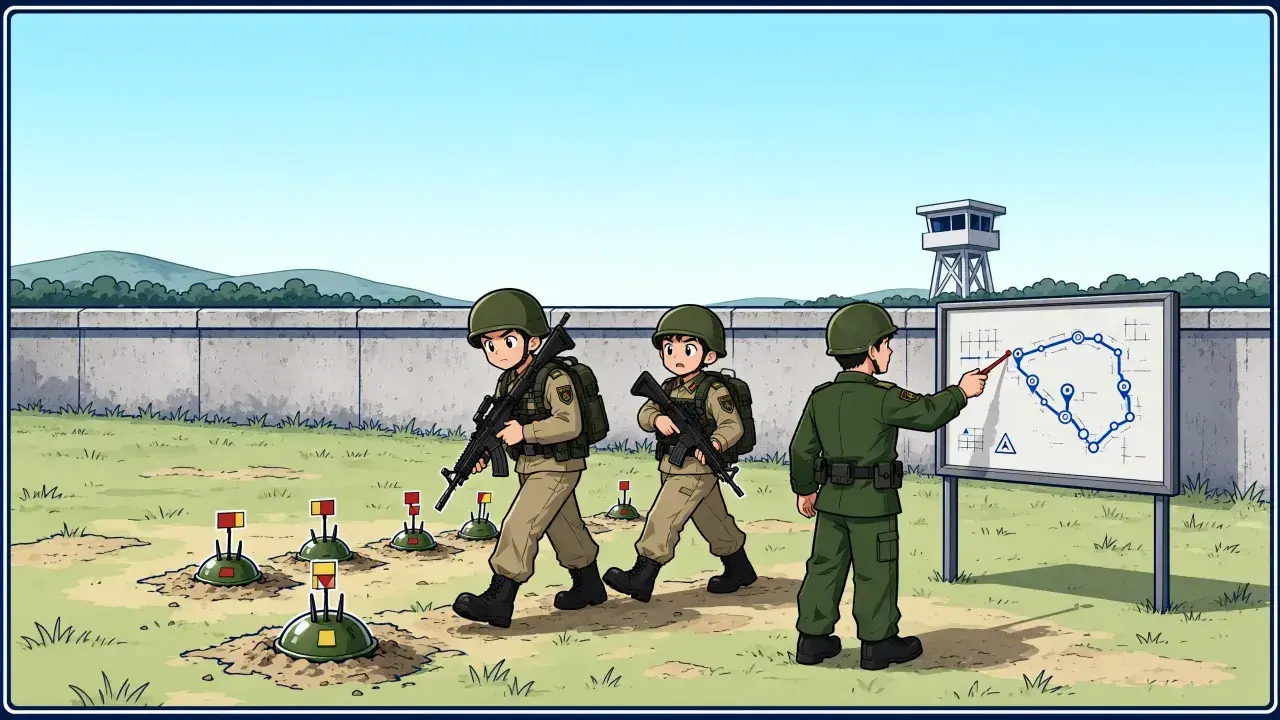
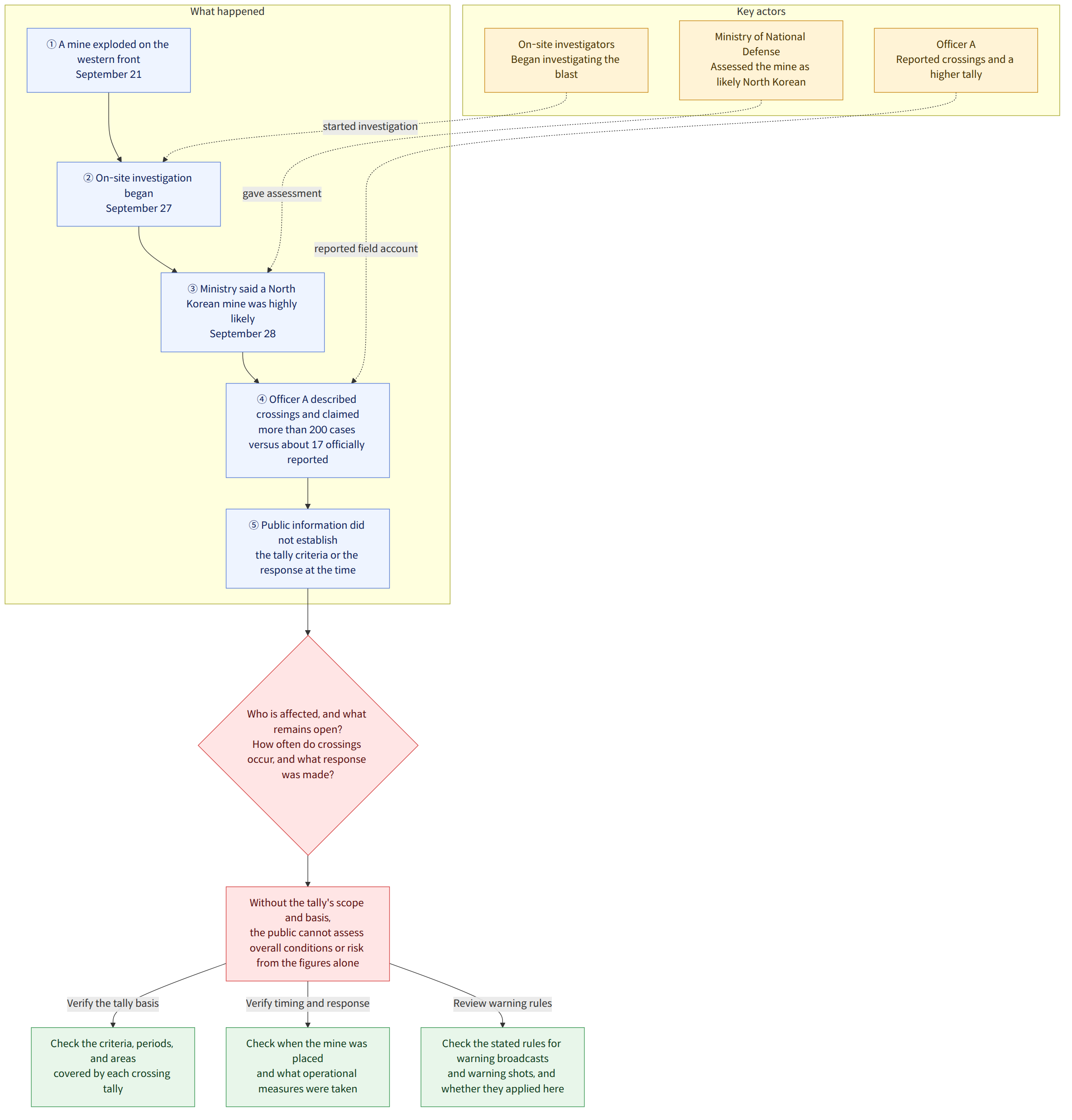
A mine exploded in the Demilitarized Zone on the western front on September 21. At a briefing on September 28, the Ministry of National Defense (국방부) said it was highly likely to be a North Korean mine. However, based on the information made public, it is not possible to confirm when the mine was placed or what measures the South Korean military took at the time.
Officer A, who works in the situation room of a unit on the eastern front, said North Korean troops came south of the Military Demarcation Line carrying boxes believed to contain mines, worked for more than 10 hours, and then went back north. If this account is accurate, the incident should be examined not only as a matter of determining the cause of an individual explosion, but also in the context of repeated crossings in the border area and issues of surveillance and response. However, Officer A’s field account and the official tally differ in scope and basis, so their figures should not be directly compared as if they were the same kind of measure.
Background and context
According to Officer A, North Korean troops generally come south to work between 6 and 6:30 a.m. and return north between 7 and 9 p.m. He claimed that although the Ministry of National Defense reported about 17 violations of the Military Demarcation Line last year, the total exceeded 200 when undisclosed cases from all corps were included. However, the report does not establish the criteria used to tally those more than 200 cases or the periods and areas covered.
Officer A said that regulations require warning broadcasts and warning shots in response to North Korean provocations or incursions. According to his explanation, the main purpose of warning shots is to make the gunfire audible, and they are fired at the ground or into the air. He said that on a day when his unit detected a crossing, it issued more than 50 warning broadcasts, but North Korean troops finished their work and went back anyway. This is a field account, not an official explanation confirming the response at every unit or the measures taken at the time of this incident.
Asked about the response when the mines were placed, the military said it could not provide details because the matter involved operational measures. The on-site investigation began on the 27th, six days after the incident. The date the investigation began and the military’s response are separate matters that need to be verified; the investigation schedule alone does not establish whether operational measures were taken at the time or whether they were appropriate.
The article reported that during the 2015 DMZ wooden-box mine incident, the South Korean military did not know that North Korean troops had crossed the Military Demarcation Line or when the mines were placed. It said that Kim Kwan-jin, then director of the National Security Office at the Blue House (청와대 국가안보실), subsequently resumed loudspeaker broadcasts toward North Korea, and that after North Korea shelled the South, the South Korean military fired 29 rounds from K-9 self-propelled howitzers in response, after which North Korea accepted responsibility and apologized. The response to the earlier incident provides context for comparison with the current situation, but no basis has been presented for concluding that the field conditions or operational judgments then were the same as they are now.
What this news means
When assessing security conditions in border areas, it is important to consider not only the number of crossings but also what actions took place, when the military detected them, and what response it made. The official figure of about 17 and Officer A’s claim of more than 200 may cover different scopes, making it difficult to conclude from the numbers alone that either one represents the overall situation. Without public disclosure of the tally’s criteria and basis, it is also difficult for the public to assess how often such incidents occur or the level of risk.
The report also includes differing interpretations of the purpose of North Korean crossings. Officer A said that internal assessments included the fortification of the border, preventing South Korea from advancing north, and preventing North Korean troops and residents from defecting. Park Hwi-rak, head of the Nuclear Response Research Group at the Korean Peninsula Advancement Foundation (한반도선진화재단), argued that the mine placement was part of a series of provocations and an intent to attack. These explanations should be treated as separate analyses and claims; they cannot be taken as confirmed purposes for placing the mines or as established command intent.
After the incident, North Korea said on September 30, in a statement by Kim Yo-jong, director of the General Affairs Department of the Workers’ Party of Korea, that it would reinforce tactical countermeasures in the direction of the Demilitarized Zone near the South Korean Army’s 21st Infantry Division of III Corps. On the same day, Kang Hyun-woo, head of the Operations Headquarters of the Joint Chiefs of Staff (합동참모본부), said North Korea’s mine attack violated the Armistice Agreement (정전협정) and called on the North to apologize and take responsible measures. With statements exchanged by both sides, how tensions surrounding the border area are managed is another issue that needs to be monitored.
For example, soldiers serving in border areas or their families could assess the safety situation by checking official military investigation findings separately from field accounts, rather than relying on a single figure for the number of crossings. In particular, until the timing of the mine’s placement and the operational measures taken at the time of this incident are established, it is difficult to reach a definitive conclusion about the cause or the appropriateness of the response.
What is confirmed and what remains unknown
Confirmed facts
- A mine exploded in the Demilitarized Zone on the western front on September 21, and on September 28 the Ministry of National Defense said it was highly likely to be a North Korean mine.
- Officer A described frequent North Korean crossings of the Military Demarcation Line, lengthy work, and an instance in which troops finished their work despite warning broadcasts.
- The Ministry of National Defense reported about 17 violations of the Military Demarcation Line last year, while Officer A claimed the total exceeded 200 when undisclosed cases from all corps were included.
- The on-site investigation began on the 27th, six days after the incident, and the military said it could not answer questions about its response at the time because the matter involved operational measures.
- On September 30, North Korea announced plans to reinforce tactical countermeasures, and the head of the Operations Headquarters of the Joint Chiefs of Staff called for an apology and responsible measures.
What remains unknown
- It has not been confirmed when the exploded mine was placed. At a National Assembly National Defense Committee meeting on September 29, Defense Minister Kang Shin-chul said, in effect, that investigators should determine whether it was a mine that had been there since 1969 or one placed in September 2025.
- The specific basis and scope for the more than 200 Military Demarcation Line violations cited by Officer A are not clear from the information made public.
- The operational measures taken by the South Korean military when North Korean troops placed the mines have not been made public.
What readers should check
- Check whether the follow-up investigation reaches a conclusion about the type of mine and when it was placed.
- If additional figures are released for Military Demarcation Line violations, check whether the tally’s time period, areas covered, and criteria for including cases are also provided.
- If the operational measures taken at the time are made public, distinguish whether warning broadcasts or warning shots were used from the reasons the measures were limited.

















