The status of South Korean investment in the Alaska liquefied natural gas (LNG, natural gas transported in liquid form) development project was described differently by people in and around the U.S. administration. U.S. Vice President JD Vance told reporters on October 5, 2026, before departing for Alaska, that details still needed to be coordinated with South Korea. He also expressed confidence that the project would be realized, but his remarks should be distinguished from a statement that an investment had already been finalized.
Background and context
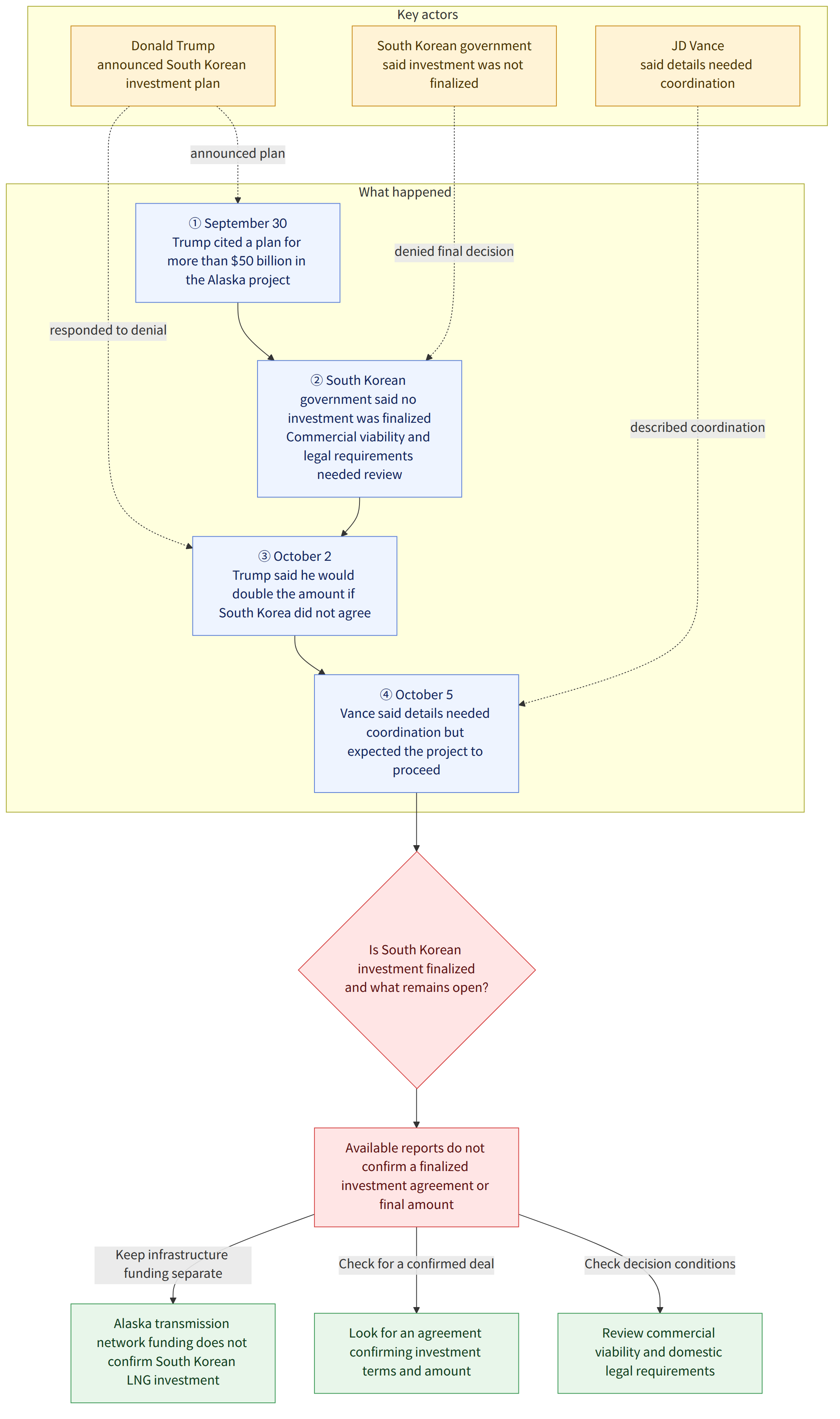
On September 30, President Donald Trump announced South Korea’s investment plan in the United States at the White House, saying in effect that it included a plan for South Korea to invest more than $50 billion in the Alaska project. The South Korean government, however, denied that an investment had been finalized, saying that further discussions were needed to assess the project’s commercial viability and domestic legal requirements. Reports also said that a fact sheet released by the U.S. Department of Commerce stated that further discussions were needed.
Vance’s remarks on October 5 again highlighted this gap. He acknowledged that details needed to be coordinated with South Korea, while saying he thought the project would be realized. Japan and East Asian economies facing high natural gas prices also want U.S. gas, he said, and strong demand meant the project could be brought to fruition.
On October 2, when asked about South Korea denying that it had reached an investment agreement, President Trump said to tell South Korea that if it did not agree, he would double the investment amount. The issue, then, is not only U.S. expectations or pressure regarding the project, but also the conditions and procedures under which South Korea’s investment will actually be decided. The president’s announcement of an investment plan, the South Korean government’s denial that an investment has been finalized, and the vice president’s remarks about further coordination should be considered separately.
What this news means
Vance’s optimistic remarks show that the United States views gas demand in East Asia, including South Korea, as a basis for pursuing the project. But the existence of demand alone does not confirm either South Korea’s investment decision or the project’s commercial viability. The commercial viability and domestic legal requirements that the South Korean government said it would review remain conditions for any decision.
This distinction matters when interpreting statements about the investment amount. The fact that President Trump mentioned more than $50 billion is not the same as South Korea having finalized a decision to invest that amount. The reports currently available do not present an agreement or outcome that confirms a finalized investment or its final amount. Vance’s remarks also combine an expectation that the project will go ahead with the need for further negotiations, so it would be difficult to treat either point on its own as evidence of a final agreement.
For example, if a South Korean company or the government is considering whether to participate in the project, the U.S. expectation that it will move forward and whether the investment terms have been finalized should be treated as separate questions. Assessments of commercial viability and domestic legal procedures will be important in deciding whether to participate, but the schedule and outcome of those reviews cannot be determined from the current reports.
Reuters also reported, in connection with Vance’s visit, that the Trump administration would provide $150 million in federal funds to expand Alaska’s transmission network. The project involves building a 223-mile (359-kilometer) transmission line from the Beluga power plant to Healy, and its total cost was reported to be about $400 million. This is separate reporting about infrastructure investment in Alaska; the funding alone does not confirm South Korean investment in the LNG project or a final agreement.
What is confirmed and what is still unknown
Confirmed facts
- On October 5, Vice President Vance said that further coordination with South Korea was needed on the details of the project.
- He said he believed the project would be realized and cited East Asian demand for U.S. natural gas.
- On September 30, President Trump said in effect that South Korea’s investment plan in the United States included a plan to invest more than $50 billion in the Alaska project.
- The South Korean government denied that an investment had been finalized, saying that commercial viability and domestic legal requirements, among other matters, needed further review.
- Reports said the transmission-network project would receive $150 million in federal funding; the transmission line is 223 miles (359 kilometers) long, and the total project cost was reported to be about $400 million.
What is still unknown
- How will South Korea’s decision on whether to invest in the Alaska LNG project, and the final investment amount, be determined?
- When will the reviews of commercial viability and domestic legal requirements be completed, and what will their outcomes be?
- What are the specific terms that South Korea and the United States still need to coordinate, and when will a final agreement be reached?
What readers should watch for
- In follow-up announcements, distinguish between the phrase “included in the investment plan” and the phrase “investment finalized.”
- Watch for disclosures about the progress and outcome of the reviews of commercial viability and domestic legal requirements mentioned by the South Korean government.
- Check whether support for transmission-line construction and an investment agreement for the LNG project are separate matters, and how each is described in subsequent announcements.
References
- Other coverage consulted: koreatimes.co.kr
- Other coverage consulted: en.yna.co.kr