
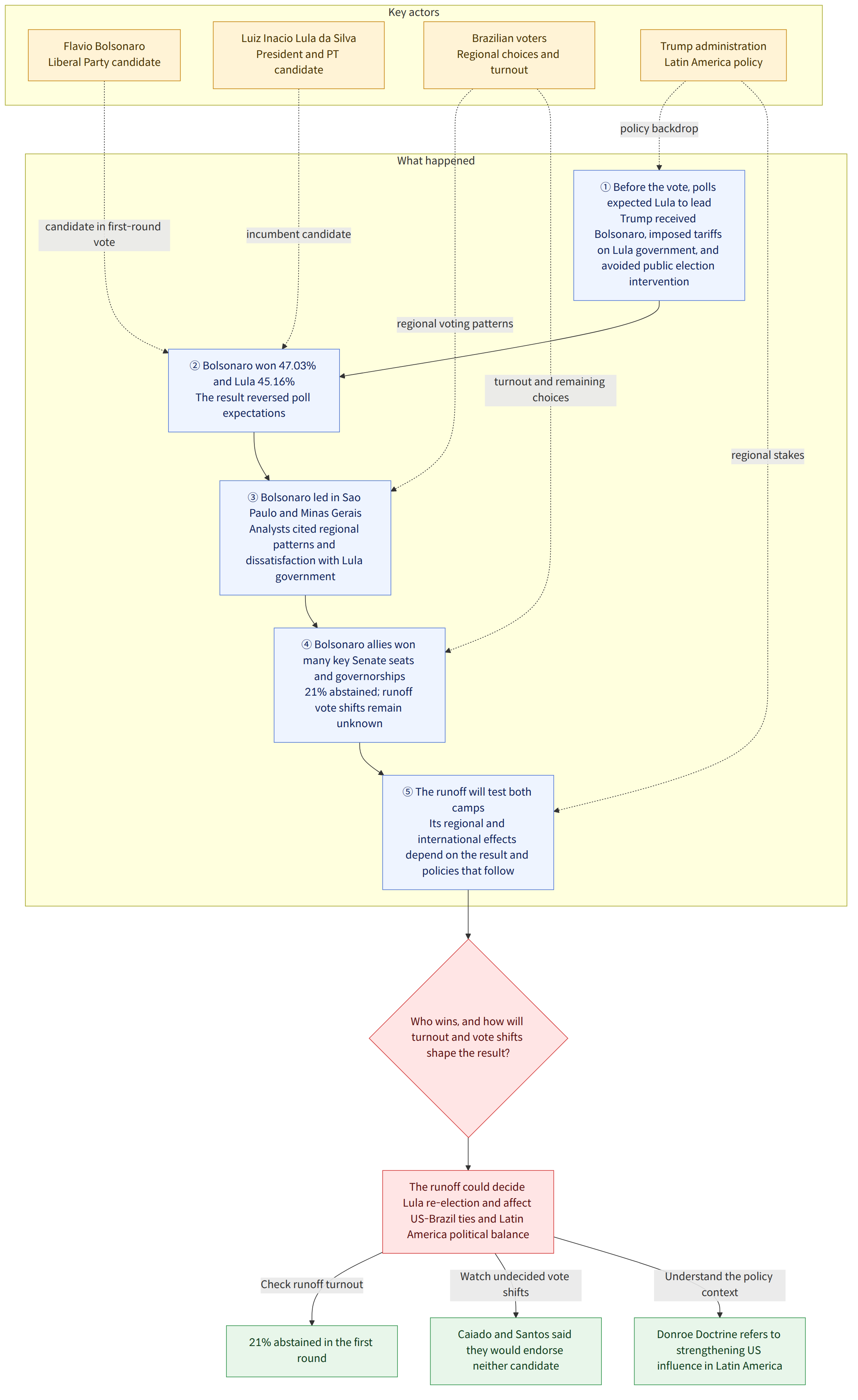
In the first round of Brazil’s presidential election, Liberal Party (자유당) candidate Flávio Bolsonaro came first with 47.03%, ahead of Workers’ Party (노동자당, PT) candidate and President Luiz Inácio Lula da Silva, who received 45.16%. Pre-election polls had expected Lula to lead by 1–3 percentage points, but the result was the opposite. Bolsonaro is the son of former president Jair Bolsonaro, who is serving a prison sentence for coup-related charges.
It is not yet known which of the two candidates will win the runoff. But this first-round vote is drawing attention not simply because the frontrunner changed: it is an election shaped by voter dissatisfaction with Lula’s government, regional voting patterns in Brazil, and the Trump administration’s Latin America policy.
Background and context
In the first round, Bolsonaro led in São Paulo and Minas Gerais in the southeast. Lula did not build a large lead in the northeastern and northwestern rural areas considered part of his support base. This means that regional differences in support were an important factor in widening or narrowing the gap between the candidates’ nationwide vote shares.
Analysts interpreted the first-round result as a protest vote against Lula and the Workers’ Party. This interpretation focuses on the possibility that the votes reflected not only support for Bolsonaro but also dissatisfaction with the incumbent government and governing party. Other explanations pointed to the high cost of living, household debt, crime, and the spread of gang activity as factors that made it difficult for Lula’s government to persuade voters.
In legislative and gubernatorial elections held alongside the first round, Bolsonaro’s Liberal Party and its allies won many Senate seats and governorships in key states. The runoff may therefore be about more than the presidency: it could also test the political strength Bolsonaro’s camp has secured and Lula’s bid for re-election.
The other nine candidates received a combined 7.82% in the first round. Writer Augusto Cury came third with 3.4 million votes, while Ronaldo Caiado and Renan Santos said they would not endorse either candidate in the runoff. It is not yet clear how these votes will shift in the runoff, or whether voters who did not participate will turn out.
What this news means
For Lula, the challenge may be to address the dissatisfaction revealed in the first round and mobilize his support base. Twenty-one percent of first-round voters abstained. The article does not say how many of those who abstained will vote in the runoff, but this share suggests that turnout, as well as shifts in support between the candidates, could affect the result.
For Bolsonaro, it may be important to turn his first-round lead and gains in the legislative and gubernatorial elections into support in the runoff. But leading in the first round does not, by itself, determine who will win the runoff. The choices of supporters of eliminated candidates and turnout among those who abstained remain possible factors.
Internationally, Brazil’s choice could affect the Trump administration’s Latin America policy and the regional balance. According to the article, President Trump received Bolsonaro at the White House and imposed punitive tariffs on Lula’s government, but refrained from publicly intervening before Brazil’s election. The article suggests that if Lula is re-elected, he could serve as a bulwark for maintaining balance in Latin America against Trump’s Donroe Doctrine (돈로주의).
The Donroe Doctrine refers to Trump’s foreign policy aimed at strengthening U.S. influence in Latin America. The runoff result could therefore be both a domestic choice of government in Brazil and a moment that offers an indication of the state of U.S.-Brazil relations and the strength of different political approaches in Latin America. However, the regional effects could vary depending on the runoff result and the policies that follow.
For example, if large numbers of voters who abstained in the first round take part in the runoff, the result may be difficult to explain by looking only at the candidates’ existing support. Conversely, if their participation is limited, where voters who already turned out shift their support may matter more. These are possible scenarios, not claims about actual turnout or who will win.
President Lula said he would seek re-election and that “the second round is the real test.”
What is confirmed and what remains unknown
Confirmed facts
- In Brazil’s first-round presidential vote on October 4, 2026, Bolsonaro received 47.03% and Lula received 45.16%.
- Bolsonaro came first, contrary to pre-election opinion-poll projections.
- Bolsonaro led in São Paulo and Minas Gerais, while Lula did not build a large lead in the northeastern and northwestern rural areas.
- In the legislative and gubernatorial elections held alongside the first round, Bolsonaro’s Liberal Party and its allies won many Senate seats and governorships in key states.
- The abstention rate in the first round was 21%, and the nine candidates other than the two frontrunners received a combined 7.82%.
What remains unknown
- Whether Lula or Bolsonaro will win the runoff.
- How many voters who abstained in the first round will participate in the runoff.
- Which candidate supporters of the eliminated candidates will actually choose in the runoff.
- What specific changes Brazil’s election result will bring to the Trump administration’s Latin America policy.
What readers should watch
- When assessing the runoff result, it is worth considering not only first-round vote shares but also turnout among those who abstained and shifts in support among voters for eliminated candidates.
- Readers can also watch how the balance of power formed in the legislative and gubernatorial elections affects the government’s ability to govern after the presidential election.
- Tracking how the Trump administration’s policies toward Brazil and Latin America continue before and after the election can help gauge the international significance of Brazil’s runoff.