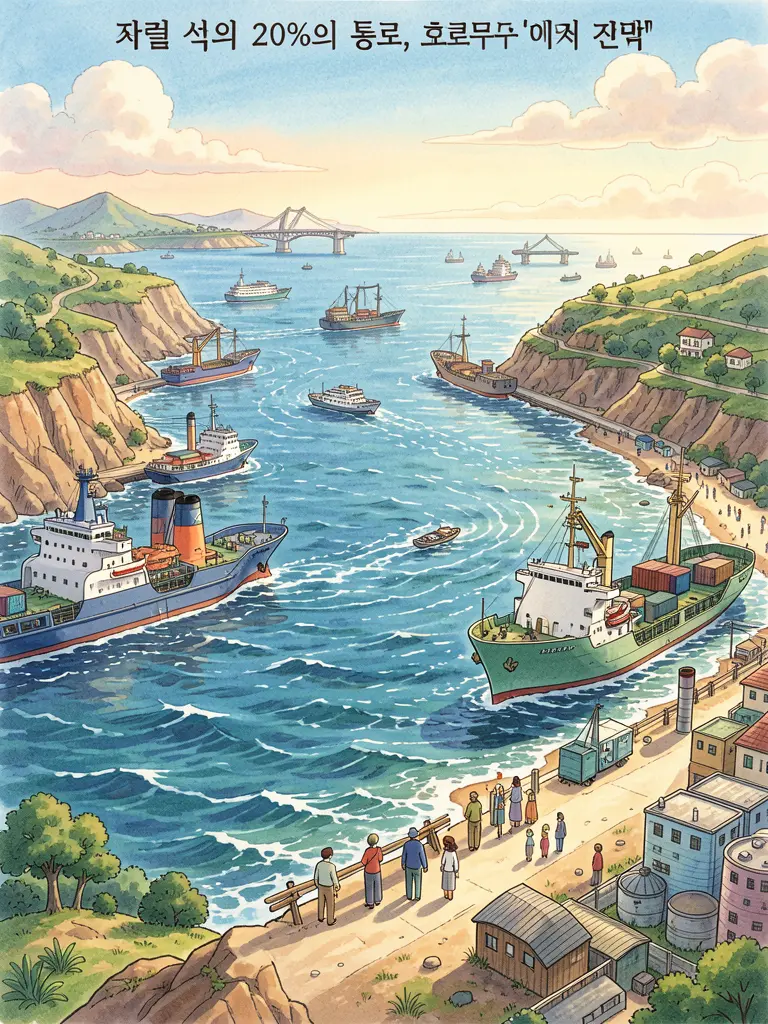
The Global Choke Point: More Than Just Geography
Geographically, the Strait of Hormuz is a simple narrow sea passage connecting the Persian Gulf to the Gulf of Oman. However, in the realm of geopolitics and international law, it is one of the most contested pieces of water on Earth. This narrow corridor is a critical choke point (a strategic narrow passage that can be easily blocked to stop traffic), through which approximately 20% of the world's total oil consumption flows daily.
Because of this immense economic importance, the legal status of the strait is not merely an academic debate but a matter of national security and global economic stability. The United States and Iran view the water through entirely different legal lenses, leading to a volatile environment where a single misunderstanding can trigger a global energy crisis.
The Foundation: Understanding the Law of the Sea
To understand this conflict, one must first understand the Law of the Sea, a complex network of international laws, customs, and agreements that dictate who owns what in the ocean and who has the right to travel where.
The Role of UNCLOS
The primary framework for these rules is the United Nations Convention on the Law of the Sea (UNCLOS). Established in 1982 and entering into force in 1994, UNCLOS was designed to create a stable, global set of zones to prevent conflicts over maritime boundaries. It defines specific rights for coastal states and the rights of foreign vessels to pass through those waters.
Crucial Legal Gap: While 171 countries and the European Union have ratified UNCLOS, both the United States and Iran have not. Iran signed the treaty but never ratified it (formally approved it into national law), and the U.S. has neither signed nor ratified it.
This creates a legal vacuum. Because neither superpower in this region is a formal party to the treaty, they cannot use UNCLOS as a mutually agreed-upon rulebook to resolve their disputes. Instead, they rely on different interpretations of customary international law (rules that become binding because they are consistently followed by most nations, even if not written in a treaty).
The Iranian Perspective: Sovereignty and 'Innocent Passage'
Iran views the Strait of Hormuz primarily as part of its territorial waters (the belt of coastal waters extending from a country's coast, over which the state has full sovereignty). Tehran relies on older legal standards that predate UNCLOS, such as the 1958 Territorial Seas Convention and the 1949 Corfu Channel case.
The Concept of Innocent Passage
Under these older standards, foreign ships are granted the right of innocent passage.
- What is Innocent Passage?: It is the right of a vessel to pass through the territorial waters of another state, provided the passage is continuous, expeditious, and not prejudicial to the peace, good order, or security of the coastal state.
- Example: A cargo ship sailing straight through the strait to reach a port is exercising innocent passage. A warship conducting military exercises or spying while in the strait would be considered non-innocent.
The Conflict of Interpretation
Iran claims the right to suspend passage through its half of the strait if it deems the passage non-innocent. However, this is a point of legal contention. Even the 1958 Convention, which Iran cites, states that if a territorial sea is also an international strait, innocent passage cannot be suspended. By attempting to charge tolls or block ships, Iran is pushing the boundaries of its own cited legal framework to assert maximum control over the waterway.
The U.S. Perspective: 'Transit Passage' and Global Access
Washington views the Strait of Hormuz as an international strait that requires transit passage, a more liberal standard introduced by UNCLOS. Even though the U.S. has not ratified UNCLOS, it argues that the concept of transit passage has become a part of customary international law and should apply to everyone.
Transit Passage vs. Innocent Passage
Transit passage is significantly more permissive than innocent passage. It shifts the balance of power away from the coastal state (Iran) and toward the navigating state (the U.S. and its allies).
- Overflight and Submarines: Under transit passage, aircraft can fly over the strait, and submarines can transit submerged (underwater). Under innocent passage, submarines must travel on the surface and aircraft have no inherent right to fly over territorial waters.
- Continuous and Expeditious: As long as the movement is fast and direct, the coastal state cannot legally impede it.
Freedom of Navigation Operations (FONOPs)
To enforce this view, the U.S. conducts Freedom of Navigation (FON) patrols. These are deliberate naval missions where U.S. warships sail through contested waters to physically demonstrate that they do not recognize the coastal state's restrictive claims. This is a form of legal signaling, telling the world that the U.S. will not accept any rules that limit the movement of its fleet or global trade.
The 'Persistent Objector' Dilemma
One of the most complex parts of this legal battle is the Persistent Objector Rule. In international law, if a country consistently and openly objects to a new custom while it is forming, that country may be exempt from that rule.
Iran's Legal Shield
Tehran argues that it is a persistent objector to the concept of transit passage. Iran and Oman both fought against the inclusion of transit passage during the original UNCLOS negotiations. Because Iran has been consistently opposed to this standard since the beginning, it claims that the rule of transit passage simply does not apply to it.
The U.S. Counter-Argument
U.S. legal scholars, such as James Kraska, argue that Iran is engaging in lawfare (the use of law as a weapon to achieve a military or political objective). They contend that the global community has moved past the 1958 standards and that Iran must abide by the modern compromises of UNCLOS to ensure global stability, regardless of its ratification status.
Future Outlook: Navigating a Legal Minefield
The struggle over the Strait of Hormuz is not just about ships and oil; it is a struggle over the precedent of international law. If Iran successfully restricts passage, it sets a precedent that coastal states can hold global trade hostage. If the U.S. continues to ignore Iranian claims, it risks escalating military tensions.
The Path to Stability
For a stable post-war status to be achieved, the two nations need more than just a ceasefire; they need a shared legal framework. This would require:
- Mutual Recognition: An agreement on which specific rules (UNCLOS or customary law) apply to the strait.
- Clear Definitions: A shared understanding of what constitutes 'innocent' or 'transit' passage to avoid accidental escalations.
- Multilateral Cooperation: Involvement from other 'flag states' (countries where the oil tankers are registered) to ensure a unified approach to maritime safety.
Until such an agreement is reached, the Strait of Hormuz will remain a place where the law is not a set of rules, but a tool of conflict.