
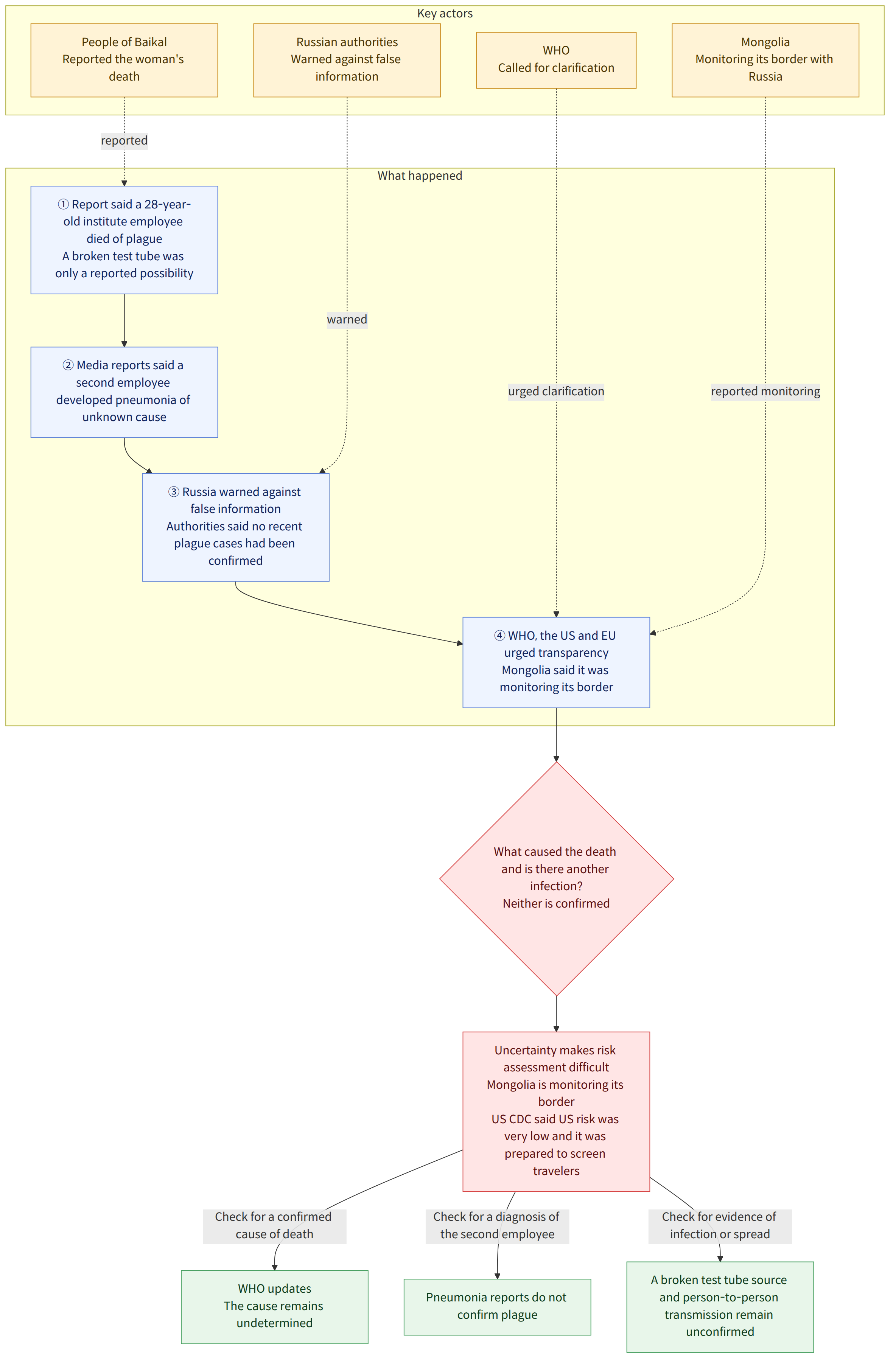
After reports that an employee at a plague research institute in Russia’s Siberian region of Irkutsk had died and a second employee had fallen ill, Russia warned on Wednesday against “false” information. However, the actual cause of death of the woman who died and whether the second employee is ill have not been confirmed. The United States, the European Union (유럽연합, EU) and the World Health Organization (세계보건기구, WHO) urged Russia to disclose information about the situation transparently, while Mongolia said it was conducting health surveillance and monitoring along its border with Russia.
Background and context
The Russian outlet People of Baikal (피플 오브 바이칼) reported last Friday that a 28-year-old woman who worked at a plague research institute in the Irkutsk region had died of plague. The outlet also raised the possibility that she had been infected by a broken test tube. However, that was only a reported possibility; it has not been confirmed that the test tube was the source of infection.
Reports and concerns about a second employee have also emerged, but what has been confirmed is that media reports said the employee had developed pneumonia of unknown cause. WHO Director-General Tedros Adhanom Ghebreyesus urged Russia to clarify these reports. Therefore, the phrase “second plague case” should not be treated as a confirmed case.
Pneumonic plague can spread between people and causes severe pneumonia. However, the WHO said it had not yet determined the woman’s cause of death, and the initial suspicion of plague was reportedly based on unconfirmed reports. According to the WHO, Russian authorities said the employee’s death initially presented as a typical acute respiratory viral infection and that no recent plague cases had been confirmed.
What this news means
The key issue is not that an outbreak of plague has been confirmed. Rather, different explanations are circulating even though the cause of death, the second employee’s condition and the route of infection remain unknown. When there is not enough information to establish the cause and determine whether there have been additional infections, health authorities and neighboring countries may also find it difficult to assess the risk.
Mongolia said it was conducting health surveillance and monitoring along its border with Russia, and the head of the U.S. Centers for Disease Control and Prevention (CDC) said the risk to the United States from unconfirmed reports of pneumonic plague in Siberia was very low, but that the country was prepared to monitor and screen travelers.
For example, if the second employee at the Irkutsk institute is confirmed to have been infected with plague, that could change the information needed to assess the risk from what is currently reported as “pneumonia of unknown cause.” But based on the evidence available now, it cannot be said that such an infection or transmission between people has been confirmed.
What differed among the reports
One report said that a second suspected case had been mentioned as Russia warned against false information, and described international calls for transparency. Another report explained that the WHO had not yet established the cause of death and that the initial report amounted only to an unconfirmed suspicion of plague. It also reported, citing the WHO, that Russian authorities had described the death as an acute respiratory viral infection and said there had been no recent plague cases.
No definitive diagnosis of the second employee has been reported either. The WHO director-general’s call for an explanation concerned reports of “pneumonia of unknown cause.” One report said a local mayor had stated that the hospital where the woman died was placed under quarantine, but it did not specify the scope or duration of the measure.
The head of the U.S. CDC said the risk to the United States from the unconfirmed case was very low. That does not mean that the cause or spread of the situation in Russia has been established; the risk assessment for the United States and the effort to establish the facts on the ground in Siberia are separate matters.
What is confirmed and what remains unknown
Confirmed facts
- People of Baikal reported that a 28-year-old woman who worked at a plague research institute in the Irkutsk region had died.
- The WHO said it had not yet determined the woman’s cause of death.
- Media reports said a second employee at the Irkutsk institute had developed pneumonia of unknown cause.
- The Mongolian government said it was conducting health surveillance and monitoring along its border with Russia.
What remains unknown
- What was the actual cause of the woman’s death?
- Have the second employee’s condition and the cause of the illness been established?
- Was the broken test tube the source of the woman’s infection?
- Was the second employee infected with plague, or was there any further transmission?
What readers should check
- In follow-up reports, readers should check whether “suspected,” “initial report” and “confirmed” are being distinguished. Current reports have not established the cause of death or the second employee’s diagnosis.
- Readers can look for any additional information from Russian authorities and the WHO about the cause of death and the second employee’s condition.
- Mongolia’s border monitoring has been reported as underway, but no specific measures or guidance for ordinary travelers have been provided. When making decisions about travel or movement, it is reasonable not to conclude on the basis of these reports alone that any separate restrictions or risk of infection have been confirmed.
References
- Other coverage consulted: koreatimes.co.kr
- Other coverage consulted: koreatimes.co.kr