
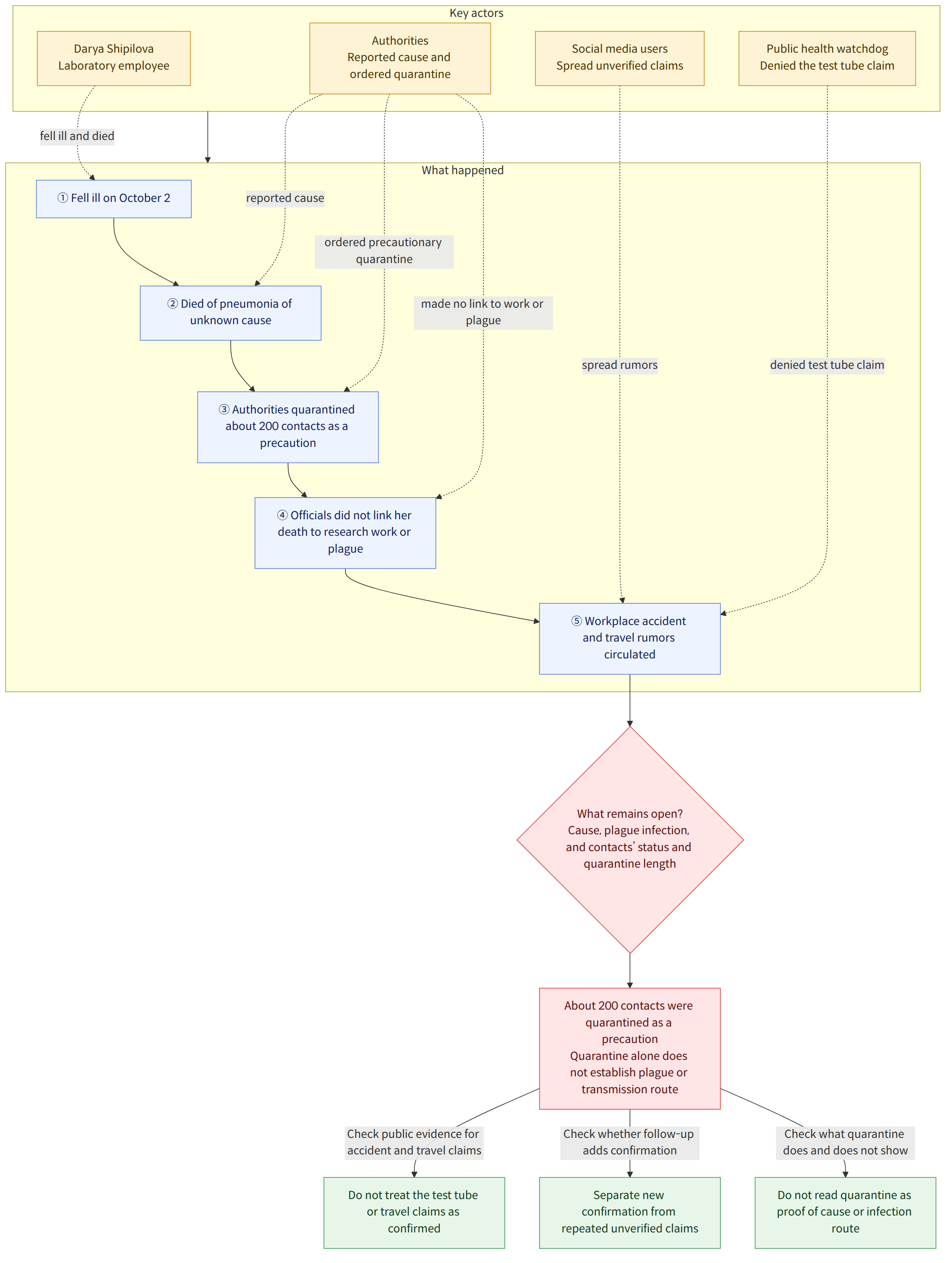
A laboratory employee at a plague research institute in Siberia fell ill on October 2 and died. Authorities quarantined about 200 people who had been in contact with her as a precaution and said the cause of death was a type of pneumonia of unknown cause. Officials did not link her death to her research work or to plague, but unverified claims about a workplace accident and travel spread on social media.
Background and context
Russian media reported that the deceased was 28-year-old Darya Shipilova, an employee of the Irkutsk Siberian and Far Eastern Anti-Plague Research Institute (이르쿠츠크 시베리아·극동 항페스트 연구소). Authorities said they had quarantined her contacts as a precaution. Quarantine means that precautionary measures were taken for the contacts, but does not in itself show that the deceased was infected with plague or contracted an infection in the laboratory.
Different claims about the circumstances of her death circulated on social media. Russia’s public health watchdog denied the claim that she had dropped a test tube containing live bacteria at work. Claims that she became ill after traveling to Thailand and that she became ill after visiting an area near the Mongolian border also circulated, but there is no publicly available evidence to support any of these three claims.
What this news means
The most important distinction in the information currently available is between what authorities have said and speculation on social media. What is known is that authorities said she died of a type of pneumonia of unknown cause and that about 200 contacts were quarantined. By contrast, how she became ill and whether she was infected with plague have not been confirmed.
The quarantine was reported as a precautionary measure to protect the contacts, but the fact of quarantine alone cannot establish the type of infectious disease or how an infection was transmitted. For example, readers who come across the claim about a test-tube accident at work should also note that it was officially denied and that there is no publicly available evidence for it. It is important to distinguish the source of information and whether it has been confirmed, because presenting unverified claims as fact can add to confusion about circumstances of the death that have yet to be established.
What is confirmed and what is still unknown
Confirmed facts
- A laboratory employee at a plague research institute in Siberia fell ill on October 2 and died.
- Russian media identified the deceased as Darya Shipilova.
- Authorities said she died of a type of pneumonia of unknown cause.
- Authorities quarantined about 200 people who had been in contact with her as a precaution.
- Officials did not link her death to her research work or to plague.
What is still unknown
- What the exact cause of death was and how she became ill.
- Whether she was actually infected with plague.
- How long the quarantined people will remain in quarantine and what their current health status is.
What readers should check
- If you encounter claims about a test-tube accident or travel, do not treat them as confirmed facts; check whether publicly available evidence supports them.
- If follow-up reports emerge, distinguish between new confirmation of the cause of death or plague infection and reports that merely repeat earlier unverified claims.
- Do not interpret news of the contacts’ quarantine as proof that the cause of death or the route of infection has been established.