
Africa is one of the continents that has contributed least to greenhouse gas emissions, yet climate impacts are already affecting food production, water security, livelihoods, and economic activity there. Public funding to respond to these shocks is severely lacking. The United Nations Environment Programme (유엔환경계획; UNEP) estimates that developing countries will need $310–365 billion annually for climate change adaptation by 2035.
Background and context
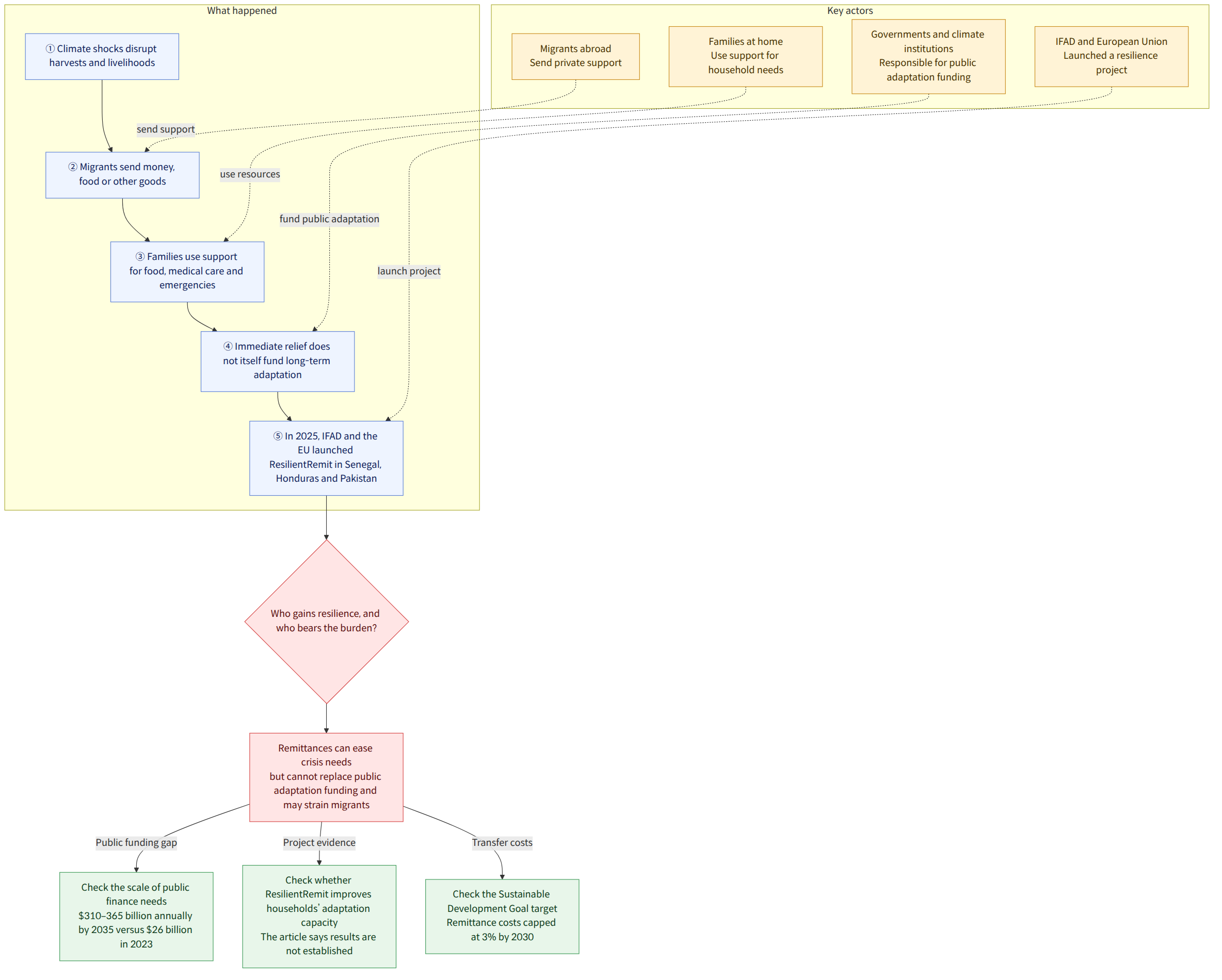
In 2023, international public adaptation finance totaled $26 billion. According to the article, estimated needs are 12–14 times the current flow of international public finance. In this funding gap, remittances sent to family members can help households respond to climate shocks, but remittances themselves are not climate finance.
According to the International Fund for Agricultural Development (국제농업개발기금; IFAD), remittances to low- and middle-income countries totaled $728.6 billion in 2025, of which Africa received $124.2 billion. About $233 billion of remittances worldwide went to rural areas. However, these statistics do not include informal remittances or money sent by people who migrated within their own country to support relatives back home.
Remittances do not mean cash alone. Migrants may also send food and other goods, while families can use the resources they receive for food, medical care, and education, to make up for lost income, support businesses, or respond to emergencies. When harvests decline or livelihoods are disrupted, this support can help meet immediate needs.
But covering urgent expenses is not the same as reducing future climate risks. Buying food does not serve the same purpose as investing in water infrastructure, drought-resistant agriculture, insurance, or livelihood diversification. That is why remittances may help households during a crisis without necessarily building their capacity to adapt to climate change.
What this means
The effects of remittances varied by place and circumstance. A study in Burkina Faso found that worsening climate conditions harmed household food security, while remittances improved food security and mitigated some of the negative effects of climate variability. By contrast, a study in Somalia found that remittances declined after climate shocks and that easier access to mobile remittances did not strengthen households’ capacity to respond.
The fact that remittances can help during a crisis is different from saying that they can replace the public investment needed for climate adaptation.
For example, a household whose harvest has fallen because of drought may use money sent by a relative abroad to buy food, easing its immediate food shortage. But that alone does not show that the household is better prepared for the next climate shock. The roles of family remittances and public funding need to be distinguished because being better prepared for the next shock requires adaptation investments beyond food purchases.
The burden of remittances can also fall on migrants. A study of Ghanaian migrants living in Qatar found that remittances improved food security and household welfare in Ghana, but pressure to send money affected the migrants’ own food security in Qatar. This means that while one side of a family may see its living conditions improve, the other side’s circumstances may worsen.
Policies should take into account the role remittances play in helping households respond to climate risks, but should not assume that migrants must meet the growing needs of their families. Governments and international climate institutions are responsible for securing the funding needed for public adaptation, infrastructure, and social protection. Remittances should be treated not as money that takes the place of this responsibility, but as a private resource that households already use.
Where remittances and climate policy intersect
In 2025, IFAD and the European Union (유럽연합) launched the €4.26 million ResilientRemit project in Senegal, Honduras, and Pakistan. The project seeks to connect remittances and diaspora investment (investment by communities of migrants abroad) with savings, credit, insurance, and climate resilience. The available information does not establish how much the project has actually improved households’ capacity to adapt in each country.
The cost of sending remittances is another policy issue. The World Bank identifies sub-Saharan Africa as the region with the highest remittance costs. The United Nations Sustainable Development Goals (유엔 지속가능발전목표) set a target of capping remittance costs at 3% by 2030. Lowering remittance costs could help increase the resources that reach families, but it would not resolve the shortfall in public adaptation finance.
Another option put forward for governments and international organizations is to connect resources voluntarily pooled by migrant communities with public funding to support local projects, such as those involving water or climate-resilient agriculture. The article does not provide details on the criteria or procedures for matching public funds.
What is known and what remains unclear
What is known
- UNEP estimates that developing countries will need $310–365 billion annually for climate adaptation by 2035, while international public adaptation finance totaled $26 billion in 2023.
- According to IFAD figures, low- and middle-income countries received $728.6 billion in remittances in 2025, including $124.2 billion received by Africa.
- Remittances can be used for food, medical care, and education, to make up for lost income, support businesses, and respond to emergencies, but studies have found varying effects depending on the location and circumstances.
- Pressure to send remittances can also affect migrants’ food security, and remittances are not a substitute for public climate finance.
What remains unclear
- How much has the ResilientRemit project actually improved households’ capacity to adapt to climate change in each country?
- How will governments collect and use data to identify households that rely on remittances and regions vulnerable to climate change?
- If voluntary funds from migrant communities are matched with public funding, what criteria and procedures will govern the process?
What readers should look for
- When assessing remittance support, distinguish between meeting immediate food and medical expenses and making long-term adaptation investments in areas such as water infrastructure, agriculture, and insurance.
- When checking remittance costs, consider both the high costs of receiving remittances in sub-Saharan Africa and the goal of capping costs at 3% by 2030. That target does not mean that every remittance currently costs 3% to send.
- When examining climate adaptation policies or local projects, check whether they rely solely on family remittances or also provide public funding for adaptation, infrastructure, and social protection. It is also important to consider whether the burden is being shifted onto either migrants or their families.