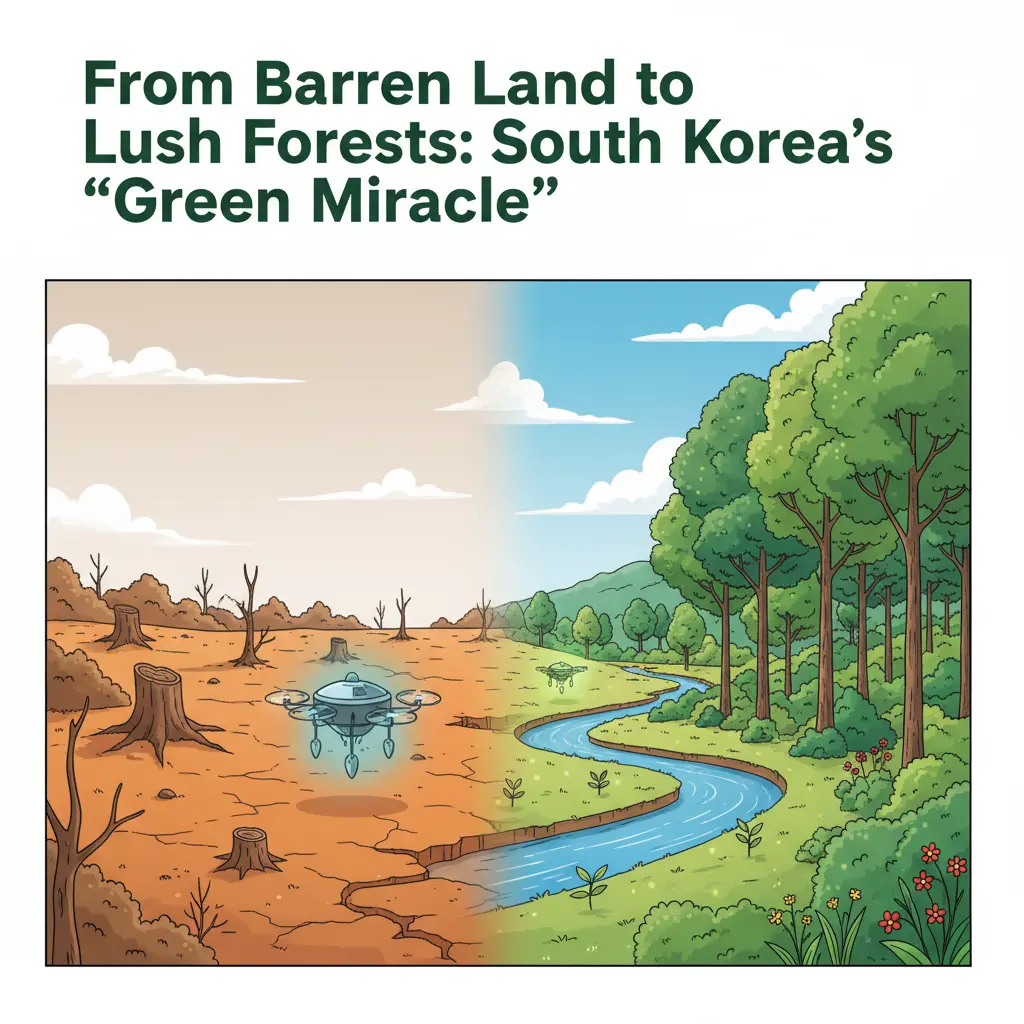
Life Returning from the Ashes
Immediately after the Korean War, South Korea's mountains were completely bare. Without trees to hold the soil, heavy rains led to constant floods, and people struggled to find firewood. At the time, international experts believed it was impossible for forests to ever grow back on this land.
"South Korea's reforestation is one of the most remarkable human achievements of the 20th century." — Evaluation by international environmental organizations
Three Keys to the Miracle
South Korea’s success in reforestation (the process of planting trees to create a forest) was due to a systematic strategy that went beyond simple planting.
- Nationwide Participation: Through 'Arbor Day' (a designated day for planting trees), everyone from children to the elderly joined the effort.
- Strong Government Will: The government established the Korea Forest Service and made greening the nation a top priority, strictly banning illegal logging.
- Scientific Selection: They chose tree species (such as Acacia) that could survive even in poor soil conditions, significantly increasing the survival rate.
Gifts of the Forest and Our Future
Today, approximately 63% of South Korea's land is covered in thick, green forests. These forests act as a 'Green Dam', purifying the air and storing vast amounts of water to prevent natural disasters.
Recently, their value has grown even further as carbon sinks to fight climate change (the phenomenon where the Earth warms up due to greenhouse gases). The forests we have nurtured are now the most precious economic asset and source of life for future generations.