The National Assembly’s Industry, Trade, Energy, SMEs and Startups Committee (산업통상자원중소벤처기업위원회) will begin its annual audit on October 6, examining policies pursued by the Lee Jae-myung administration. According to a report by The Hankyoreh, the ruling and opposition parties are expected to clash over a Honam semiconductor cluster worth 800 trillion won and $200 billion in investment in the United States. The easing of working-hour regulations for semiconductor R&D employees and the merger of public institutions are also set to be discussed.
Background and context
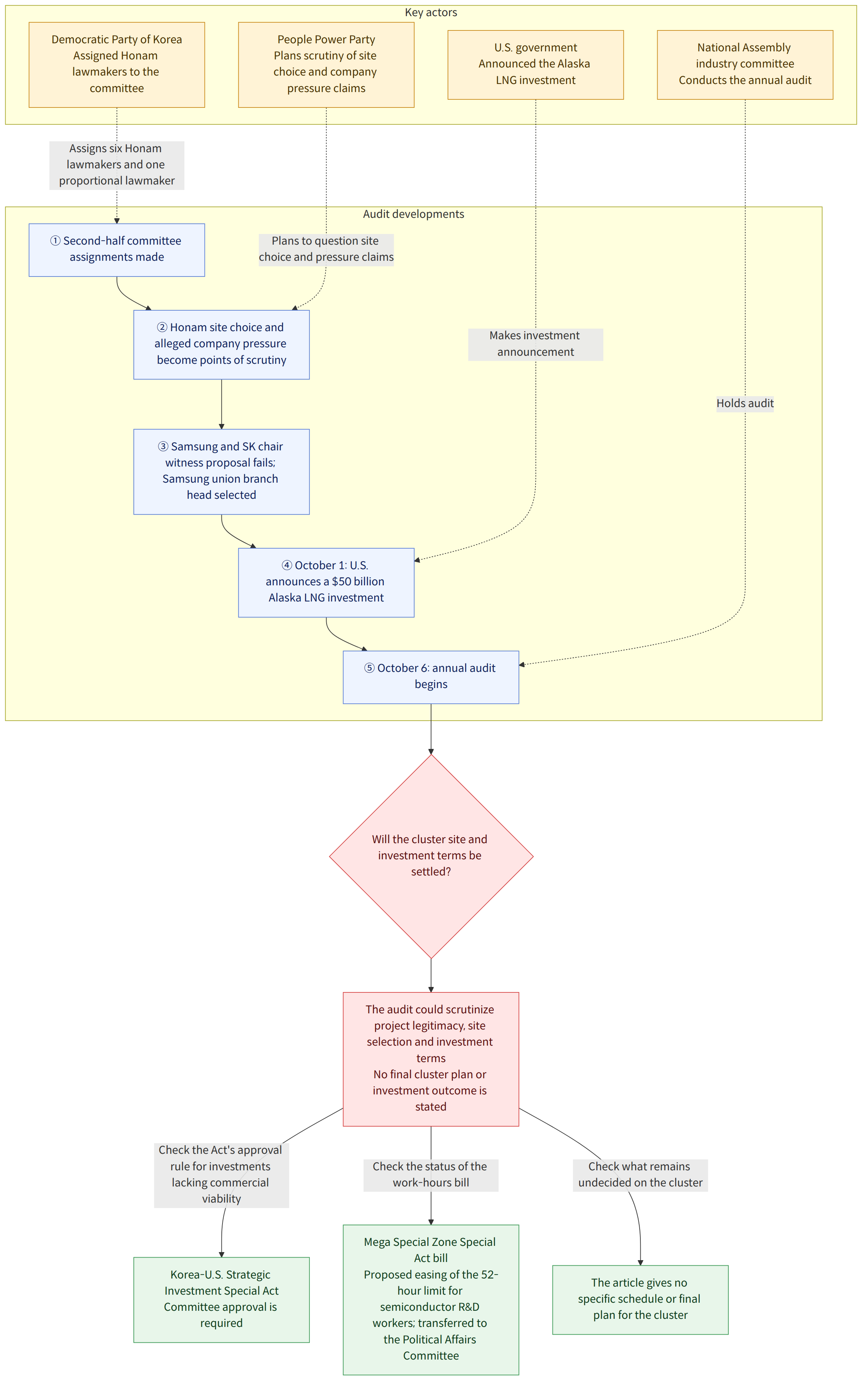
The People Power Party (국민의힘) reportedly plans to focus on whether companies were pressured during the pursuit of three major megaprojects in the Honam, Chungcheong, and Yeongnam regions. On the choice of location for the semiconductor cluster, it has challenged the decision with questions to the effect of: Why Honam, and not Daegu or North Gyeongsang Province? In response, the Democratic Party of Korea (더불어민주당) assigned six Honam lawmakers and one proportional-representation lawmaker to the committee when the National Assembly’s committee assignments were made for the second half of the year.
The two parties also sparred over the selection of witnesses. The People Power Party strongly called for Samsung Electronics Chairman Lee Jae-yong and SK Group Chairman Chey Tae-won to be called as witnesses, but the proposal failed during discussions between the parties’ floor committee secretaries. However, Choi Seung-ho, head of the Samsung Electronics branch of the Samsung Group Supermajority Union, was selected as a witness for the October 6 audit in connection with Samsung Electronics’ performance bonuses.
The dispute over U.S. investment arose after reports that, on October 1, just before the audit, the United States unilaterally announced a $50 billion investment in liquefied natural gas (LNG, natural gas converted into liquid fuel) in Alaska. According to the article, a ruling-party member of the committee said the government was putting the brakes on the investment by citing commercial rationality and domestic legal procedures, and that parliamentary approval was also necessary. The report explains that, under the Korea-U.S. Strategic Investment Special Act (한미전략투자특별법), investments that are not commercially viable require the committee’s approval.
The Mega Special Zone Special Act bill (메가특구특별법안), which includes easing the 52-hour workweek regulations for semiconductor R&D employees, was transferred from the committee to the Political Affairs Committee (정무위원회). On the Comprehensive and Progressive Agreement for Trans-Pacific Partnership (CPTPP·포괄적·점진적 환태평양동반자협정), which the government is seeking to join again, the expectation is that lawmakers from both parties representing rural districts will emphasize gathering public input.
What this news means
The debate over the Honam cluster could lead the National Assembly to scrutinize not only the scale of the investment but also the legitimacy of the project’s development process and site selection. The People Power Party’s allegations of pressure on companies and the Democratic Party’s assignment of lawmakers from the region show that regional representation and corporate decision-making may both come into focus during the audit, regardless of whether the project is actually pursued. The article does not, however, say whether companies were in fact pressured or provide a specific schedule or final plan for the cluster.
On U.S. investment, the commercial viability of the investment itself, domestic procedures, and parliamentary approval were raised as issues separate from the two parties’ usual political divisions over trade. Given the report’s statement that investments lacking commercial viability require the committee’s approval, the committee’s review could be linked to the National Assembly’s role in determining investment terms. It is also notable that the committee chair is Kim Seong-won of the People Power Party, but that alone cannot be used to predict the outcome of subsequent negotiations or votes.
For example, someone looking for semiconductor-related work in Honam or another region could follow how the audit addresses the direction of the project and discussions of working-hour regulations. But the fact that these issues are on the audit agenda does not mean that an investment has been finalized or working conditions have changed.
Related laws and support information
The Mega Special Zone Special Act bill was reported to include easing the 52-hour workweek regulations for semiconductor R&D employees, but the article does not specify the bill’s precise scope, when it would take effect, or the outcome of its consideration. The discussion should therefore not be interpreted as meaning that current working-hour rules have changed.
An in-house legal guide (L1) advises workers to distinguish actual working hours from break time. Its explanation that overtime pay may be recognized for work exceeding 40 hours a week is subject to the condition that the workplace has at least five employees; it also notes that break-time rules apply to workplaces with four or fewer regular employees. The guide also says that pregnant employees cannot be required to work overtime, but whether this applies in a particular case depends on the actual work arrangement and conditions.
For R&D employees, it is therefore important to distinguish discussion of easing regulations from the working conditions that currently apply. They should check clock-in and clock-out records separately from the time they were actually able to take breaks, and consider workplace size and employment arrangements as well. This is general legal guidance; it does not explain the bill’s detailed provisions or any separate standards that might apply to this occupational group.
What is confirmed and what remains unknown
Confirmed facts
- The committee’s annual audit begins October 6, and the Honam semiconductor cluster and investment in the United States have been reported as major issues.
- The People Power Party plans to question whether companies were pressured during the three megaprojects; the proposal to call Chairmen Lee Jae-yong and Chey Tae-won as witnesses failed during discussions between the parties’ committee secretaries.
- The article explains that, under the Korea-U.S. Strategic Investment Special Act, investments in the United States that are not commercially viable require the committee’s approval.
- The Mega Special Zone Special Act bill was transferred to the Political Affairs Committee, and union leaders from related institutions were selected as reference witnesses for the public-institution audit on October 19.
What remains unknown
- The article does not say how discussions between South Korea and the United States over the Alaska LNG investment will proceed.
- The specific schedule and final plan for the Honam semiconductor cluster have not been confirmed.
- The article alone does not establish the basis for the allegations of pressure on companies that may be raised during the audit, the results of any investigation, how the Mega Special Zone Special Act bill will be handled, or whether working conditions will actually change.
What readers should check
- Semiconductor R&D employees should distinguish discussion of the bill from the working conditions currently in effect, and check their actual working-hour and break-time records as well as the size of their workplace.
- Regarding U.S. investment, readers can check which projects are actually subject to the National Assembly committee’s approval process and follow any discussions or reviews subsequently made public through official channels.
- Anyone interested in regional semiconductor projects should separately check the project schedule and plans confirmed during the audit, and the findings of any investigation into whether companies were pressured.