
When I encountered a Sumatran rhino at a sanctuary in Malaysian Borneo in late 1998, the global population was estimated at about 300. According to the International Rhino Foundation’s 2026 “State of the Rhino” report, fewer than 50 remain today, and all live in Indonesia. The Javan rhino population is also estimated at about 50, and those animals are all concentrated in one national park on the Indonesian island of Java.
The crisis facing the two species is about more than their small numbers. Sumatran rhinos are scattered across several subpopulations on two islands, making it unlikely—or perhaps impossible—for some to encounter one another. Javan rhinos are concentrated in a single area, so a disaster affecting their habitat could affect the entire species.
Background and context
Rhinos often appear in popular culture as symbols of power and resilience, but that familiarity can lead people to underestimate their actual numbers and risk of extinction. Of the five rhino species alive today, the Sumatran rhino and the Javan rhino are critically endangered. The population figures in this article are estimates, and the report emphasizes just how precarious the situation is, given the decline of both species and their unstable distribution.
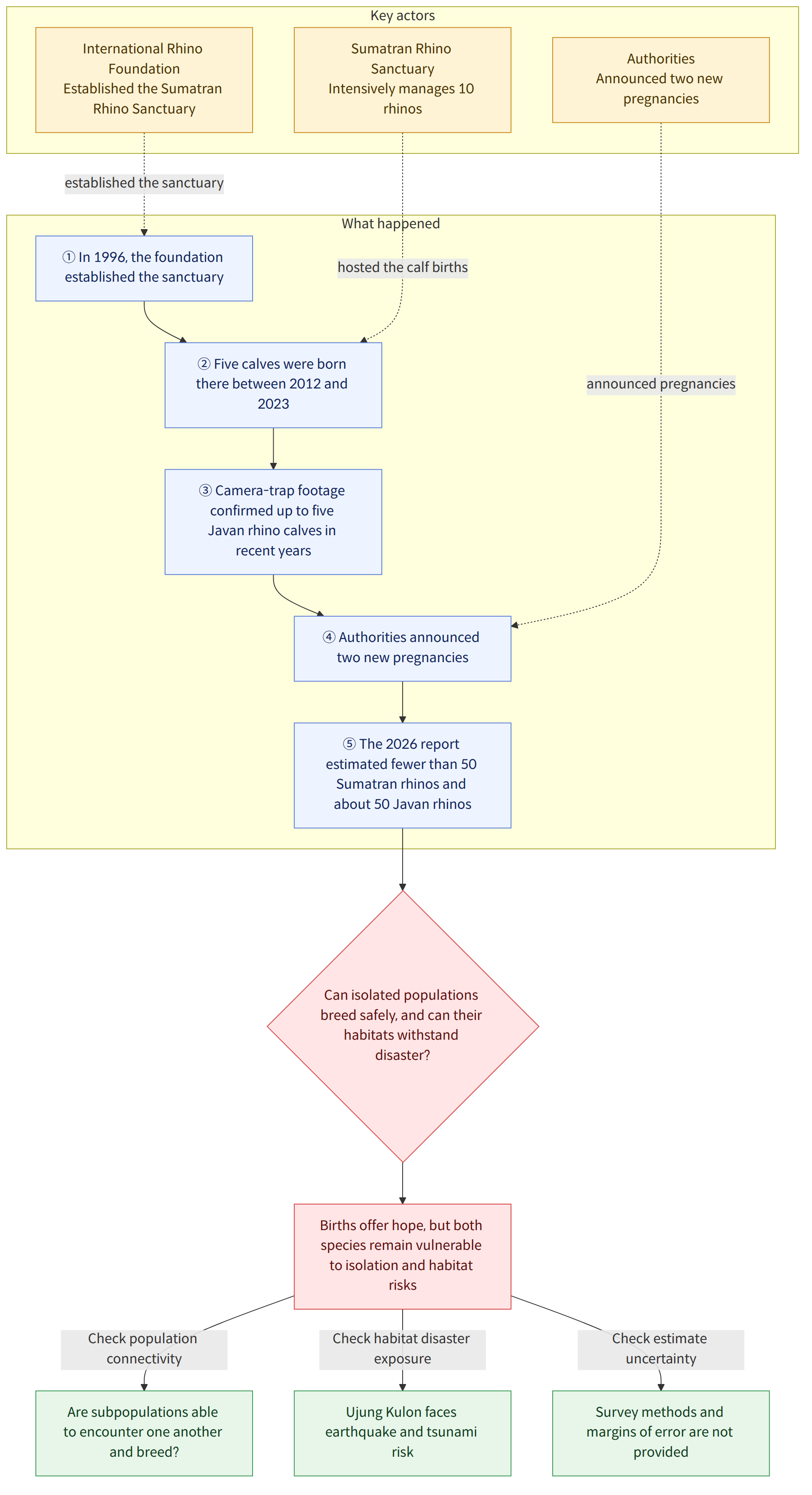
About 50 Javan rhinos live in Ujung Kulon National Park (우중쿨론 국립공원) on the island of Java. The report says that tectonic plates converge near the park, leaving the area vulnerable to earthquakes and tsunamis. A single natural disaster could therefore threaten the entire population, which is concentrated in one place.
The Sumatran rhino faces a different kind of risk. The few dozen that remain live in several separate subpopulations, making encounters between wild rhinos unlikely. The article also notes that if an animal cannot find a mate, its genetic line may not continue.
What this news means
Protecting the two species means not only safeguarding the remaining animals but also creating conditions in which they can actually breed. Female Sumatran rhinos carry their young for about 16 months and give birth to one calf at a time; it may be several years before the next birth. That is why even breeding successes do not necessarily mean the population will grow quickly. According to the article, infertility is also recognized as a problem in some rhinos.
To protect the scattered Sumatran rhino populations, the International Rhino Foundation established the Sumatran Rhino Sanctuary (수마트라코뿔소 보호구역) in Way Kambas National Park (와이캄바스 국립공원) on the island of Sumatra in 1996. The sanctuary is now home to 10 intensively managed, semi-captive Sumatran rhinos. They live in a large natural forest habitat and receive nutritional support, security, and regular veterinary care.
Through breeding management and monitoring, five calves were born at the sanctuary between 2012 and 2023. Authorities have also announced two new pregnancies. On Java, camera-trap footage from Ujung Kulon has confirmed that up to five Javan rhino calves have been born in recent years. These are signs that breeding is continuing, but they do not eliminate the vulnerability of the two species, each of which has only a small population.
The birth of a calf is a sign of hope, but the risks posed by isolated populations and disaster-prone habitats remain.
For example, if a Sumatran rhino lives somewhere it is highly unlikely to encounter another subpopulation, breeding successes at a sanctuary do not guarantee that animal an opportunity to breed. This is a hypothetical example illustrating how population fragmentation affects breeding; the article does not provide the location or status of any particular wild rhino. It is why conservation progress for both species must be assessed not only by the number of births but also by the connectivity of populations and the safety of their habitats.
What is confirmed and what remains unknown
Confirmed facts
- The International Rhino Foundation’s 2026 report says that fewer than 50 Sumatran rhinos remain and that they all live in Indonesia.
- About 50 Javan rhinos remain, and they all live in Ujung Kulon National Park.
- The Sumatran Rhino Sanctuary has 10 animals under intensive management in semi-captive conditions.
- Five calves were born at the sanctuary between 2012 and 2023, and authorities have announced two new pregnancies.
- Camera-trap footage confirmed that up to five Javan rhino calves have been born in Ujung Kulon in recent years.
What remains unknown
- The article does not provide the specific survey methods used to estimate the populations of the two species or the margin of error for those estimates.
- The article alone does not reveal any additional conservation plans to connect the populations or reduce the risk of earthquakes and tsunamis in Ujung Kulon.
What readers should check
- When reading population estimates, check whether the date of the survey, the estimation method, and the margin of error are also provided.
- When reading reports of births or pregnancies, distinguish the number of confirmed calves from estimates of the total population.
- In follow-up coverage, look for details on plans to connect Sumatran rhino populations and conservation measures to reduce disaster risks in Ujung Kulon.