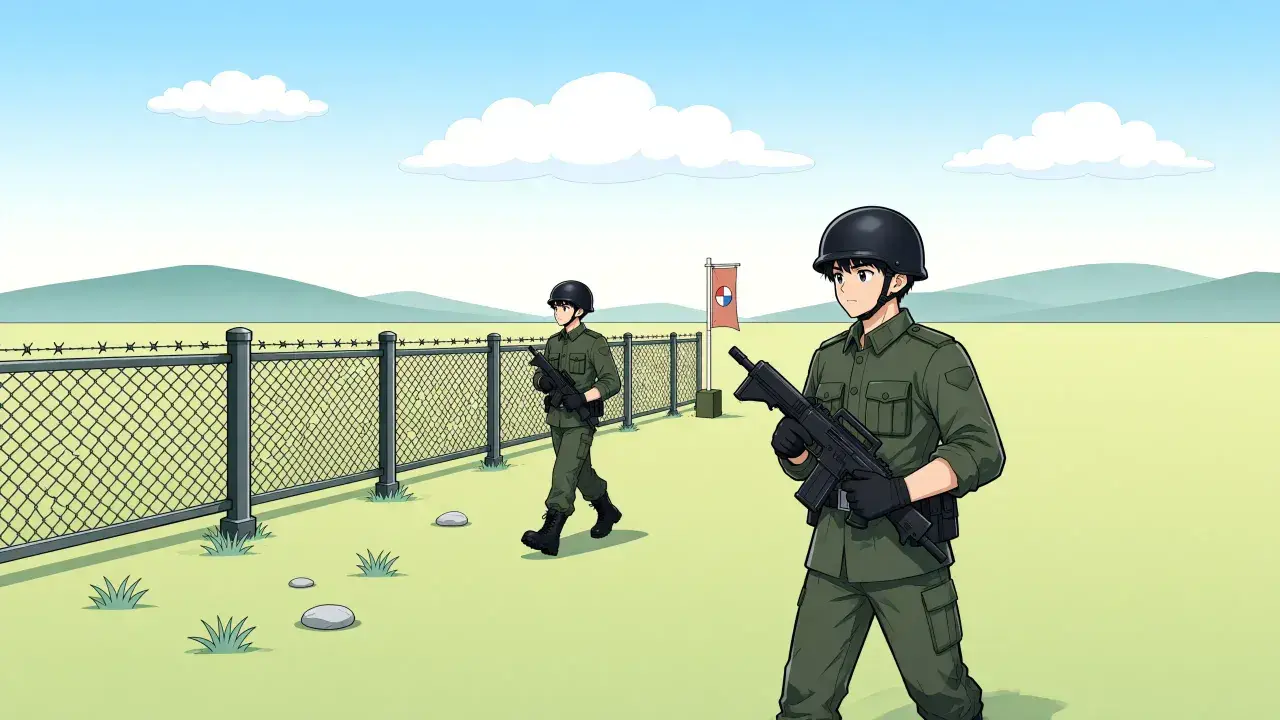
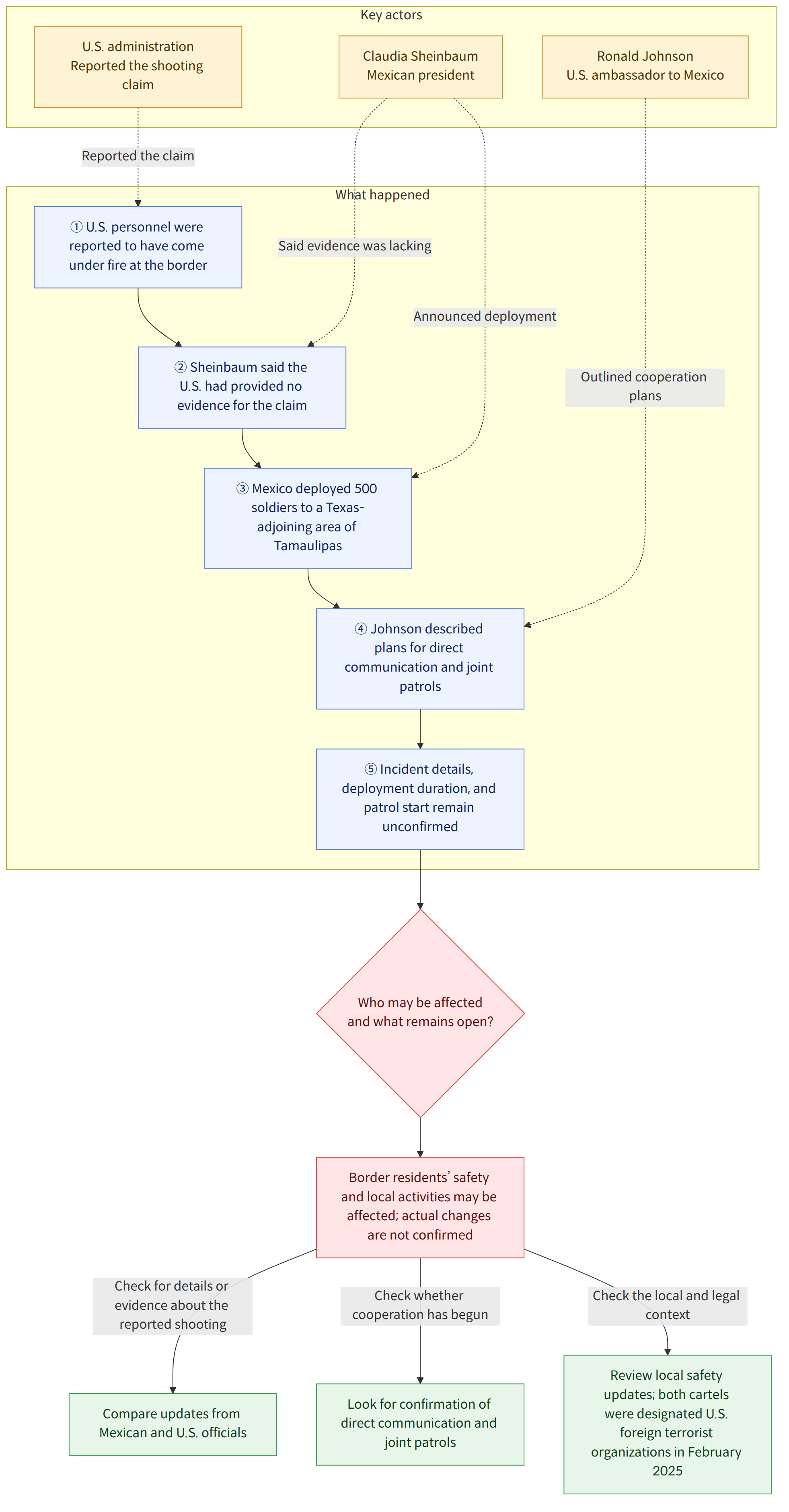
Mexico deployed 500 soldiers to a border area adjoining Texas after a report of a shooting involving the United States. Mexican President Claudia Sheinbaum announced the deployment at her regular Monday news conference. The troops were sent to an area of Tamaulipas state where the rival Northeast Cartel and Gulf Cartel are fighting for control.
However, President Sheinbaum said the Trump administration had not provided evidence to support the shooting claim. While noting the lack of evidence, she said Mexico had decided to deploy troops along the Rio Grande. With questions still unresolved between the U.S. account and the Mexican president’s account, the troop deployment and security cooperation between the two countries are both drawing attention.
Background and context
The deployment came after U.S. personnel were reported to have come under fire at the border. President Sheinbaum said the United States had reported that “there had been a shooting at the Mexican border,” but added that the U.S. government had not provided evidence related to the claim. On the accounts presented so far, it is therefore difficult to determine exactly how the shooting occurred or what material supports the claim.
Ronald Johnson, the U.S. ambassador to Mexico, described the U.S. account in a post on X. He wrote that U.S. Coast Guard personnel had come under fire. He said the newly deployed Mexican troops would communicate directly with U.S. forces, and wrote that the two sides would patrol both sides of the border together, protect communities, and make it harder for criminal and terrorist organizations to operate. This is the ambassador’s stated approach to cooperation; it does not mean joint patrols have already begun.
The security context in the deployment area is also important. In the area of Tamaulipas state where Mexican troops were sent, the Northeast Cartel and Gulf Cartel are fighting for control. The United States designated both organizations as foreign terrorist organizations in February 2025. This designation and the local power struggle indicate that the deployment is connected not only to routine border security but also to the two countries’ proposed cooperation to make it harder for criminal and terrorist organizations to operate.
What this news means
The move involves both border security cooperation and uncertainty about the facts. Mexico deployed troops following the U.S. report, and the U.S. ambassador announced direct communication between the two countries’ militaries and joint patrols. At the same time, the Mexican president said the United States had not provided evidence. This means that, alongside the need for cooperation, the information underlying the response and how the two countries verify the incident may become important.
Patrols by the two countries and efforts to counter criminal organizations could affect safety and local activities for people living in the border region. However, based on what has been confirmed so far, it is not known what changes residents’ daily lives have seen or when joint patrols will begin. For example, people who live or travel in the deployment area of Tamaulipas state may find it useful to check whether patrols have actually begun and to review safety information issued by local authorities. This is a hypothetical example; it does not mean that any travel restrictions or specific risks have been confirmed.
Confirmed facts and what is still unknown
Confirmed facts
- President Sheinbaum said Monday that Mexico had deployed 500 soldiers to the border adjoining Texas.
- The troops were sent to an area of Tamaulipas state where the Northeast Cartel and Gulf Cartel are fighting for control.
- President Sheinbaum said the United States had reported a shooting, but that the Trump administration had not provided evidence.
- Ambassador Johnson wrote that U.S. Coast Guard personnel had come under fire and announced plans for direct communication between Mexican and U.S. forces and joint patrols on both sides of the border.
- The United States designated the Northeast Cartel and Gulf Cartel as foreign terrorist organizations in February 2025.
What is still unknown
- When and where exactly did the shooting occur?
- Was anyone injured in the shooting?
- Has the U.S. side provided evidence related to the shooting claim?
- How long will the Mexican troop deployment at the border last?
What readers should check
- It is worth checking what further information the Mexican government and U.S. officials provide about the time and location of the shooting and any evidence.
- Readers can look for confirmation of whether the direct communication and joint patrols announced by Ambassador Johnson have actually begun, and whether the areas and procedures involved are specified.
- Residents of or visitors to the deployment area of Tamaulipas state should check for any new local safety guidance or travel notices.