
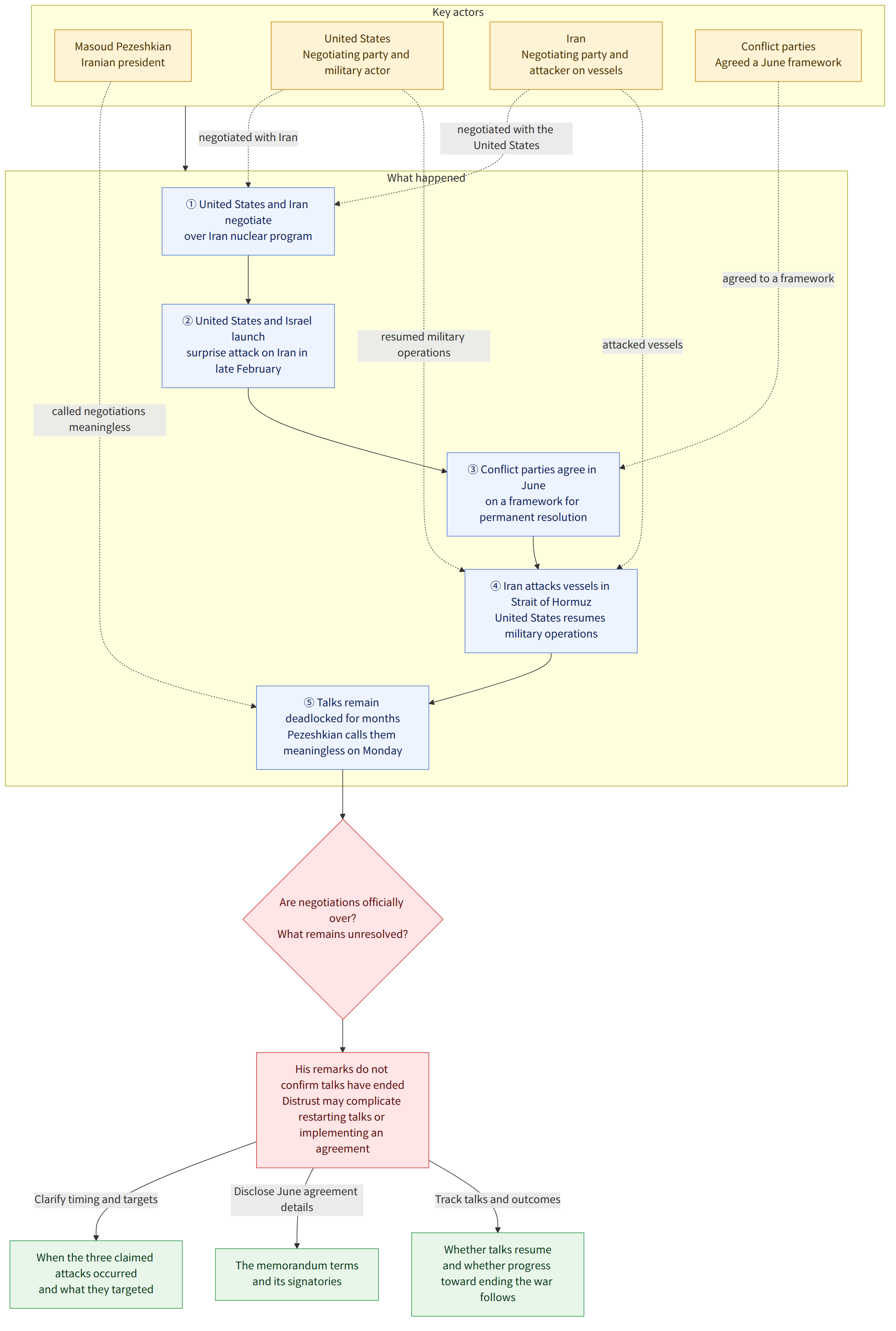
Iranian President Masoud Pezeshkian said Monday that negotiations with the United States were “meaningless,” Iranian state media reported. He said he had been attacked three times since negotiations and claimed that the United States aims to overthrow the Islamic Republic of Iran, not to engage in dialogue. The remarks came as discussions to end the war have been deadlocked for months.
This is the Iranian president’s assessment of and claim about the negotiations. The report provided does not establish when the three attacks he referred to took place or what they involved.
Background and context
According to the report, the war in the Middle East began in late February, when the United States and Israel launched a surprise attack on Iran. At the time the attack began, the United States and Iran were negotiating over Iran’s nuclear program. The talks that had been underway before the war and the military clashes that followed are thus interwoven as different phases of the same events.
The parties to the conflict agreed in June to a memorandum of understanding outlining a framework for a permanent resolution of the conflict. However, U.S. military operations resumed after Iran attacked vessels in the Strait of Hormuz, and progress toward ending the war has been deadlocked for months, the report said. The fact that fighting resumed despite the memorandum shows that the existence of an agreement alone did not end the conflict.
What this news means
Pezeshkian’s remarks reveal Iran’s distrust of whether negotiations can continue. However, one president’s statement alone does not establish that negotiations between the United States and Iran have officially ended. What is currently confirmed is his claim that attacks occurred after negotiations and the report that discussions to end the war have been deadlocked for months.
A diplomatic solution requires confidence that dialogue can continue. If one side describes negotiations themselves as meaningless, it may become more difficult to resolve questions about the conditions for restarting talks or implementing an agreement. This is a possibility that can be considered in light of the remarks and the current deadlock; it does not determine the outcome of future negotiations.
For example, even if the two sides resume dialogue, it may remain uncertain whether talks will lead to an end to the war if questions about attacks and the fulfillment of commitments are unresolved. The report does not provide specific terms of an agreement or a schedule for follow-up negotiations that would address these questions.
What is confirmed and what remains unknown
Confirmed facts
- Iranian state media reported that Pezeshkian said Monday that negotiations with the United States were “meaningless.”
- He claimed that he had been attacked three times since negotiations.
- According to the report, the war began in late February with a surprise U.S. and Israeli attack on Iran, and the United States and Iran were negotiating over Iran’s nuclear program at the time.
- The parties to the conflict agreed in June to a memorandum of understanding outlining a framework for a permanent resolution, but U.S. military operations resumed after Iran attacked vessels in the Strait of Hormuz.
- The report said that progress toward ending the war has been deadlocked for months.
What remains unknown
- When did each of the three attacks Pezeshkian said occurred after negotiations take place, and what attacks was he referring to?
- What were the specific terms of the June memorandum of understanding, and who were its signatories?
- What did the negotiation-related passage that was cut off at the end of the report say, and what is the current status of negotiations?
What readers should watch for
- Follow-up reporting should clarify when the three attacks Pezeshkian referred to took place and what they targeted.
- Further disclosures about the parties and terms of the June memorandum of understanding, and the circumstances in which military operations resumed after the agreement, could help explain where the negotiations stalled.
- It is important to distinguish between whether negotiations resume and whether discussions to end the war make progress. Even if talks begin again, that alone would not confirm that the conflict has been resolved.