
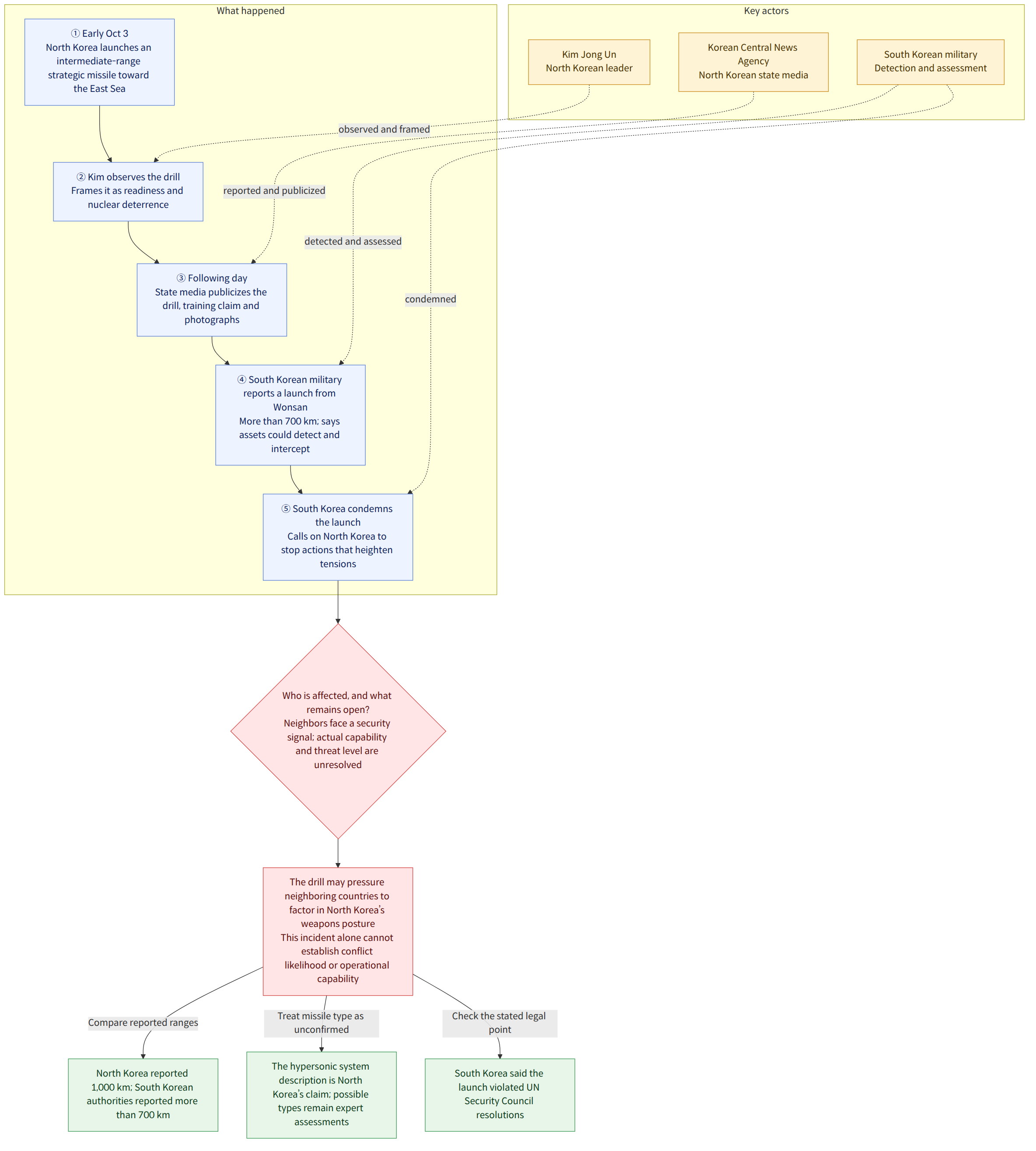
North Korean state media reported the following day that leader Kim Jong Un observed a drill involving the launch of an intermediate-range strategic missile toward the East Sea in the early hours of October 3. The Korean Central News Agency (조선중앙통신) described the purpose of the drill as training for a missile unit to operate a “hypersonic strategic weapons system.” Kim said it was important to show that North Korea was ready to deploy its counterattack capabilities at any time, and presented the launch as an exercise of deterrence and an effort to advance nuclear war deterrence more rapidly.
Background and context
What matters in this report is not only the launch itself, but also how North Korea’s leadership explained its significance. Kim said the other side must remain aware of the reliability and “lethality” of North Korea’s strategic strike capabilities. North Korea thus presented the missile drill as both a display of military readiness and part of strengthening its nuclear deterrent.
North Korean state media also described the drill as an effort to hone the missile unit’s operational capabilities and assess the reliability, effectiveness and readiness of its war deterrent. Released photographs showed Kim, his daughter Ju Ae and his wife Ri Sol Ju observing the launch. North Korea’s reports and photographs show the message the country sought to convey by publicizing the drill at home and abroad, but they do not, on their own, independently verify the missile’s actual performance.
The missile’s type and flight profile should also be described with care. North Korea said the drill was intended to train forces to operate a “hypersonic strategic weapons system.” According to one report, experts suggested that the missile could have been a Hwasong-16na or a hypersonic intermediate-range ballistic missile, citing details such as the description of changes to its flight path published by North Korean media. This is an assessment of what is possible, not confirmation of the missile’s type based on publicly available information.
What this news means
By directly linking the launch to nuclear war deterrence, North Korea made the drill a demonstration of its military message as well as a weapons test. North Korea described making the other side aware of the reliability and lethality of its offensive capabilities as an exercise of deterrence. While it claims that this approach is preparation to prevent an attack, it can also serve as pressure on neighboring countries by making them continually factor North Korea’s weapons development and military posture into their calculations.
South Korea’s Ministry of National Defense (국방부) was reported to have assessed that the missile fell within the range in which South Korean and U.S. military assets could detect and intercept it. It also condemned North Korea’s ballistic missile launch as a violation of United Nations Security Council resolutions and called on it to stop actions that heighten tensions. Since North Korea’s display of deterrence and South Korea’s emphasis on its ability to detect and intercept the missile are both part of the reporting, readers should distinguish between the accounts of the different parties rather than treating North Korea’s claims alone as conclusive about the threat level or assuming that South Korea’s assessment means the risk has been eliminated.
For example, readers following the security situation on the Korean Peninsula might view this report as a signal of how North Korea justifies its nuclear deterrent. This incident alone, however, cannot establish the likelihood of an actual conflict or the missile’s operational capabilities. It is important to treat North Korea’s statements, the South Korean Ministry of National Defense’s assessment and launch details that have not yet been made public as distinct types of information.
Where reports differ
Reports from different sources gave different flight distances. North Korean state media reported that the missile was launched northeast and hit a target 1,000 km away over the East Sea. South Korean military authorities, by contrast, said they detected a ballistic missile launched from the Wonsan area toward the East Sea and that it flew more than 700 km. Since the two figures come respectively from North Korea’s account and the South Korean military’s detection report, it is difficult to treat either one as the confirmed flight distance.
The descriptions of the launch direction also differ. North Korea’s report referred to a northeastern direction and a target over the East Sea, while the South Korean account described the launch as being toward the East Sea. These are differences in how the launch direction was described; the full flight path cannot be compared using the publicly available information alone.
What is confirmed and what remains unknown
Confirmed facts
- North Korea conducted a missile launch drill toward the East Sea in the early hours of October 3, and state media reported the following day that Kim Jong Un had observed it.
- North Korea described the drill as training for a missile unit to operate a “hypersonic strategic weapons system.”
- Kim said it was important to show that North Korea’s counterattack capabilities were ready for use at any time, and said the launch was an exercise of deterrence and a means of advancing nuclear war deterrence.
- North Korean state media reported that the missile hit a target 1,000 km away, while South Korean military authorities said they detected it flying more than 700 km.
- The South Korean Ministry of National Defense was reported to have assessed that the missile was within the detection and interception range of South Korean and U.S. military assets, and to have condemned the launch as a violation of United Nations Security Council resolutions.
What remains unknown
- The launch’s detailed results, including the actual flight distance, speed and full flight path, are difficult to establish based only on the publicly available accounts.
- It is not known whether the missile’s exact type and the performance of the flight profile claimed by North Korea have been independently verified.
- The reports provided do not establish what official responses other countries issued after the launch.
What readers should watch for
- When reviewing subsequent announcements about flight distance, it is useful to distinguish by source between North Korea’s claim that it hit a target and the figures reported by South Korean military authorities.
- If terms such as “hypersonic” or the name of a specific missile type appear, readers should check whether they come from North Korea’s statement, an expert’s assessment of what is possible, or independently verified information.
- Checking whether the South Korean Ministry of National Defense issues a follow-up assessment and whether neighboring countries make official responses can provide further insight into the military significance of the launch and how each country responds.
References
- Other coverage consulted: en.yna.co.kr
- Other coverage consulted: hani.co.kr