U.S. Secretary of State Marco Rubio said Monday that the United States is closely watching the case of an employee of the Irkutsk Anti-Plague Research Institute of Siberia and the Far East (시베리아·극동 이르쿠츠크 항페스트 연구소) who fell ill and died. Russian authorities said the cause of death was pneumonia, and reports said authorities had quarantined dozens of people. Rubio said the situation did not warrant sounding the alarm, but that it needed to be watched closely and continuously.
Background and context
The employee who died was reported to be 28 years old. However, reports differ on when and where the employee fell ill. The circumstances of the death also cannot be established in detail from the information made public.
Russian authorities said the employee died of pneumonia. Other reports said the cause of the pneumonia was unknown and that Russian authorities had found no evidence that the employee became ill because of a pathogen they had handled. Unconfirmed media reports raised the possibility of pneumonic plague (a severe form in which the plague bacterium infects the lungs and can be transmitted between people), but this is not a confirmed cause of death.
The head of Russia’s health surveillance agency traveled to the region. According to another report, a hospital was placed under quarantine and contacts were put under observation. The hospital reportedly stopped admitting patients and discharging them, and routine testing at its laboratory was suspended, while its outpatient clinic continued to operate as usual.
What this news means
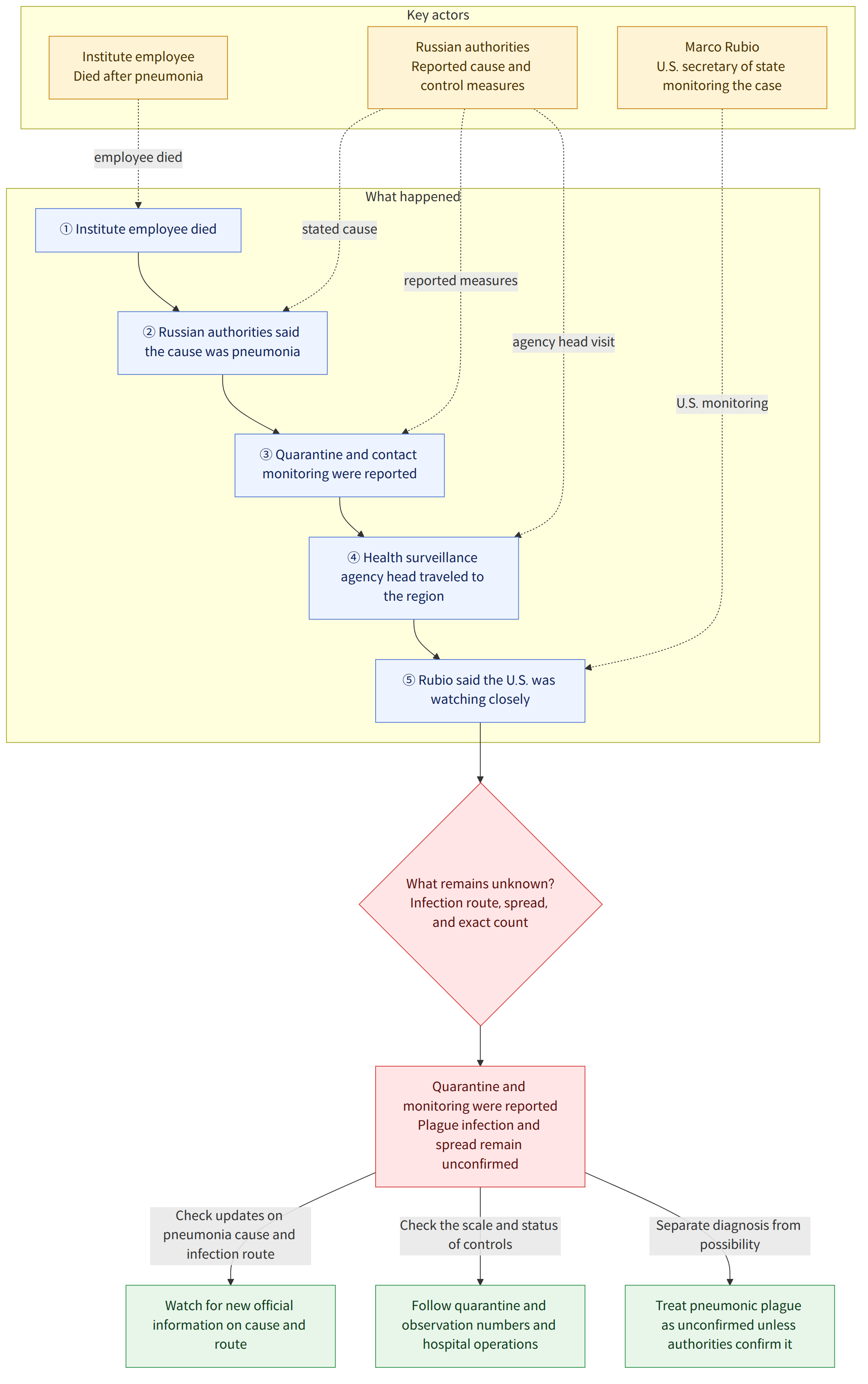
What has been confirmed in this case is the death of an institute employee, the authorities’ statement that the cause was pneumonia, and the authorities’ quarantine and monitoring measures. By contrast, it has not been confirmed how the employee became infected, whether the disease spread inside the institute, or whether it spread beyond the institute. It is therefore important not to treat plague infection or community spread as confirmed.
Rubio said that, based on information made public by Russia, the situation appeared to involve concern that a laboratory employee had become infected and that the disease may have spread internally. This is a concern conveyed by the U.S. secretary of state, not an announcement confirming infection or spread. He also added that travel between the United States and Russia is very limited.
For example, readers following this case can distinguish between the fact that “quarantine measures were taken” and the claim that “plague was confirmed.” The information currently available supports the former, while the latter has only been raised as a possibility in unconfirmed reports.
What different reports said
Reports focused on different aspects of the case. One reported Rubio’s statement that the United States was monitoring the situation and that authorities had quarantined dozens of people, while another detailed the fact that the cause of the pneumonia was unknown and described measures to manage the hospital and contacts.
Reports said there were discrepancies about when and where the employee fell ill, but did not provide details that would resolve them. One report, citing local television, said the employee died last week at a hospital in Shelekhov. The exact number of people quarantined has also not been confirmed beyond the description “dozens.”
What is confirmed and what remains unknown
Confirmed facts
- The deceased was an employee of the Irkutsk Anti-Plague Research Institute of Siberia and the Far East and was reported to be 28 years old.
- Russian authorities said the cause of death was pneumonia.
- The United States is closely monitoring the case, and Rubio said it warranted attention.
- Quarantine and monitoring measures by authorities, as well as the visit to the region by the head of Russia’s health surveillance agency, were reported.
What remains unknown
- How did the researcher actually become infected?
- Did the disease spread inside the institute or beyond it?
- Exactly how many people were quarantined or placed under observation?
- What caused the pneumonia, and was it connected to a pathogen the employee had handled?
What readers should watch for
- In follow-up reports, check whether authorities have provided new information about the cause of the pneumonia or the route of infection.
- You can check how the number of people under quarantine or observation and the hospital’s operations have changed, while distinguishing reported information from official statements.
- When a specific disease name such as pneumonic plague appears, distinguish between a confirmed diagnosis and an unconfirmed possibility.
References
- Other coverage consulted: koreatimes.co.kr