
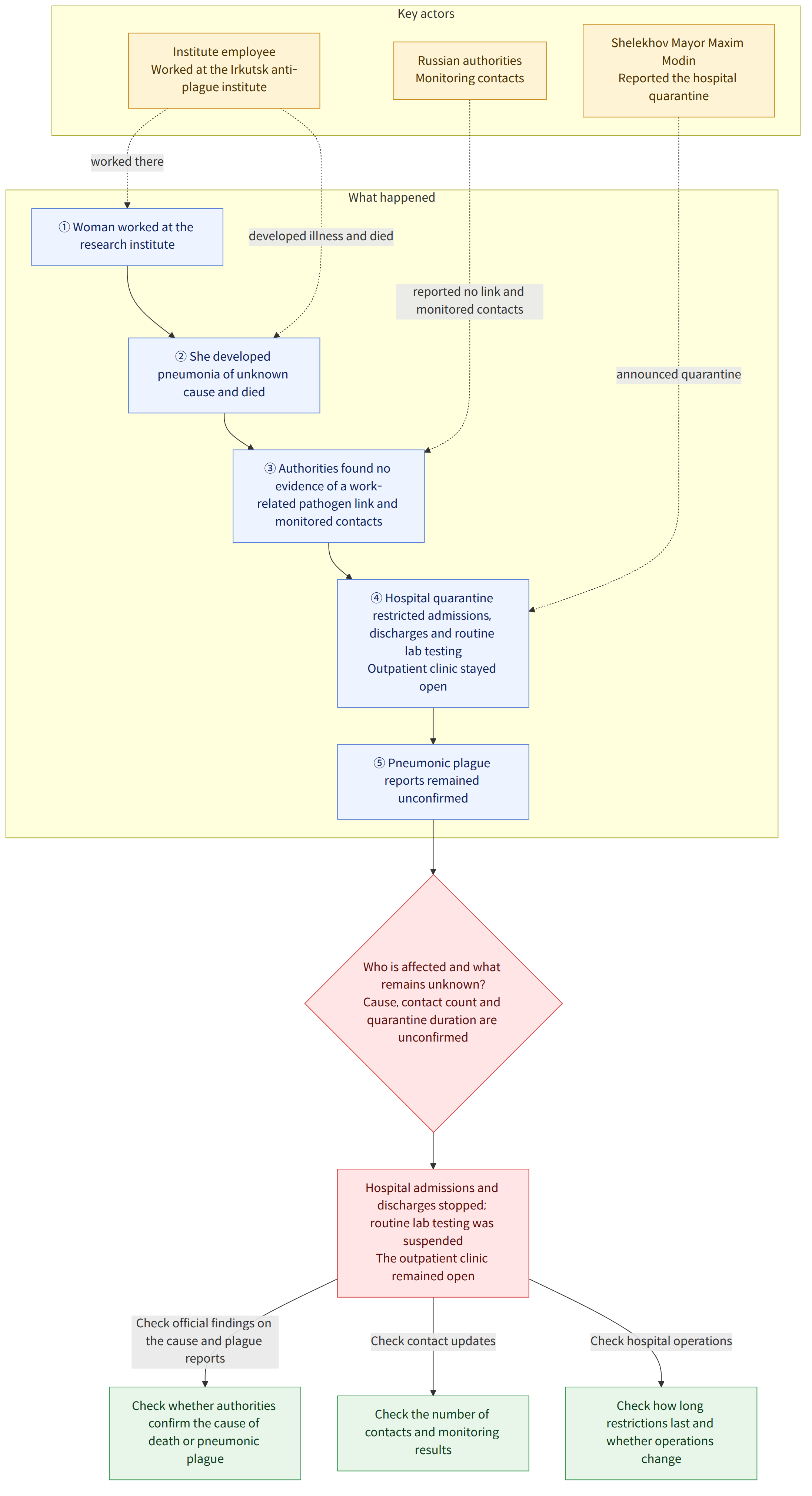
A woman who worked at a plague research institute in Irkutsk, Siberia, died in hospital after developing pneumonia of unknown cause. Authorities said they had found no evidence that she became ill because of a pathogen she handled at work.
Background and context
The woman worked at the Irkutsk Anti-Plague Research Institute of Siberia and the Far East. Irkutsk state television reported on Monday that she died last week at a hospital in Shelekhov, outside Irkutsk.
Pneumonic plague is a relatively rare but severe form of plague that can spread from person to person. Unconfirmed media reports raised concerns by suggesting that the woman may have died of pneumonic plague, but this has not been confirmed as the cause of death.
Shelekhov Mayor Maxim Modin said on Friday that the hospital had been quarantined and was no longer admitting or discharging patients. The hospital’s laboratory had suspended routine testing, but the outpatient clinic was operating as usual, Mayor Modin said.
What this news means
The response is being carried out amid uncertainty about the cause of an unexplained death and the possibility of transmission, rather than because the cause of an infectious disease has been established. Authorities have said they found no evidence linking the disease to pathogens handled at the research institute, but the hospital quarantine and monitoring of contacts are continuing. The response currently known should therefore not be taken as confirmation of a pneumonic plague outbreak.
The hospital quarantine restricts patient admissions and discharges, while the outpatient clinic remains open. These measures together show that care at the entire hospital has not stopped, but that admissions, discharges and laboratory operations have been restricted. However, the reports available do not say which tests were affected by the suspension of routine laboratory testing or how long the quarantine will remain in place.
For example, residents in the area should not conclude from this news alone that they have been exposed to infection. Instead, they should check whether authorities release further information about the results of contact monitoring and changes to hospital operations. This can help distinguish unconfirmed reports from confirmed public health measures.
Points reported differently
Reports differed on the number of contacts. One report said only that authorities were monitoring contacts, while another said dozens of people had been quarantined. The specific number and the monitoring results have not been confirmed.
Accounts of the woman’s condition and the circumstances of her death also differed. One report said she died last week at the Shelekhov hospital, while another said there were conflicting accounts of how and where she became ill. Another report gave the woman’s age as 28, but the first report did not state her age.
U.S. Secretary of State Marco Rubio said on Monday that the United States was closely monitoring the incident. He said he did not consider it a cause for alarm, but that it warranted continued attention. This reflected the U.S. position on monitoring the incident; it did not confirm the cause of the woman’s illness or whether the disease had spread.
What is confirmed and what remains unknown
Confirmed facts
- The woman worked at the Irkutsk Anti-Plague Research Institute of Siberia and the Far East in Irkutsk.
- She died after developing pneumonia of unknown cause, and Russian authorities said they had found no evidence that a pathogen she handled at work caused the illness.
- The Shelekhov hospital was quarantined, suspending patient admissions and discharges, and its laboratory stopped routine testing. The outpatient clinic was reported to be operating as usual.
- Authorities are monitoring contacts. One report said dozens of people had been quarantined, but other reports gave no specific number.
What remains unknown
- What actually caused the woman’s pneumonia?
- Has it been confirmed that pneumonic plague caused her death?
- Exactly how many contacts are there, and what are the results of monitoring them?
- How long will the hospital quarantine and restrictions on laboratory operations remain in place?
What readers should check
- Follow-up reports should be checked to see whether authorities have officially confirmed the cause of death and the possibility of pneumonic plague.
- Check whether new information has been released about the number of contacts and the results of monitoring. The current reports do not establish the number of contacts or the results.
- Checking for changes to restrictions on hospital admissions and discharges and the suspension of laboratory operations can help clarify the extent to which the quarantine measures are affecting hospital operations.
References
- Other coverage consulted: koreatimes.co.kr