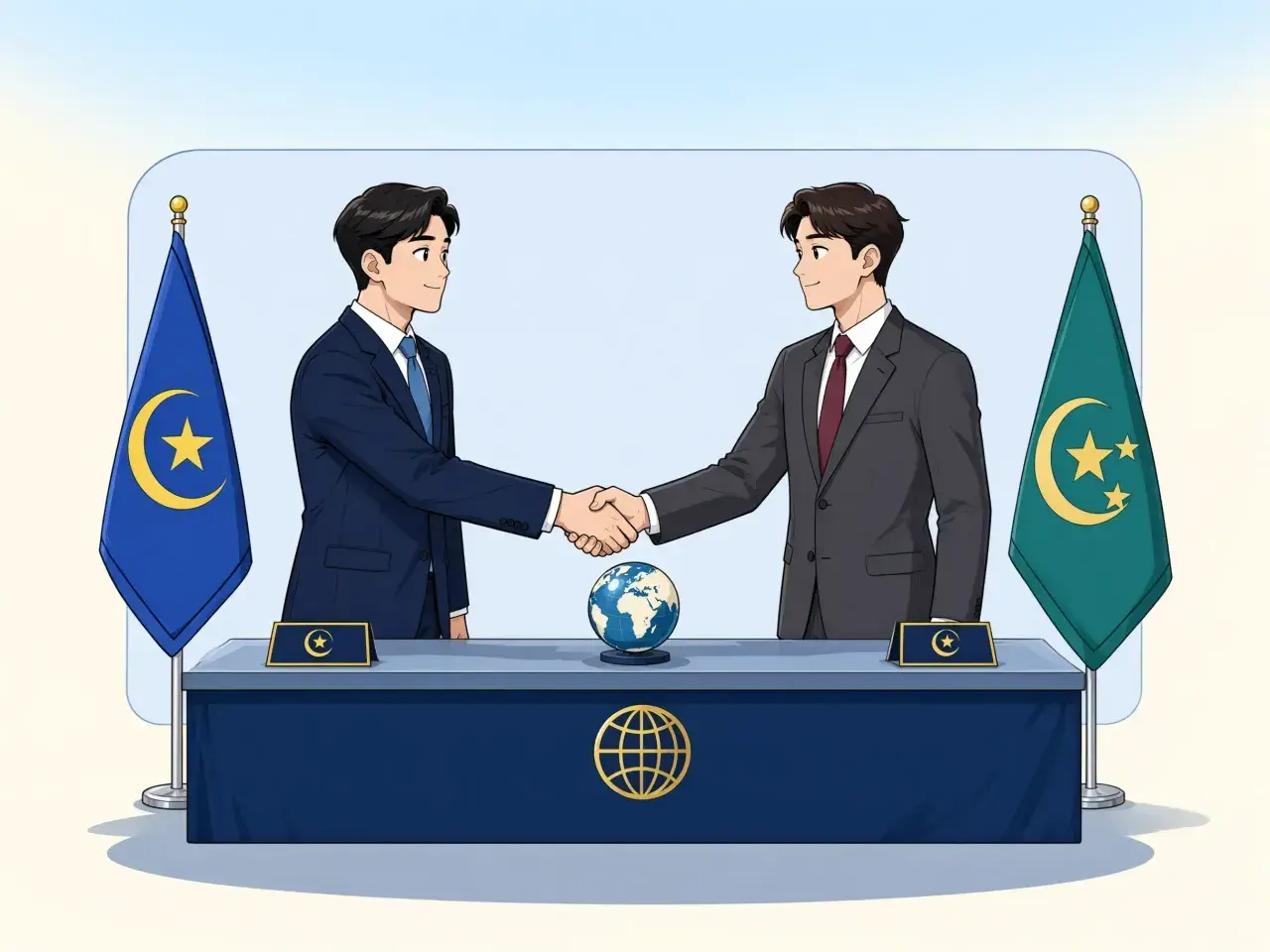
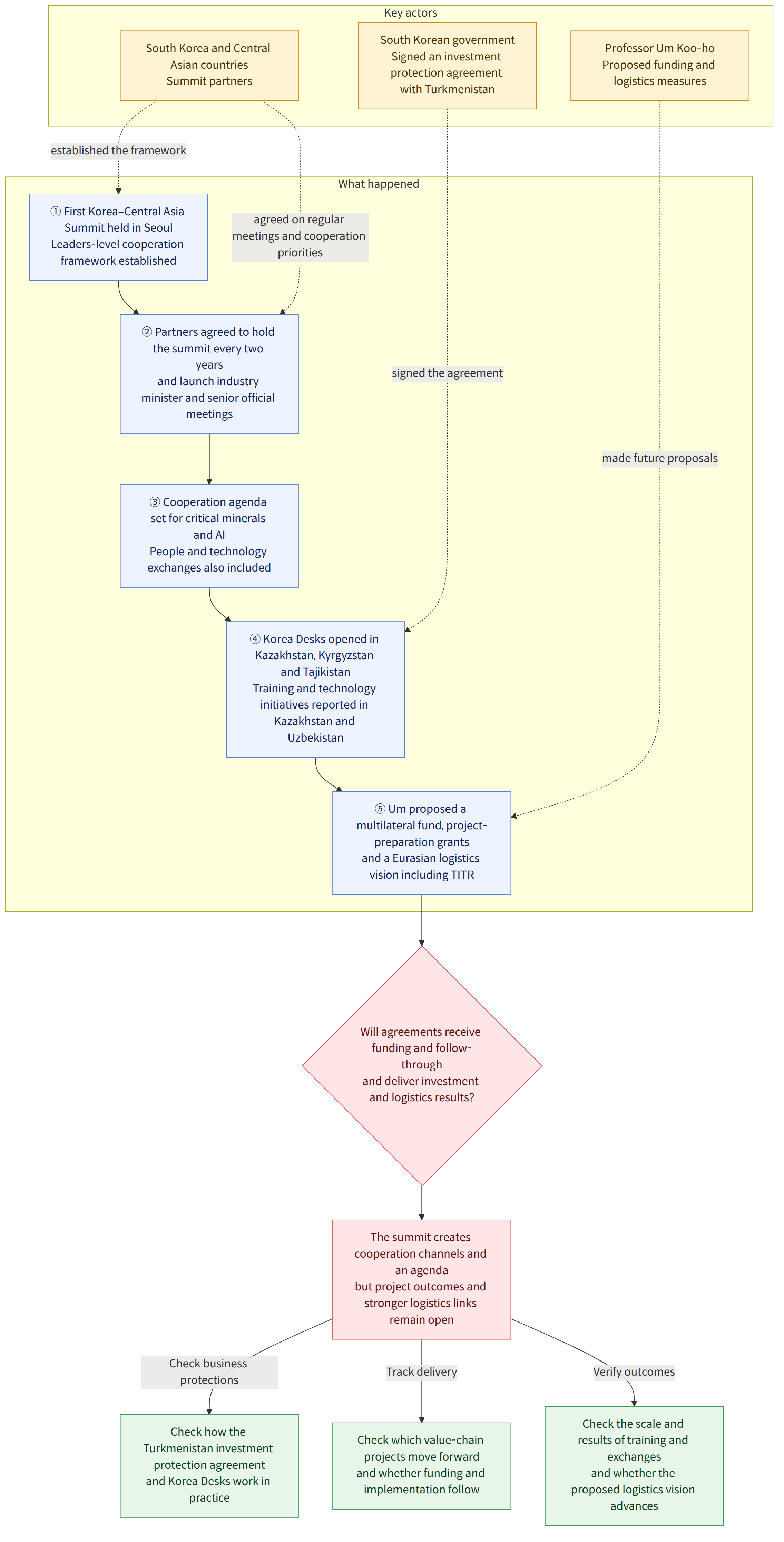
At the first Korea–Central Asia Summit (한-중앙아시아 정상회의), held in Seoul from September 14 to 16, the two sides agreed to hold the summit on a rotating basis every two years and to launch meetings of industry ministers and deputy-minister-level senior officials. After elevating the existing ministerial-level forum to a leaders-level meeting, they also established bodies to review cooperation priorities.
Background and context
The change at this meeting goes beyond simply raising the level of the meetings. Making the summit a regular event and launching meetings of industry ministers and senior officials creates multiple channels for addressing the agreements.
In the economic sphere, the two sides agreed to build a mutually beneficial value chain spanning the entire critical-minerals lifecycle by linking Central Asia’s critical minerals with South Korea’s processing and manufacturing capabilities. Cooperation on artificial intelligence was also put on the agenda. The explanation was that cooperation could expand into areas such as smart cities, logistics digitization and future air mobility.
Measures to reduce investment risks for businesses were also included. Korea Desks (한국 데스크), where senior officials directly address difficulties faced by businesses, were opened in Kazakhstan, Kyrgyzstan and Tajikistan. South Korea was reported to have signed an investment protection agreement with Turkmenistan. These measures can be seen as an institutional foundation for providing businesses with a channel to raise difficulties and for improving the security of long-term investment, but they do not mean that specific companies’ problems have already been resolved or that investment results have been achieved.
Exchanges of people and technology are another pillar of cooperation. The two sides agreed to link industrial technology training for Central Asian personnel with technology transfer and to expand exchanges to include researchers, entrepreneurs and government officials. The article reports that the Kazakhstan Advanced Institute of Science and Technology (Kaz-AIST; 카자흐스탄 고등과학기술원), modeled on the Korea Advanced Institute of Science and Technology (KAIST; 한국과학기술원), has opened in Kazakhstan, and that a personnel training program centered on a rare metals center has been launched in Uzbekistan.
What this development means
For businesses, the critical-minerals value chain, Korea Desks and investment protection agreements could each provide a different kind of foundation. The value-chain agreement signals an intention to expand cooperation beyond securing resources to include processing and manufacturing. Korea Desks are a channel through which senior officials directly address difficulties businesses face locally. However, it will take follow-up implementation to determine what projects actually move forward and how many obstacles are resolved.
For example, if a South Korean company were considering a minerals-related project in the region, it would need to look at how the value-chain cooperation is translated into specific stages and projects, and how the local Korea Desk addresses business difficulties. This is a hypothetical example and does not mean that the summit confirmed a project or support for any particular company.
The decision to expand exchanges to include researchers, entrepreneurs and government officials, and to link industrial technology training with technology transfer, can be understood as an effort to extend cooperation into skills development and knowledge sharing. Kaz-AIST and Uzbekistan’s program are also aligned with this direction. However, the scale of the training and exchanges and their specific results cannot be confirmed from the information provided.
Professor Um Koo-ho proposed that more funding and institutional design are needed to implement the summit agreements. He pointed to a shortage of government-level policy finance funds in South Korea and proposed creating a multilateral cooperation fund. He also suggested using grants to support feasibility studies and the preparation of master plans, linking them with concessional loans, and cooperating with the World Bank and the Asian Development Bank. These should be distinguished from agreements adopted at the summit: they are proposals by the article’s contributor for future consideration.
Logistics links are another outstanding task. Professor Um proposed that South Korea develop a vision for connecting with Eurasian logistics networks, including the Trans-Caspian International Transport Route (TITR; 트랜스카스피해 국제운송로). His proposal was to participate in initiatives such as digitizing logistics networks and developing major ports and their hinterlands, going beyond the transport of individual resources or specific projects. Since no logistics connectivity plan was finalized at the summit, this should be understood as a proposal for future strategy.
An institution to monitor implementation of the agreements was also proposed. Professor Um said a summit secretariat should continuously monitor the agreements and that a separate permanent secretariat was also needed to coordinate cooperation among local governments. The point is that, even with regular meetings and a senior officials’ meeting in place, it may be necessary to consider whether a separate body is needed to track progress on each agreement and manage cooperation among local governments.
What is confirmed and what is not yet known
Confirmed facts
- The first Korea–Central Asia Summit (한-중앙아시아 정상회의) was held in Seoul from September 14 to 16, and the parties agreed to hold it on a rotating basis every two years.
- Meetings of industry ministers and deputy-minister-level senior officials have been launched, and the parties agreed to create a mutually beneficial value chain spanning the entire lifecycle of critical minerals.
- Korea Desks (한국 데스크) to address business difficulties were opened in Kazakhstan, Kyrgyzstan and Tajikistan, and South Korea was reported to have signed an investment protection agreement with Turkmenistan.
- The parties agreed to link industrial technology training with technology transfer and expand exchanges to include researchers, entrepreneurs and government officials.
- Policy finance and a multilateral cooperation fund, links to logistics networks such as TITR, and a permanent secretariat are future tasks proposed by Professor Um Koo-ho.
What is not yet known
- No specific implementation timelines or performance indicators for the summit agreements were provided.
- It is not known whether South Korea will actually establish a policy finance fund or a multilateral cooperation fund, or what their size would be if it does.
- The information provided does not say what projects will emerge from artificial intelligence cooperation and the critical-minerals value chain, or what the investment amounts and participating parties for each project will be.
What readers should watch for
- It is worth checking whether follow-up meetings set timelines and performance indicators for each agreement and whether progress on implementation is reported regularly.
- Readers can look for whether the creation of South Korean policy finance or multilateral cooperation funds is presented as an actual plan, and whether funding amounts are specified.
- As projects in areas of interest take shape, businesses and research institutions should check how the role of local Korea Desks and the ways to participate in technology transfer and personnel exchanges are explained.