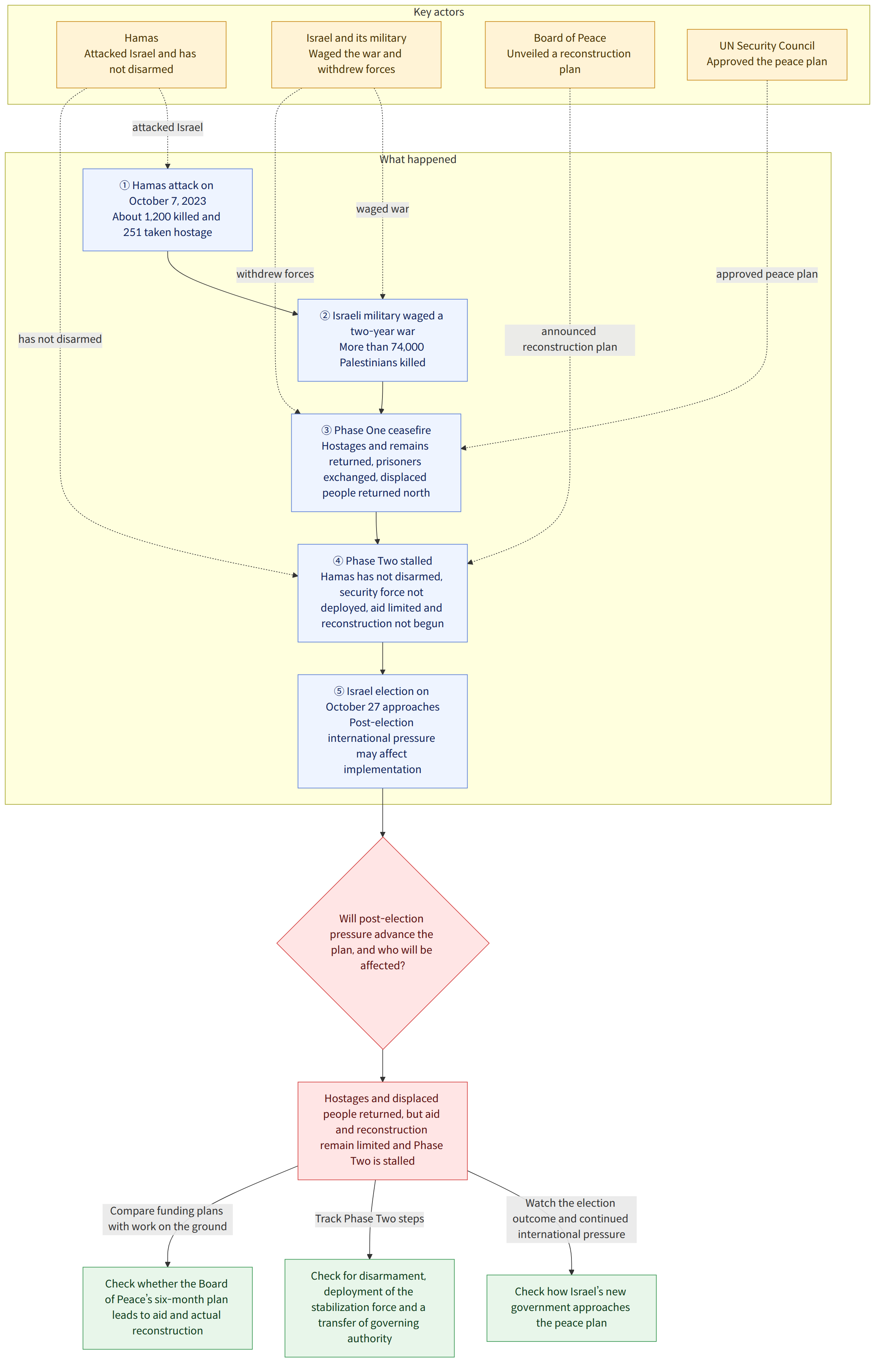
The Hamas attack on October 7, 2023, killed about 1,200 people and took 251 hostage. Most of those killed were Israeli civilians. The Israeli military then waged a two-year war in Gaza, in which more than 74,000 Palestinians were killed, and thousands more are believed to be buried under the rubble. Israel is heading into a parliamentary election on October 27.
Under the ceasefire and Phase One of the peace plan, the surviving Israeli hostages returned in exchange for about 2,000 Palestinian prisoners and detainees, and the remains of hostages who had died were returned over the following months. Hundreds of thousands of displaced people returned to northern Gaza, and Israeli forces withdrew to the “Yellow Line.” But aid remains limited, and meaningful reconstruction has not begun. That is why whether international attention and pressure continue after the election has emerged as a factor that could determine what comes next for the peace plan.
Background and context
The damage from the Hamas attack and the ensuing war remains even after the ceasefire. The article reports that a United Nations commission of inquiry, leading scholars of genocide, and human rights organizations have concluded that Israel’s war in Gaza constitutes genocide. This is a report of those parties’ conclusions; the article also says that much of Gaza has been reduced to rubble and that more than 74,000 people have been killed.
Phase One of U.S. President Donald Trump’s 20-point peace plan saw a hostage exchange and the return of remains, the return of displaced people to the north, and the withdrawal of Israeli forces to the Yellow Line. The United Nations Security Council (유엔 안전보장이사회) approved the peace plan and the U.S.-chaired “Board of Peace” (평화위원회). These measures showed that some of the agreements between the parties could be carried out, but a ceasefire did not in itself mean comprehensive peace or reconstruction.
In the year following the ceasefire signed on October 9, 2025, Gaza’s Health Ministry (가자 보건부) reported that about 1,400 people had been killed in Gaza. The article explains that the United Nations uses the Gaza Health Ministry’s death toll figures. The fact that deaths were reported even after large-scale attacks stopped shows that a ceasefire and the safety of residents are not the same thing.
Phase Two of the peace plan is stalled. Hamas has not disarmed, and the International Stabilization Force (국제안정화군), which is supposed to be responsible for security in Gaza, has not been deployed. The Palestinian technocratic committee (팔레스타인 기술관료위원회), which is supposed to govern Gaza, has also not taken over authority on the ground. The article reports that Israel is unwilling to allow reconstruction before full disarmament, while Hamas has not disarmed under the terms required by the peace plan.
Last week, the Board of Peace unveiled a $2.45 billion, six-month plan to begin reconstruction. But this is only a portion of the $71.4 billion estimated to be needed for recovery over 10 years. Announcing a plan and carrying out repairs on the ground are separate steps, and the aid restrictions and delays in reconstruction reported by the article show that a financial plan alone will not immediately change residents’ living conditions.
What this means
The October 27 election is tied to how Israel’s new government will approach implementing the peace plan. The article asks whether attention and pressure on Gaza and the West Bank will be sustained depending on the election results, and suggests that international pressure after the election could become important to the peace process. However, it is not yet known which party or government will win, or how the new government will respond to the peace plan.
It is difficult to conclude that international pressure will have only one effect. The article explains that external pressure before the election could rally a leader’s supporters, and that international criticism of the war in Gaza has reinforced a sense of being under siege among some in Israeli society. Whether pressure leads to a change in policy or instead hardens a hard-line stance may therefore depend on the political context before and after the election.
The article analyzes U.S. influence as a major potential source of pressure to advance the peace process. It cites the Israeli government’s heavy reliance on U.S. support. Meanwhile, normalization of relations with Saudi Arabia is cited as a possible incentive for Israel, but the article reports that Saudi Arabia has made a credible path toward establishing a Palestinian state a condition. This suggests that implementation of the peace plan is connected not only to the issue of disarmament within Gaza but also to broader political agreements.
The situation in the West Bank also makes it difficult for international attention to remain focused solely on Gaza. The United Nations recorded an average of six settler attacks targeting Palestinians per day as of June this year, the fastest rate in any year on record. The article also reports that by July, deaths linked to settler attacks had already exceeded the total for all of 2025, and that thousands of Palestinians had been displaced alongside the expansion of settlements.
In September, the United Kingdom announced a ban on products from West Bank settlements, and Foreign Secretary Ed Miliband condemned settler violence as ethnic cleansing by “settler terrorists.” However, because settlement exports are relatively small in scale, the economic impact of such measures may be limited; the article notes that their significance is mainly political. More than 150 countries have recognized Palestine as a state, but, as the article reports, conditions on the ground have not changed. This means that diplomatic recognition or announcements of sanctions do not automatically guarantee change on the ground.
For example, if international attention shifts to other crises after Israel’s election, the reconstruction plan could remain just an announcement while Phase Two of the peace plan remains stalled. Conversely, there is no basis to conclude that continued pressure alone would secure Hamas’s disarmament or the deployment of an International Stabilization Force. What matters is not only the extent of attention, but also whether pressure is tied to specific stages of the peace plan and whether the parties accept those terms.
What is confirmed and what remains unknown
Confirmed facts
- The Hamas attack on October 7, 2023, killed about 1,200 people and took 251 hostage.
- Under Phase One of the peace plan, the surviving hostages returned in exchange for about 2,000 Palestinian prisoners and detainees, and hundreds of thousands of displaced people returned to northern Gaza.
- In the year after the ceasefire, Gaza’s Health Ministry reported that about 1,400 people had been killed in Gaza.
- Aid remains limited; Hamas has not disarmed, an International Stabilization Force has not been deployed, and meaningful reconstruction has not begun.
- An Israeli parliamentary election is scheduled for October 27, and the Board of Peace has unveiled a six-month plan for reconstruction.
What remains unknown
- Which party or government will win the October 27 election.
- Whether Phase Two of the peace plan and the reconstruction plan for Gaza will actually be implemented after the election.
- When and under what conditions Hamas will disarm and an International Stabilization Force will be deployed.
- What pressure the United States and other countries will exert on Israel after the election.
What readers should watch
- It will be important to see what position the new government takes after the election on Phase Two of the peace plan and the Palestinian technocratic committee.
- Readers should look not only at the announced amount of the reconstruction plan, but also at whether aid actually increases and repairs begin on the ground.
- It will be important to watch whether Hamas’s disarmament and the deployment of an International Stabilization Force are agreed upon, and what changes follow for the withdrawal of Israeli forces and residents’ safety.