
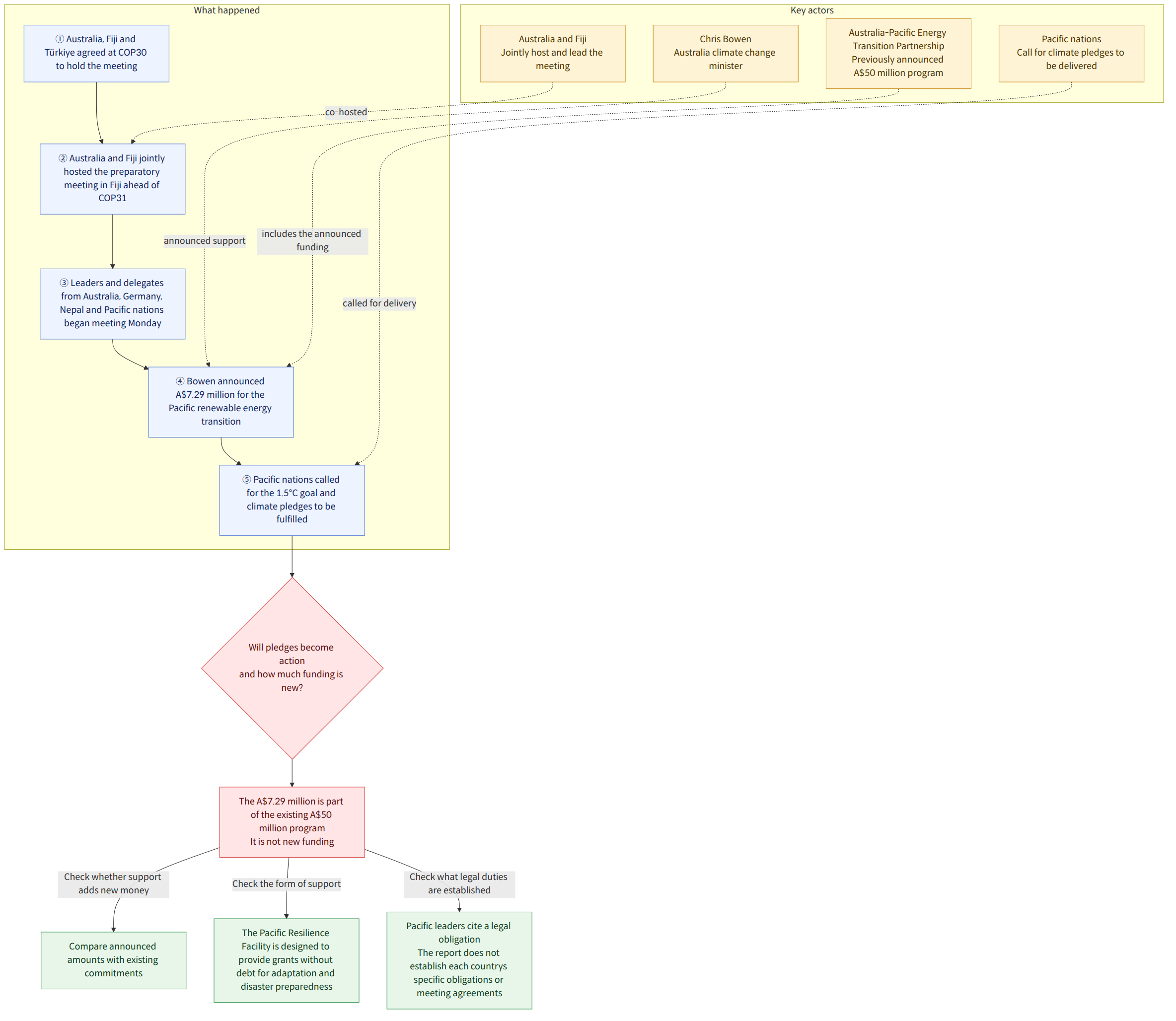
Leaders and delegates from Australia, Germany, Nepal and Pacific nations began a climate meeting in Fiji on Monday. The meeting was an opportunity to discuss the threat climate change poses to small island nations, as well as a preparatory meeting ahead of the United Nations climate summit, COP31, to be held in Türkiye in early November. Australian Prime Minister Anthony Albanese arrived in Fiji on Monday afternoon, and Climate Change Minister Chris Bowen announced A$7.29 million in support for the Pacific region’s transition to renewable energy.
The amount is not the only thing to note about the announcement. The funding is included in the previously announced A$50 million Australia-Pacific Energy Transition Partnership (호주-태평양 에너지전환 파트너십), so it is not new funding. There is a difference between an announcement that may appear to launch a new program and money that has actually been added. As Pacific nations call for climate pledges to be “delivered,” assessments of support need to consider not only the amount announced but also whether it overlaps with existing commitments.
Background and context
The meeting is part of a compromise agreed by Australia, Fiji and Türkiye at last year’s COP30, and is being jointly hosted and led by Australia and Fiji. As of Sunday evening, about 600 official national negotiating delegates had registered, along with 2,560 participants from civil society, academia, activist groups and community organizations. The range of participants, given the meeting’s preparatory format, also shows that the discussions extend beyond negotiations between governments.
Fijian Prime Minister Sitiveni Rabuka asked visiting leaders to come to the region, see for themselves and listen to Pacific people with open minds. The request can be understood as a call to discuss climate change not only as an abstract goal or diplomatic language, but in connection with the experiences of people in affected communities.
Pacific nations regard the 1.5°C goal of the Paris Agreement (파리협정) as a matter of survival. Fiji’s Environment and Climate Change Minister Linda Tabuya reiterated on Monday the message that the goal must remain within reach. COP31 envoy Christina Stege said that even if warming exceeds 1.5°C, the amount and duration of the overshoot must be kept as small as possible. The point is that efforts to reduce harm must continue, rather than abandoning the goal itself because it may be exceeded.
What this means
The meeting’s central question is whether emissions-reduction targets and funding pledges will lead to action. The “35 by 35” initiative for COP31, as described by participants, is a global electrification goal to raise electricity’s share of the global energy mix to 35% by 2035. The announcement of support for the transition to renewable energy is linked to this goal, but the fact that the A$7.29 million is included in the existing A$50 million program shows that the amount of any newly added contribution needs to be checked separately.
Differences in perspective between Pacific nations and donor countries also matter in discussions about finance. Pacific leaders describe climate finance not as aid or charity but as a legal obligation, and are calling on developed countries to meet that obligation reliably and accountably rather than limiting themselves to voluntary support. According to the article, this position was reaffirmed in an opinion of the International Court of Justice (국제사법재판소), and Australia voted in favor of a United Nations General Assembly (유엔총회) resolution supporting that opinion. This report, however, does not establish the specific obligations of each country or what was agreed at this meeting.
One form of support sought by Pacific nations is funding through the Pacific Resilience Facility (태평양 회복력 시설). It is a regional financial institution designed to provide grants without debt for climate adaptation and disaster preparedness. The call for grants rather than loans can be seen as an effort to ensure that the costs of responding to disaster risks do not create further debt burdens.
For example, if a Pacific nation were to pursue a climate-adaptation project, it could be important to check whether the funding is a newly pledged grant or part of an existing program budget, and whether it would increase debt. This is a hypothetical example; it does not mean that a specific country or project was allocated a particular amount at this meeting.
The cost of the meeting also became a point of debate within Australia. The Australian Coalition criticized the A$20 million reportedly spent by Australia on the meeting, calling it “a sham” and a waste of taxpayers’ money. Therefore, when assessing the meeting’s outcomes, it is also worth considering whether the discussions lead to actual financial commitments and policy implementation, separately from the controversy over hosting costs.
What is confirmed and what remains unknown
What is confirmed
- The meeting in Fiji is a preparatory meeting ahead of COP31, and is being jointly hosted and led by Australia and Fiji.
- The A$7.29 million in support announced by Australia is included in the existing A$50 million energy-transition partnership.
- Pacific nations regard the 1.5°C goal as a matter of survival, and the meeting heard calls to limit the extent and duration of any overshoot.
- Pacific leaders are calling for climate finance to be treated as a legal obligation and for support through grants without debt, among other forms of assistance.
What remains unknown
- It has not been confirmed whether a Pacific declaration was adopted or announced at the meeting.
- No amount of new funding pledged by countries to the Pacific Resilience Facility was provided.
- It is not known whether COP31 will produce agreements on the 1.5°C goal and climate finance.
What readers should check
- When considering funding announcements, it is important to distinguish between the total amount and whether the money is part of a previously announced program or newly added funding.
- Climate-finance pledges can be assessed by considering whether they are grants or loans and how they will be used for adaptation and disaster preparedness.
- When reviewing the outcome of COP31, it is worth checking not only the wording on the 1.5°C goal but also whether specific funding commitments and implementation arrangements are set out.