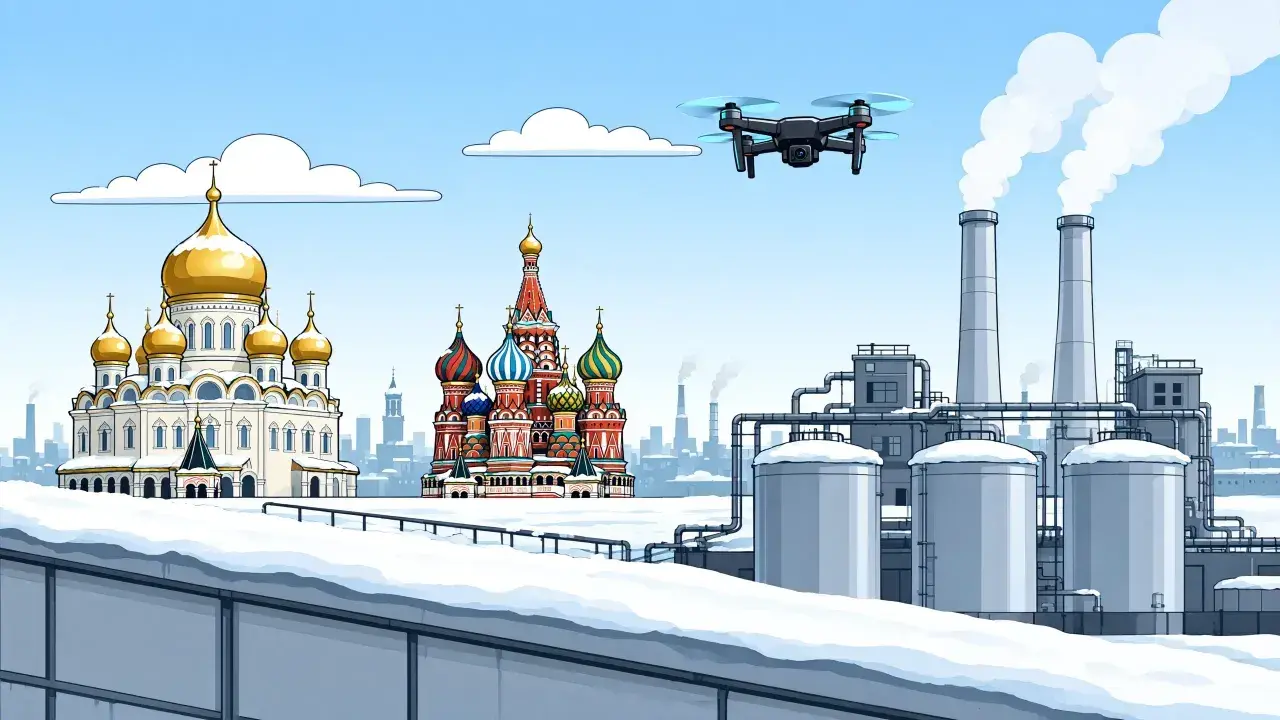
Among Moscow’s traffic jams, street performances and students outside an art museum, war seemed to appear briefly, like a military recruitment ad, and then disappear. The column connects changing relations between Russia and South Korea to issues in diplomacy on the Korean Peninsula and raises the need for communication between the two Koreas.
Background and context
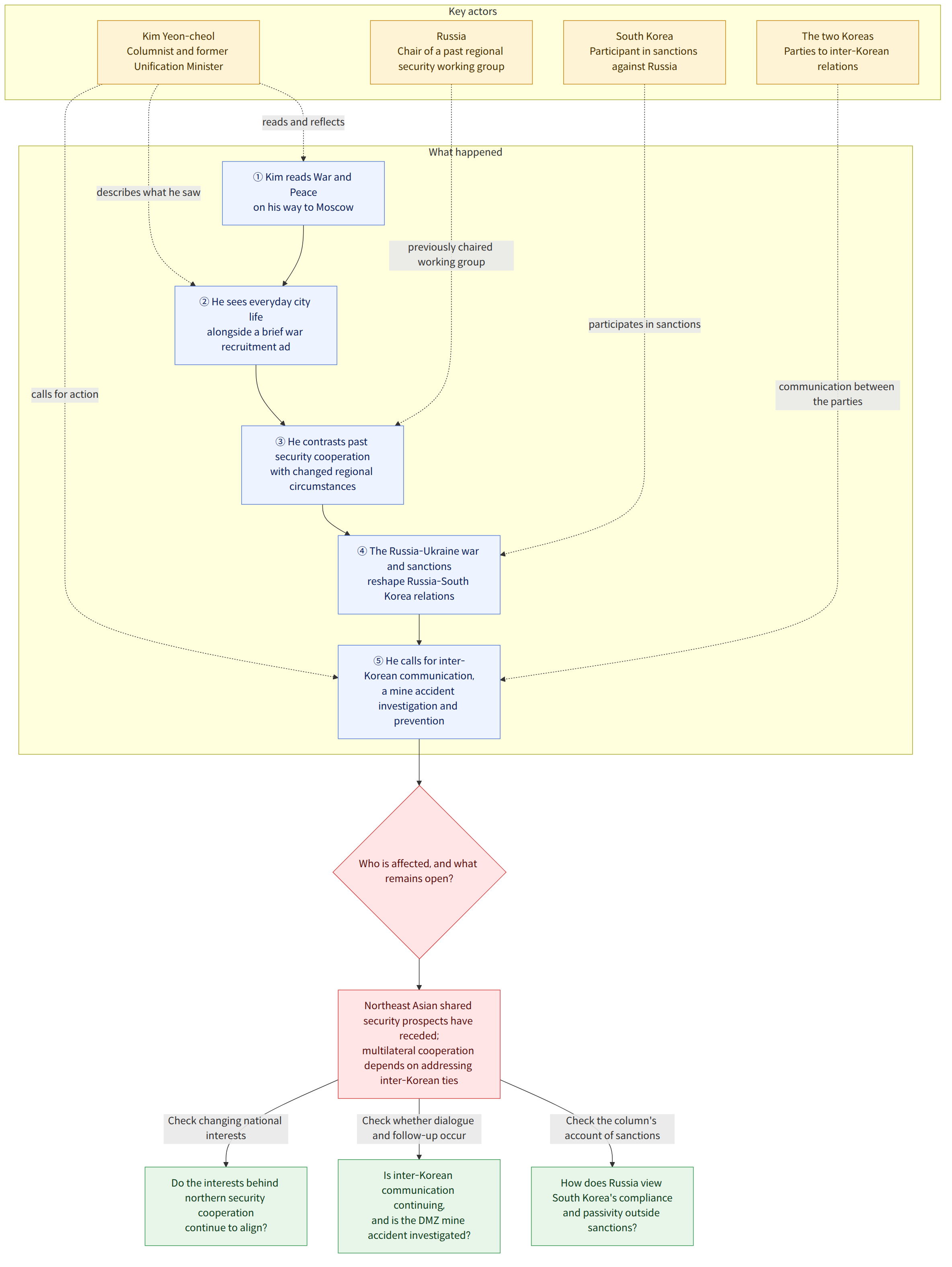
Kim Yeon-cheol wrote that he read Tolstoy’s War and Peace on his way to Moscow. Reflecting on the novel’s treatment of war and individual lives, he describes encountering scenes in Moscow where war and everyday life coexist uneasily. A recruitment ad that briefly appeared on a digital billboard in the street symbolized his observation that war can be hard to notice in the cityscape.
The Moscow he describes was full of traffic jams, motorcycle gangs roaring past, young students outside an art museum, and young couples dancing in front of a street singer on Arbat Street. The column also relays a rumor that lines at gas stations had grown longer after Ukraine used drones to strike an oil refinery south of Moscow. The rumor does not establish the size of any confirmed queues or the actual effect on fuel supplies.
Kim Yeon-cheol wrote that Russia’s fiscal deficit (a situation in which government spending exceeds revenue) and national debt had grown because of defense spending, and that various taxes had been raised to make up for shortfalls in tax revenue. He described restaurants as quiet amid the economic downturn and the airport’s entry and exit procedures as time-consuming and difficult. These are scenes and assessments reported by the columnist from what he saw and heard in Moscow, not independently verified statistics on the scale or causes of each economic condition.
The column’s central point is that the diplomatic context has also changed. Kim Yeon-cheol recalled the Northeast Asia Multilateral Security Cooperation Working Group (동북아 다자 안보협력 워킹그룹), for which Russia served as chair after the September 19 Joint Statement (9·19 공동성명) of 2005, while writing that the Eurasian security cooperation body led by Russia today reflects changed circumstances. His assessment is that prospects for shared security in Northeast Asia have receded as relations between China and Japan, Russia and Japan, and the two Koreas have deteriorated.
What this means
Kim Yeon-cheol describes relations among North Korea, China and Russia as based not on ideological solidarity but on the alignment of each country’s interests. He analyzed current Eurasian security cooperation, too, as the result of northern countries’ interests converging, and said it could change if those interests diverge. This suggests that understanding whether the cooperation will continue requires looking not only at ideological slogans but also at how the countries’ interests align.
On relations between South Korea and Russia, he wrote that Russia had maintained a balanced diplomacy toward the two Koreas after establishing diplomatic relations with South Korea, but that since the Russia-Ukraine war began, South Korea’s participation in sanctions has left Russia with little to gain from South Korea. Kim Yeon-cheol reported that Russia understands South Korea’s compliance with sanctions but finds its passivity in areas not covered by sanctions difficult to understand. This is the Russian perspective presented in the column; it should not be taken as an official agreement covering every issue in the relationship or as the position of both countries as a whole.
The solution emphasized by the column is to keep communication going even when relations are poor. Kim Yeon-cheol warned that the end of a war does not automatically restore things to how they were before it, and that prolonged absence of communication can cause hostility to harden into a structural feature of relations. He also reported that northern specialists stressed that inter-Korean relations are an issue for the parties themselves, making it difficult for third parties to intervene. His conclusion is that multilateral cooperation is possible only if bilateral relations between the two Koreas are addressed.
For example, the column’s reasoning is that if direct communication between the two Koreas is difficult, the role of neighboring countries alone cannot resolve problems in their bilateral relationship. This does not mean diplomacy with third countries is unnecessary; rather, it can be read as an argument that communication to address relations between the two Koreas should be considered alongside, not replaced by, reliance on cooperation among neighboring countries.
In this context, the column treats the land mine accident in the Demilitarized Zone as a challenge for peace. Kim Yeon-cheol expressed sympathy for the suffering of the soldiers involved and argued that the facts of the accident must be established accurately and ways to prevent a recurrence must be found. A separate report interpreted South Korea’s calls for an apology and dialogue over the land mine explosion on the 21st of last month as having been dismissed by North Korea’s missile launch drill. In that report, North Korea cited the strengthening of its nuclear war deterrent, while South Korea’s Ministry of National Defense (국방부) said the ballistic missile launch was a grave act that violated United Nations Security Council resolutions (유엔 안전보장이사회 결의) and called for an end to actions that heightened tensions.
What the reports presented differently
Reported flight distances for the missile differed by source. North Korea’s Rodong Sinmun (노동신문) reported that the missile hit a designated target point 1,000 kilometers away over the East Sea, while South Korea’s Joint Chiefs of Staff (합동참모본부) announced that it had flown more than 700 kilometers. Japan’s Ministry of Defense (일본 방위성) assessed that it had flown 680 kilometers. The missile launched by North Korea was suggested to possibly be a Hwasong-16na (화성-16나) hypersonic missile, but that report did not identify the model as confirmed.
The two articles also have different focuses. The column centers on the columnist’s interpretation of everyday life in Moscow, Russia’s foreign relations and communication between the two Koreas. The missile report covers the launch drill and statements from North Korea, South Korea and Japan, and interprets the calls for an apology and dialogue over the land mine accident as having been dismissed with a show of force. The articles do not contradict each other about the same event; they differ in focus, with the column treating the land mine accident as an issue for peace and diplomacy, and the report covering the military response that day.
What is confirmed and what remains unknown
Confirmed facts
- Kim Yeon-cheol described the coexistence of war and everyday life in Moscow and discussed the effects of the war on Russia’s economy and daily life in his column.
- The column says that Russia maintained a balanced diplomacy toward the two Koreas after establishing diplomatic relations with South Korea, and that South Korea’s participation in sanctions since the Russia-Ukraine war began has left Russia with little to gain from South Korea.
- According to a separate report, North Korea conducted a missile launch drill in the early hours of the 3rd, which was observed by Kim Jong Un, chairman of the State Affairs Commission. North Korea’s announcement and South Korean and Japanese assessments of the missile’s flight distance differed.
- Kim Yeon-cheol argued that the facts of the land mine accident in the Demilitarized Zone should be established and measures to prevent a recurrence put in place.
What remains unknown
- The original text does not give the exact date of the drone attack on the oil refinery south of Moscow or the scale of the damage.
- The basis for the rumor that lines at gas stations had grown longer, and the actual effect on fuel supplies, have not been confirmed.
- The column and the missile report do not explain in sufficient detail when and how the land mine accident in the Demilitarized Zone occurred.
What readers should check
- The attack on the oil refinery and the lines at gas stations were reported in the column as rumors. In following coverage, it is worth checking whether the date and damage from the attack, as well as its actual effect on supply, have been independently confirmed.
- The reported missile flight distances differ among North Korea’s announcement, the South Korean Joint Chiefs of Staff announcement and the Japanese Ministry of Defense assessment. Rather than treating just one figure as established fact, readers can check who made each statement and how it was worded.
- The circumstances of the land mine accident in the Demilitarized Zone, the investigation into what happened and measures to prevent a recurrence all need to be established. It is important to distinguish the column’s call for action from the report on North Korea’s missile launch and to check whether further details about the accident itself have been provided.
References
- Other coverage consulted: hani.co.kr