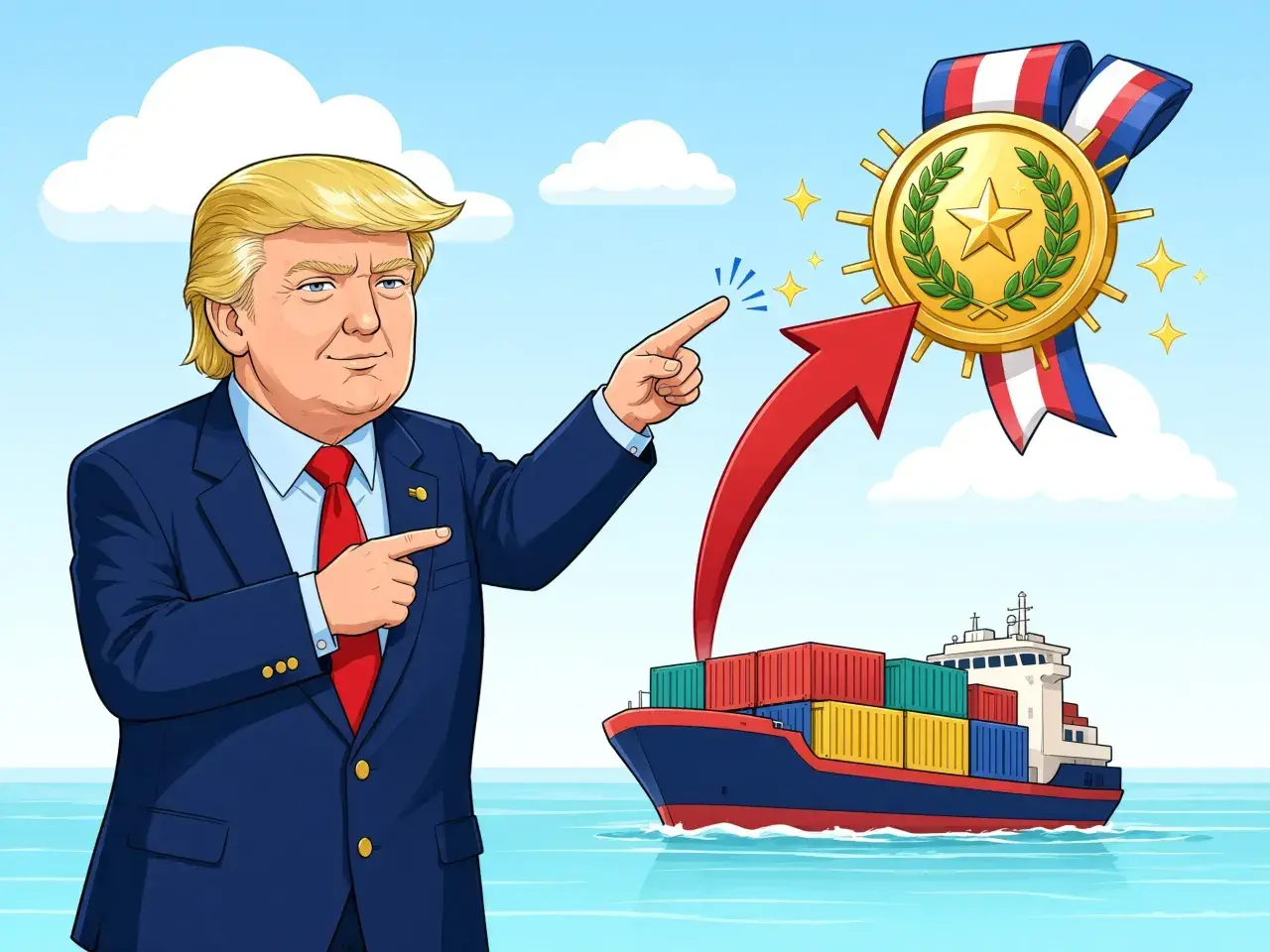
U.S. President Donald Trump expressed hope of winning the Nobel Peace Prize ahead of its announcement, emphasizing his contributions to peace. Trump said at the White House on October 7 (local time) that it would be a great disgrace for the Nobel Committee if it did not give him the award. The Norwegian Nobel Committee is scheduled to announce this year’s laureate on October 9.
The grounds he cited included resolving wars, saving lives, freeing hostages and preventing Iran from acquiring nuclear weapons. In particular, he claimed to have prevented wars by threatening certain countries with his authority to impose tariffs and with other measures. The remarks came ahead of the award announcement, but the article alone does not establish what evidence supports each claim.
Background and context
President Trump claimed that he had resolved eight wars, saved millions of lives and freed hostages. He also said he had prevented Iran from acquiring nuclear weapons and might have prevented the complete destruction of the world. These were all reported as Trump’s accounts of his own achievements.
He also brought up former President Barack Obama’s Nobel Peace Prize, saying Obama received the award despite having done nothing. He also mentioned that last year’s laureate, Venezuelan opposition leader María Corina Machado, gave him her Nobel medal. According to the article, Machado presented the medal in January, as she sought U.S. support for her work in Venezuela.
However, the article does not provide details of how that pressure led to the ceasefire or evidence to support such a connection.
What this news means
An important distinction in this report is that “expecting to win the award” and “verifying claims of contributions to peace” are separate matters. A politician’s self-assessment ahead of the Nobel Peace Prize announcement has drawn attention, but remarks made before the announcement cannot determine the committee’s judgment or the likelihood of winning. Similarly, the claim that tariff threats contributed to peace was reported as Trump’s assertion, and the article alone does not establish that causal link.
The debate raises the question of whether tariffs should be viewed only as a tool of trade policy or also assessed as a means of diplomatic pressure. However, to determine whether a particular measure actually halted a conflict, it is necessary to examine not only the threat itself but also the decisions made by the parties involved and the process that led to the ceasefire. It is therefore important to distinguish between a claim being made and its supporting evidence being established.
For example, if a politician claims that armed conflict stopped after a tariff threat, that claim alone does not make it possible to conclude that the tariffs caused the ceasefire. In this case, too, President Trump described the India-Pakistan ceasefire as a result of his tariff pressure, but the article does not provide specific supporting evidence.
What is known and what is not yet known
What is known
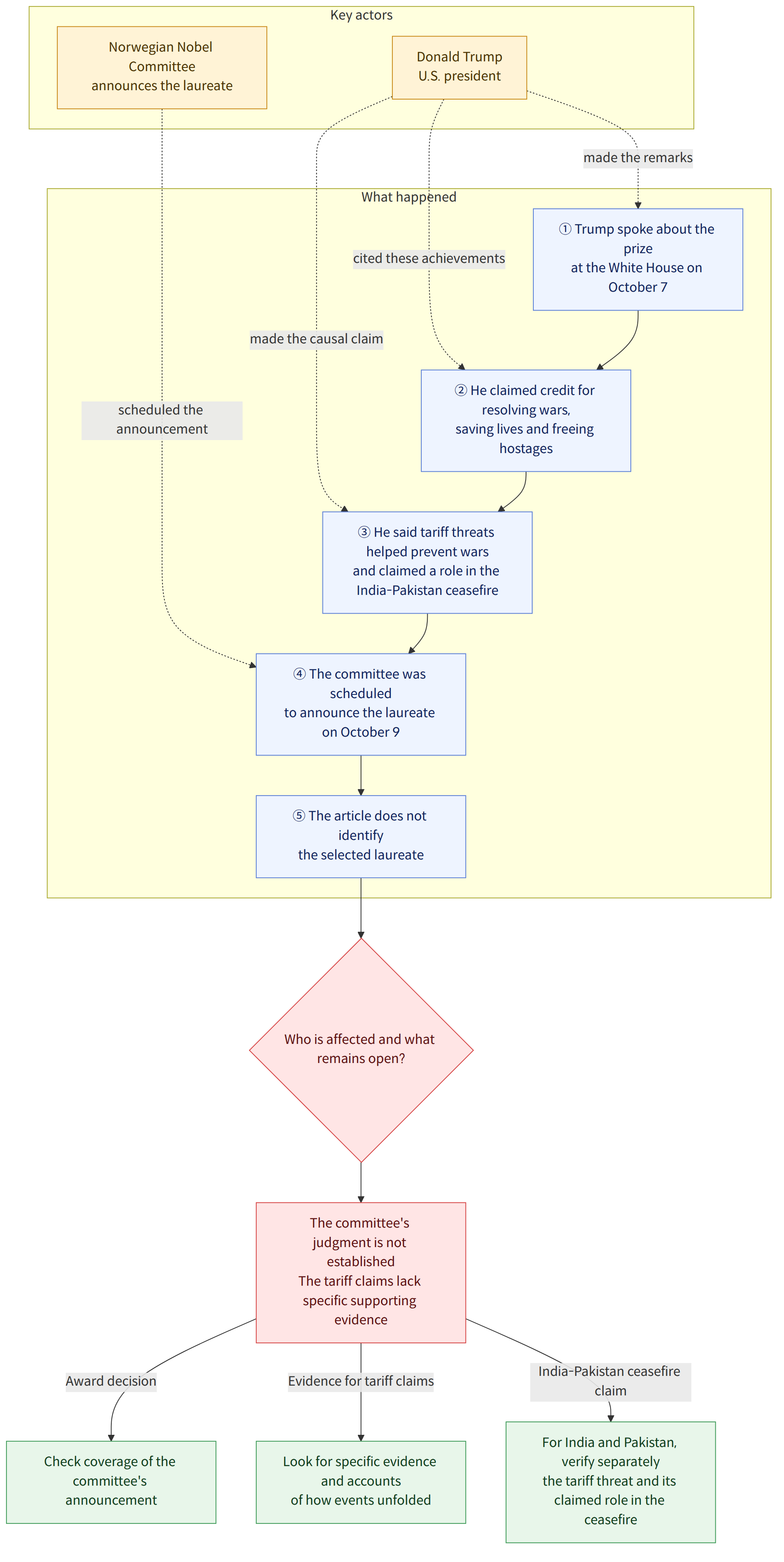
- President Trump spoke about the Nobel Peace Prize and his contributions to peace at the White House on October 7.
- He claimed credit for resolving eight wars, saving lives, freeing hostages and preventing Iran from acquiring nuclear weapons.
- He claimed to have prevented wars by using his authority to impose tariffs and other measures as threats.
- The report said the Norwegian Nobel Committee is scheduled to announce this year’s Nobel Peace Prize laureate on October 9.
What is not yet known
- The article does not say whom the Norwegian Nobel Committee selected as the 2026 laureate.
- It provides no specific evidence to support the claim that tariff threats actually prevented wars.
- The article alone does not establish what role tariff pressure played in the ceasefire between India and Pakistan.
What readers can check
- Readers can distinguish President Trump’s hopes of winning the award from the committee’s actual decision by checking coverage of the announcement.
- In follow-up reporting on the claim that tariffs prevented wars, readers can look for specific supporting evidence and accounts of how events unfolded.
- In considering the India-Pakistan case, readers should separately verify the claim that tariff pressure was applied and the explanation that it caused the ceasefire.