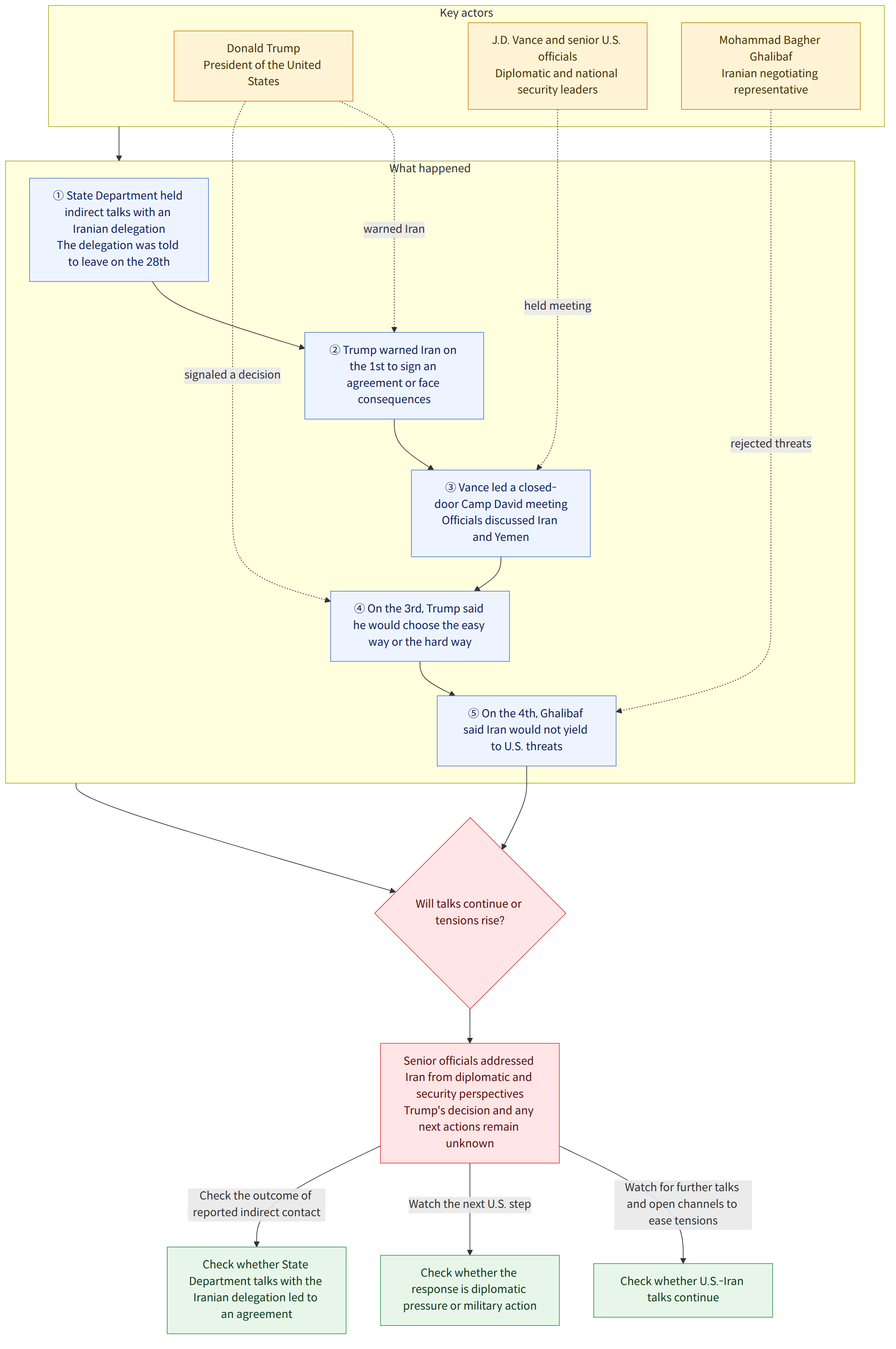
Reports said that senior U.S. diplomatic and national security officials, including Vice President J.D. Vance, held a closed-door meeting at Camp David in Maryland as President Trump said he had a decision to make about Iran. On the 3rd (local time), Trump said at the White House (백악관) that the only options were the “easy way” or the “hard way,” and that he would get it done either way. The specific details of the decision were not disclosed.
Background and context
On the 1st, Trump also warned that Iran would either sign an agreement or “no longer exist.” His renewed warning two days later shows that U.S. demands and threats are continuing. However, his remarks alone do not establish that military action will take place or that negotiations have ended.
According to Axios, Vice President Vance held a meeting the previous day at Camp David to discuss the U.S.-Iran war and the conflict in Yemen. Those attending included Secretary of State Marco Rubio, Defense Secretary Pete Hegseth, presidential envoy Steve Witkoff, Central Intelligence Agency (중앙정보국, CIA) Director John Ratcliffe, and Chairman of the Joint Chiefs of Staff (합참) Gen. Dan Caine. A government official was quoted as saying that “some decisions were made, and there was an in-depth discussion” at the meeting.
The report said it was highly unusual for the Trump administration to hold a senior-level meeting at Camp David without announcing the schedule in advance. A similar gathering took place days before the “12-day war,” when Iran was struck in June last year. That precedent is one reason for the interest in this meeting, but the fact that it took place at a similar point in time does not prove that the same outcome will follow.
Iran offered a different message in response to U.S. pressure. On the 4th, Iranian negotiating representative and Speaker of Iran’s Parliament (국회) Mohammad Bagher Ghalibaf said in a parliamentary speech that Iran does not adjust its policies or security in response to tweets or interviews by U.S. officials and will not yield to threats. With Trump’s pressure and Iran’s public rejection facing off, both the possibility of negotiations and the risk of rising tensions are drawing attention.
What this news means
The significance of the meeting lies in the positions held by those attending and the subjects they discussed. The fact that senior officials from the diplomatic, defense, intelligence and military leadership met to discuss Iran and the conflict in Yemen shows that the U.S. government is addressing the issue from both diplomatic and security perspectives. However, the fact that something was discussed at a meeting should be distinguished from the implementation of an actual policy decision.
Trump’s remarks can be read as pressing Iran to reach an agreement while warning of the consequences of failing to do so. Ghalibaf, meanwhile, said Iran would not change its policies in response to U.S. statements. With both sides taking a hard line, it may be important to watch not only whether an agreement is reached, but also whether further talks continue and whether channels for easing tensions remain open. On the basis of the available evidence, however, it is not possible to determine which side will actually pursue negotiations or take action.
For example, if the United States continues to demand an agreement and Iran rejects it, the course of the conflict could depend on whether the next U.S. step is diplomatic pressure or military action. This is a hypothetical illustration of possible scenarios; the report did not specify Trump’s decision or how it would be carried out.
Developments involving the Iranian delegation also offer a clue to the current state of diplomacy. According to reports, the U.S. Department of State (미 국무부) held indirect negotiations with the Iranian delegation, which was visiting the United States to attend the United Nations General Assembly (유엔 총회), and told the delegation to leave on the 28th of last month. Most members returned to Iran, and the two Iranian diplomats who had remained in New York also left the United States after being pressed again to depart. This shows that contact took place, but whether that contact led to an agreement is a separate question.
What is confirmed and what remains unknown
What is confirmed
- On the 3rd (local time), Trump said he had a decision to make about Iran and described the options as the “easy way” and the “hard way.”
- Axios reported that Vice President Vance held a closed-door meeting at Camp David to discuss the U.S.-Iran war and the conflict in Yemen.
- Reports said those attending included Secretary of State Rubio, Defense Secretary Hegseth, presidential envoy Witkoff, CIA Director Ratcliffe and Chairman of the Joint Chiefs of Staff Caine.
- On the 4th, Iranian Parliament Speaker Ghalibaf said Iran would not yield to U.S. threats.
- Reports said two Iranian diplomats who were in the United States left after being pressed again to depart.
What remains unknown
- What exactly is the decision Trump plans to make about Iran?
- What decisions were reportedly made at the Camp David meeting, and when might they be implemented?
- Will further negotiations or military action between the United States and Iran actually follow?
What readers should watch
- It is important to see whether the U.S. government describes Trump’s remarks or the meeting’s contents as a specific official decision.
- Iran’s subsequent position and whether further negotiations between the United States and Iran take place should be considered together. It is difficult to conclude from hard-line statements by either side alone that dialogue has ended or that action has been decided.
- It is worth watching whether the demand for the Iranian delegation to leave and the diplomats’ departure lead to changes in how future contacts take place. The reports available so far do not establish whether diplomatic channels between the two countries have been suspended.