Ukrainian President Volodymyr Zelensky said Russia was pursuing a new airstrike policy that broadens the range of civilian targets ahead of winter, and announced that Ukraine would step up attacks on Russian oil refineries in response. He said Ukraine would not target civilians.
Background and context
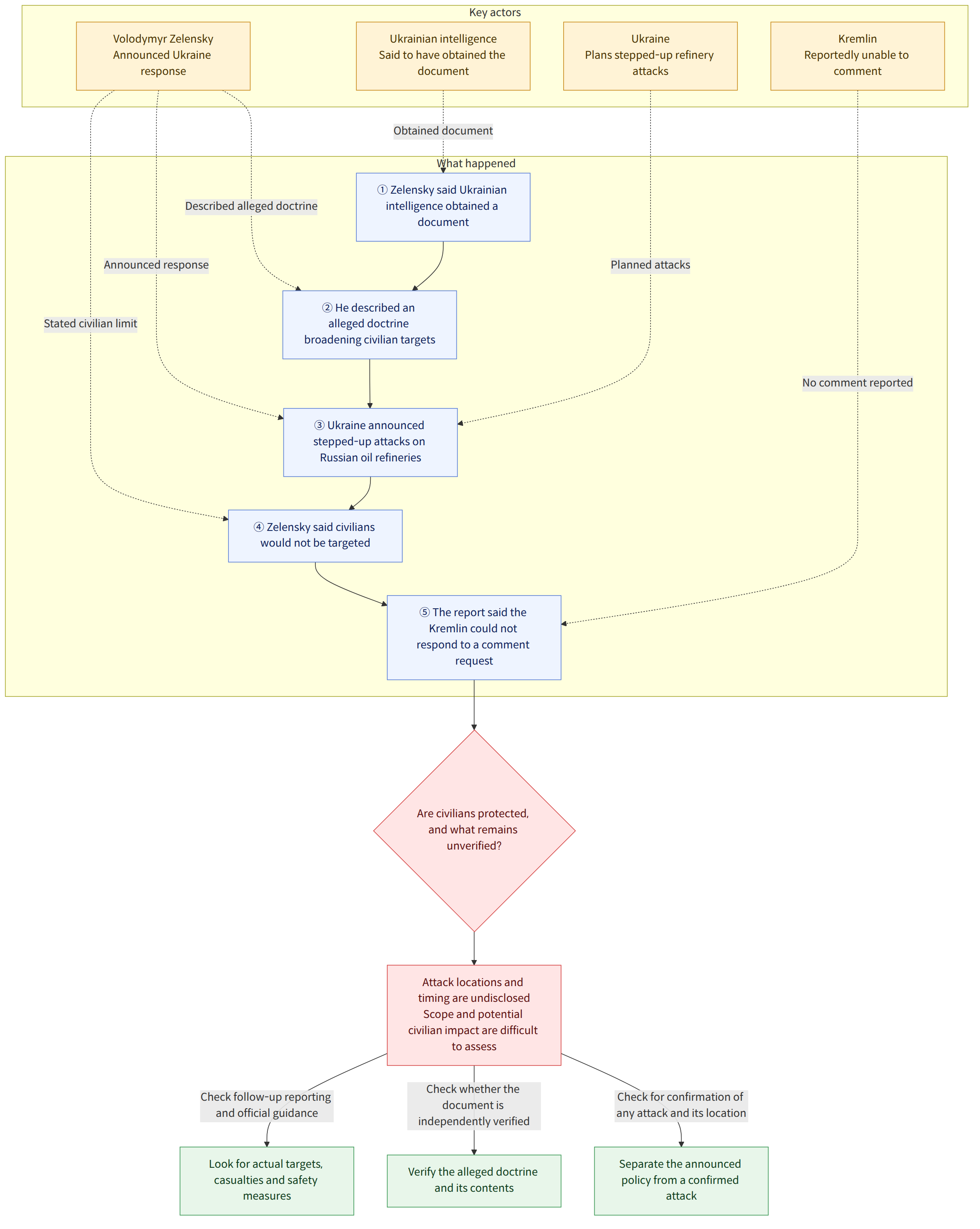
Zelensky said Ukrainian intelligence had obtained a document that showed Russian President Vladimir Putin’s “new doctrine.” According to his description, the document authorizes attacks not only on infrastructure and logistics facilities, but also on cities and towns, roads, schools and hospitals. This was reported as Zelensky’s claim; the information made public does not establish whether the document is authentic or whether it has led to actual operations.
Zelensky said the purpose of Russian operations was to pressure residents into leaving the capital and other cities. He also claimed that Putin’s desire to appear a strong leader lay behind the policy shift. According to Zelensky, at the time, Russian forces were losing ground in key frontline areas and suffering rising casualties.
The Kremlin was reportedly unable to respond to a request for comment on Saturday. As a result, this report does not include the Kremlin’s account of the alleged new Russian doctrine or the reasons behind the policy shift.
What this news means
The notable point in this announcement is that Ukraine presented stepped-up attacks on oil refineries as its response to Russian airstrikes. Zelensky drew a line by saying civilians would not be attacked, but the report does not specify the targets or methods of any refinery attacks. It is therefore difficult to assess the actual scope of the attacks or their potential impact on civilians based on the announcement alone.
If the claim that Russia is expanding its range of civilian targets is true, the targets of airstrikes and the protection of residents could become more pressing concerns. At the same time, depending on which facilities Ukraine targets in response, debate may continue over what is considered a target in the war. These are possible implications of the claims and policy described in the report, not confirmed outcomes.
For example, if an attack by Ukraine is announced, residents of a particular area should distinguish between the announcement itself and confirmation of the actual attack location and official guidance, rather than concluding from the announcement alone that the place where they live is a target. The report provides no specific information about evacuations or safety measures for residents.
What is confirmed and what remains unknown
Facts reported
- Zelensky said Ukraine would step up attacks on Russian oil refineries in response to Russia’s airstrike policy.
- He said Ukraine would not target civilians.
- Zelensky claimed that Ukrainian intelligence had obtained a document showing Russia’s “new doctrine.”
- He said the document authorizes attacks on infrastructure and logistics facilities, as well as cities, roads, schools and hospitals.
- The Kremlin was reportedly unable to respond to a request for comment on Saturday.
What remains unknown
- The locations of the oil refineries Ukraine plans to attack more extensively, and the timing of any attacks, have not been made public.
- The key frontline areas Zelensky referred to have not been identified.
- The specific contents and authenticity of the document Ukraine reportedly obtained have not been independently verified.
- The report does not establish how Russia’s new doctrine has been reflected in actual airstrike operations.
What readers should check
- Readers should distinguish between the announced policy and whether an attack has actually taken place. The report describes the policy but does not give specific attack locations or timing.
- Regarding Russia’s new doctrine, readers should distinguish between Zelensky’s account and whether the document has been independently verified.
- To assess the situation regarding civilian protection, readers should check whether follow-up information has emerged about actual targets and casualties. The report currently contains no specific information about casualties or safety measures.
References
- Other coverage consulted: koreatimes.co.kr