
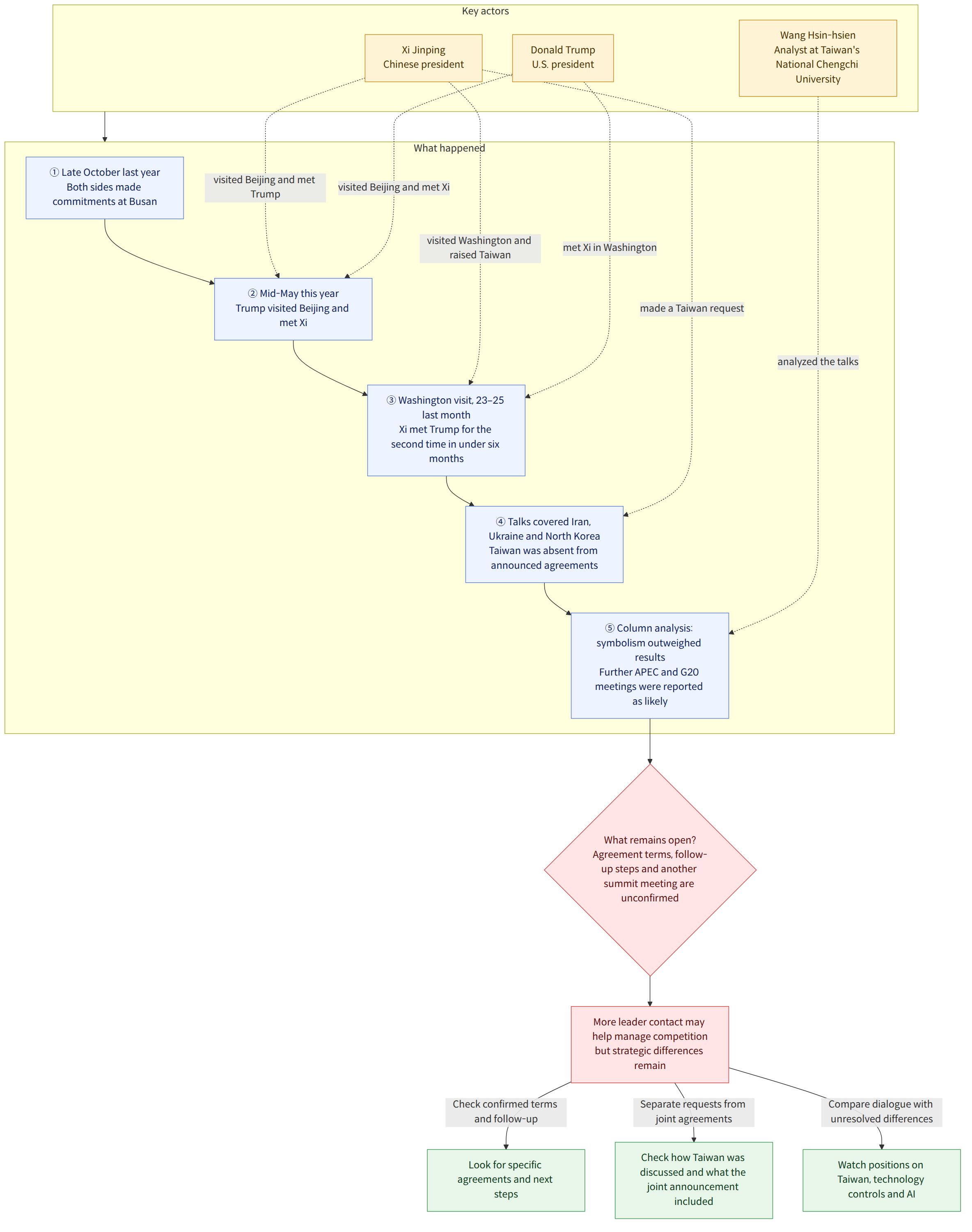
Chinese President Xi Jinping visited Washington, D.C., from the 23rd to the 25th of last month and met with U.S. President Donald Trump. The column described this as Xi’s first state visit to the United States in 11 years. The two leaders met for the second time in less than six months, following Trump’s visit to Beijing in mid-May this year. They were also reported as likely to meet again at this year’s Asia-Pacific Economic Cooperation (APEC) and Group of 20 (G20) summits.
Background and context
The visit drew attention not only because of the frequency of contact between the leaders, but also because of the protocol. According to the column, President Trump went to the airport to greet Xi, and the United States provided a high level of protocol. However, this alone does not indicate how much substantive agreement was reached at the talks.
Wang Hsin-hsien, director of the Center for International Relations at Taiwan’s National Chengchi University (대만 국립정치대학 국제관계연구센터), described the talks as having three purposes. The first was to review implementation of the commitments made by both sides at meetings in Busan in late October last year and Beijing in mid-May this year. The second was to take account of each leader’s domestic political needs, and the third was to manage the risks of U.S.-China competition and avoid an accidental clash.
The discussion of domestic politics is Wang’s analysis. He believes Trump is seeking to bolster his position in the November midterm elections by highlighting China’s purchasing commitments and his ability to manage U.S.-China relations. Wang analyzed Xi as seeking to demonstrate that he alone can stabilize relations between the two countries and build momentum for another term at next year’s “21st Party Congress.” This is an interpretation of the leaders’ motivations, not a purpose they have been confirmed as publicly stating.
What this news means
The column’s central point is that the increase in meetings does not mean the two countries’ strategic tensions have been resolved. It reported that major differences remain on core strategic issues, including Taiwan, technology controls and artificial intelligence (AI). Wang assessed that the meeting’s symbolic significance outweighed its substantive results.
Iran, Ukraine and North Korea were also included in the leaders’ discussions. According to the column, the two leaders reached a basic understanding on Iran’s nuclear weapons and tolls for passage through the Strait of Hormuz. Wang focused on the fact that the United States needs China on these issues, and interpreted them as potential bargaining chips for China in negotiations with the United States. This, too, is the column’s analysis; it does not mean that specific agreements on these matters have been confirmed.
The Taiwan issue illustrates the gap between differences and agreement. Citing a report by Xinhua News Agency (신화통신), the column reported that Xi said the United States should maintain its opposition to “Taiwan independence” and handle the Taiwan issue prudently. However, the agreements announced by the two countries did not mention Taiwan. The fact that a request was conveyed should be distinguished from the announcement of a joint agreement.
The two leaders shared the understanding that China and the United States had fought together as allies and won during World War II. The column interpreted this as a symbol that went beyond a simple recollection of the past. The writer argued that, because the Republic of China, now based in Taiwan, was the party that fought alongside the United States at the time, this shared understanding could be received in Taiwan as “erasing the Republic of China” and could foreground a Chinese Communist Party-centered interpretation of the history of the war. This is the column’s assessment; the wording of the shared understanding announced by the two countries and the writer’s interpretation should be read separately.
The important point for readers is that it is difficult to view a summit as a single signal of “improved relations” or “resolved tensions.” For example, if the two countries continue dialogue between their leaders while their positions on Taiwan or technology controls remain unchanged, continued contact may serve more to manage tensions than to resolve them. Wang analyzed that the two leaders had continued interacting since the May meeting in Beijing, laying the groundwork for another meeting at the APEC summit in Shenzhen, China, in November and the G20 summit in Miami, United States, in December. However, whether those meetings will actually take place has not been confirmed.
Confirmed facts and what remains unknown
Confirmed facts
- Xi visited Washington from the 23rd to the 25th of last month, and the column described it as his first state visit to the United States in 11 years.
- This was the second meeting between the two leaders in less than six months, following their meeting in Beijing in mid-May this year.
- The column reported that major differences remain on Taiwan, technology controls and AI.
- Xi’s remarks on Taiwan were reported by Xinhua News Agency, but the agreements announced by the two countries did not mention Taiwan.
- The possibility of the two leaders meeting again at this year’s APEC and G20 summits was raised, but no meeting has been confirmed.
What remains unknown
- Which, if any, of the commitments made at the Busan and Beijing meetings were actually reviewed for implementation this time.
- What specific terms the two countries agreed on at these talks and what follow-up steps they will take.
- Whether the two leaders will actually meet again at the APEC summit in November and the G20 summit in December.
What readers should watch for
- In subsequent announcements, readers should look for specific disclosures about which commitments from the Busan and Beijing meetings were reviewed.
- Checking whether joint announcements or follow-up measures by the two countries include provisions on Taiwan, technology controls or AI can help gauge the difference between symbolic contact and actual policy change.
- Since a summit meeting at APEC and the G20 was presented as a possibility, readers should distinguish between official confirmation of attendance and confirmation of a bilateral meeting.