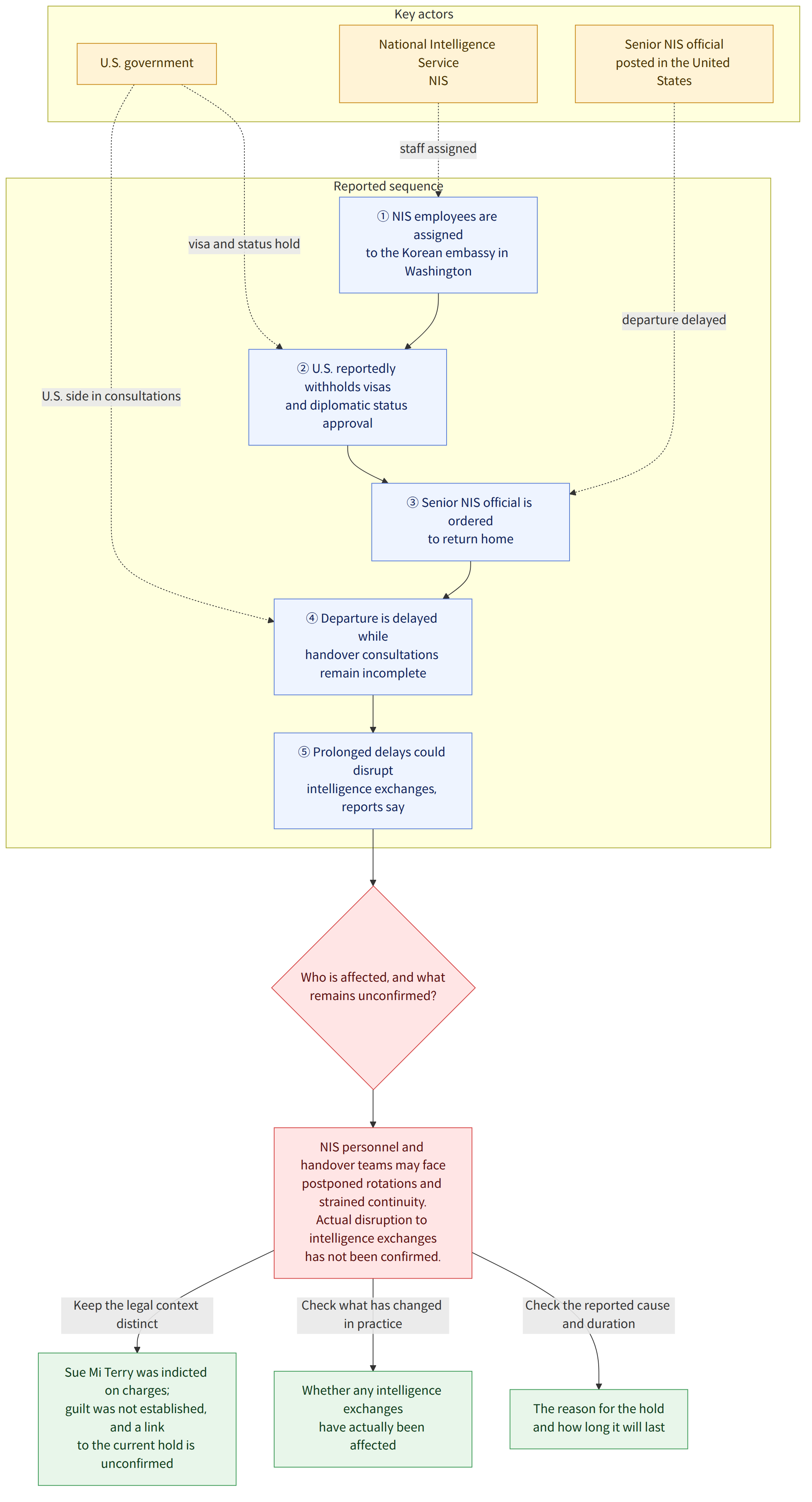
The U.S. government is reportedly withholding visas and approval of diplomatic status for National Intelligence Service (국가정보원, NIS) employees assigned to the Embassy of the Republic of Korea in Washington. A senior NIS official who had been working in the United States was also ordered to return home, but reportedly has been unable to leave because consultations with the U.S. side, including those for handing over duties, have not been completed. The specific reasons for the hold and how long it will last have not been confirmed.
Background and context
NIS employees reportedly work at overseas embassies under diplomatic titles such as minister-counselor, counselor and first secretary. A source at the National Assembly Intelligence Committee (국회 정보위원회) also reportedly said that many of those slated for deployment had worked on covert operations against North Korea and intelligence matters. However, it is not known whether the reason for the hold is related to the activities of employees who had previously worked in the United States or to issues involving the employees who are to be newly deployed.
Visa issuance and approval of diplomatic status are directly tied to deployed employees taking up their posts and carrying out their duties locally. The delay in sending replacements, alongside the delayed return of the existing official, therefore points to the possibility that personnel changes and handovers may not proceed as planned. That alone, however, does not establish that intelligence work has already stopped or that cooperation between the two countries has actually been reduced.
The key point in the reports is that the cause has not been established. Some in diplomatic circles have speculated that trust issues between the two countries may have played a role, including tensions over Coupang and intelligence activities in the United States by a former NIS official. These are not confirmed causes, but conjectures raised in the context of various outstanding issues.
One point of contention in the dispute involving Coupang concerns the investigation into a personal information leak. In a National Assembly hearing last December, the acting head of Coupang’s Korean subsidiary testified to the effect that the investigation and contact with the alleged leaker had been carried out at the NIS’s direction. The NIS denied issuing such instructions. In an interim report last July, the U.S. House Judiciary Committee (미 하원 법사위) claimed that the South Korean government had investigated and penalized U.S. companies, including Coupang, in a discriminatory manner. This is the position stated in a U.S. congressional report; it has not been confirmed as the reason for the visa hold.
Controversy over South Korean intelligence agency activities in the United States was also cited. In 2024, Sue Mi Terry, a former CIA analyst on North Korea, was indicted by federal prosecutors on charges including acting on behalf of the South Korean government without registering as a foreign agent. The indictment means that charges were brought; it does not mean that guilt has been established. It has also not been confirmed whether the case is directly connected to the current visa hold.
Information-sharing issues have previously been reported as a separate matter. The reports said that after Unification Minister (통일부 장관) Chung Dong-young referred to Kusong in North Pyongan Province as the location of a North Korean uranium enrichment facility in the National Assembly last March, the United States restricted some of the North Korea-related intelligence it shared with South Korea. This background helps explain the concerns about intelligence cooperation, but there is no basis for concluding that the current deployment hold and the earlier restriction on information sharing were the same measure or stemmed from the same reason.
What this news means
The parties directly affected are NIS personnel at the embassy in Washington and those responsible for handing over their duties. If both arrivals and departures are delayed, local staff rotations could be postponed and continuity of work could come under strain. Reports said that if the delays continue for a long time, U.S.–South Korea intelligence exchanges could be disrupted, but they did not specify which exchanges, if any, have been affected in practice.
The issue is drawing attention because it may be seen not merely as a visa matter involving individual diplomats, but as a signal of whether the two countries can maintain stable intelligence cooperation. What has been confirmed so far, however, is that visas and approval of diplomatic status are being withheld and that the official’s return home is delayed. This should not be read as a complete suspension of U.S.–South Korea intelligence cooperation or as an official U.S. sanction.
For example, if the delay in the replacement’s arrival continues, the existing official’s return and the handover of duties to the successor could be delayed, potentially putting continuity of intelligence work under strain. This is a possible scenario, not confirmation that such a disruption is actually occurring now.
What is confirmed and what remains unknown
Confirmed facts
- According to multiple diplomatic and government sources, the U.S. government is withholding visas and approval of diplomatic status for NIS employees scheduled to be deployed.
- A senior NIS official at the Embassy of the Republic of Korea in Washington was ordered to return home but reportedly has been unable to leave the United States because consultations, including those for handing over duties, have not been completed.
- It is not known whether the hold is related to the activities of existing employees or to issues involving the employees who are to be newly deployed.
- Reports have raised concerns that U.S.–South Korea intelligence exchanges could be disrupted, but the actual impact has not been confirmed.
What remains unknown
- What specific reason did the U.S. government have for deciding to impose the hold?
- How many employees are slated for deployment, and how long will the hold last?
- When will the senior official posted locally return home, and when will the replacement be deployed?
- What actual changes, if any, have occurred in U.S.–South Korea intelligence exchanges because of the visa hold?
What readers should watch for
- In follow-up announcements, watch for whether the U.S. government officially explains why it is withholding visas and approval of diplomatic status.
- Check whether the official posted locally has returned home, whether the replacement has taken up the post, and whether the handover has proceeded.
- Look for follow-up explanations confirming an actual disruption to intelligence exchanges, and distinguish them from concerns about what might happen.