
1. A Human Story
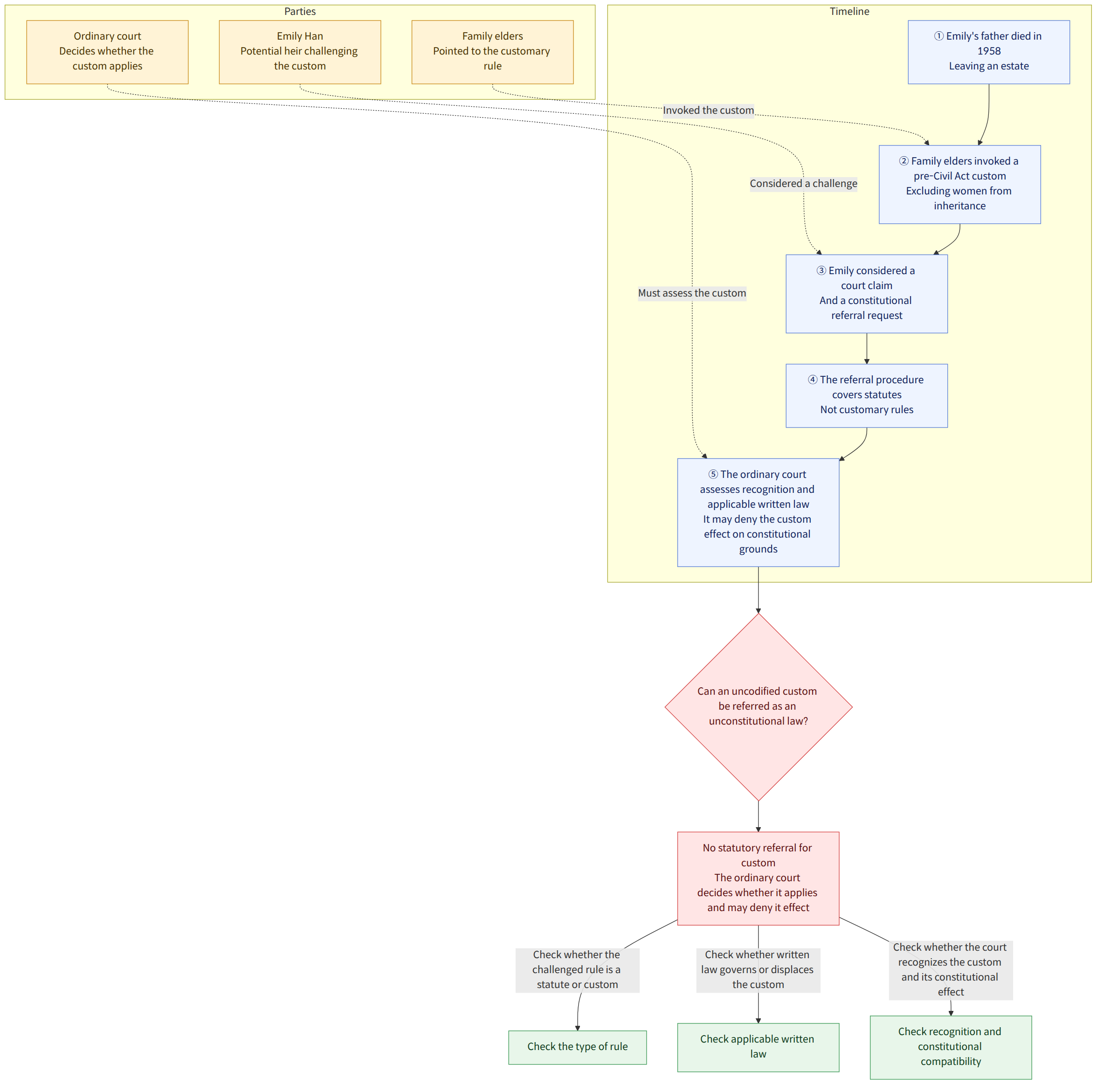
When Emily Han’s father died in 1958, the family gathered to discuss the land and savings he had left behind. Emily believed she should share in the estate alongside her brothers. But the family’s older relatives pointed to a customary inheritance rule from before Korea’s Civil Act took effect: when a male household head died, a woman had no inheritance right and no right to demand a division of the family property.
Emily did not accept that the rule could simply end the discussion. She considered bringing a claim in court and asking the judge to send the custom to the Constitutional Court, arguing that a rule excluding women could not be reconciled with constitutional equality. Her immediate problem, however, was procedural: could a customary rule be challenged through the same constitutional-review process used for statutes?
2. The Legal Question
Can a litigant ask a court to refer a customary rule of inheritance to the Constitutional Court for review as an unconstitutional law, or must the ordinary court address the custom’s validity itself?
3. What Korean Law Says
The constitutional referral procedure is designed for statutes enacted by the National Assembly. Under Article 111(1)(1) of the Constitution and Article 41(1) of the Constitutional Court Act, a court may refer a question about the constitutionality of a law when that law must be applied to a case before it. A litigant may ask the court to make such a referral, but the procedure does not cover every rule that may influence a court’s decision.
The statutory constitutional-review procedure concerns a law in the formal sense: legislation passed by the National Assembly. A customary rule is not such a statute merely because courts may recognize it as a source of law.
Customary law has a different role in Korean civil law. Article 1 of the Civil Act provides for custom to operate as a source of law when there is no applicable written law and the custom is recognized as legally binding. In that sense, custom is supplementary: it does not displace written legislation that governs the issue.
- A customary rule may be considered when a civil dispute has no controlling written-law provision.
- Its legal force depends on its recognition by the courts and its compatibility with applicable written law.
- If a court concludes that a customary rule is unconstitutional, it can refuse to give the rule effect in the case before it.
That last point matters. The fact that a custom cannot be referred to the Constitutional Court through the statutory review procedure does not mean that the custom is immune from constitutional scrutiny. It means the ordinary court—not the Constitutional Court through that particular referral process—must address whether the custom may be applied.
4. How Korean Courts Approach This
Korean courts distinguish between a formal statute and a customary rule recognized as a supplementary source of civil law. Constitutional referral is available for the former, not the latter. The Supreme Court has reasoned that because courts identify and apply customary law, and because custom operates only within the limits set by written law, an ordinary court can itself deny effect to a custom that conflicts with the Constitution.
A request for constitutional review cannot be used to turn a customary rule into a statute. The trial court must decide whether the custom is applicable and, if necessary, whether its effect should be denied on constitutional grounds.
The distinction is procedural, but important. If a dispute turns on the constitutionality of a formal statute that the court must apply, a referral may be possible. If the challenged rule is instead an uncodified custom, asking for a statutory constitutional referral is not the proper route. The ordinary court still has to resolve the legal issue relevant to the case.
5. Applying the Law to the Case
Emily’s situation involves a claimed customary rule governing an inheritance that arose before the Civil Act took effect. The rule she challenges is not an Act passed by the National Assembly. It is an alleged customary rule that courts may recognize as a supplementary source of civil law.
The analysis therefore proceeds in stages:
- Identify the kind of rule. Emily is challenging custom, not a formal statute. The constitutional-referral procedure under the Constitution and the Constitutional Court Act is limited to statutes.
- Consider whether the custom can govern the dispute. The ordinary court must determine whether the claimed custom is legally recognized and whether any written law applicable to the inheritance displaces it.
- Address the constitutional objection in the ordinary case. If the court concludes that the custom is relevant, it can consider whether the rule’s exclusion of women is compatible with the Constitution. If it finds the custom unconstitutional, it can refuse to apply it.
- Separate procedure from the merits. Emily’s inability to obtain a referral to the Constitutional Court does not, by itself, decide whether she has an inheritance claim. That question depends on the governing law and the facts of the estate.
Accordingly, if Emily files an application asking the trial court to refer this customary rule for constitutional review as though it were a statute, the application would be dismissed as procedurally improper. The trial court must still decide the inheritance dispute through the ordinary legal process, including whether the custom can be recognized and applied.
6. Conclusion: What Happened, and What Should You Do?
Emily’s request for a constitutional referral would not succeed because the challenged inheritance rule is customary law, not a statute enacted by the National Assembly. But that procedural answer does not automatically validate the custom or defeat Emily’s claim. The ordinary court must decide whether the custom is applicable and may refuse to apply it if it conflicts with the Constitution. Whether Emily ultimately receives a share of the estate remains a separate question for that court to determine.
For readers facing a similar dispute:
- Identify the rule precisely. Determine whether the contested rule is written legislation or an uncodified custom; the available constitutional procedure depends on that distinction.
- Raise the constitutional issue in the underlying case. If the dispute concerns custom, ask the ordinary court to decide whether the custom can lawfully be applied rather than relying solely on a request for constitutional referral.
- Get advice on the estate’s timing and evidence. Inheritance rights can depend on when the estate opened, which rules then governed, and what property and family relationships can be established.