At a rally for the midterm elections in Ohio on the 3rd (local time), U.S. President Donald Trump said he “gets along very well” with North Korean leader Kim Jong Un and remarked that if someone had 112 nuclear missiles, it would be good to get along with them. Explaining why he maintains good relations with Chinese President Xi Jinping, he added that it would be good to have good relationships with the leaders of huge nuclear powers. He did not, however, explain in detail what information the figure “112” was based on.
The key point in this remark is not the number itself, but how it should be understood. Since it came immediately after he mentioned Kim, it can be interpreted as referring to North Korea’s nuclear missile capabilities. But a remark without publicly available supporting evidence cannot be treated as a confirmed count of what North Korea possesses.
Background and context
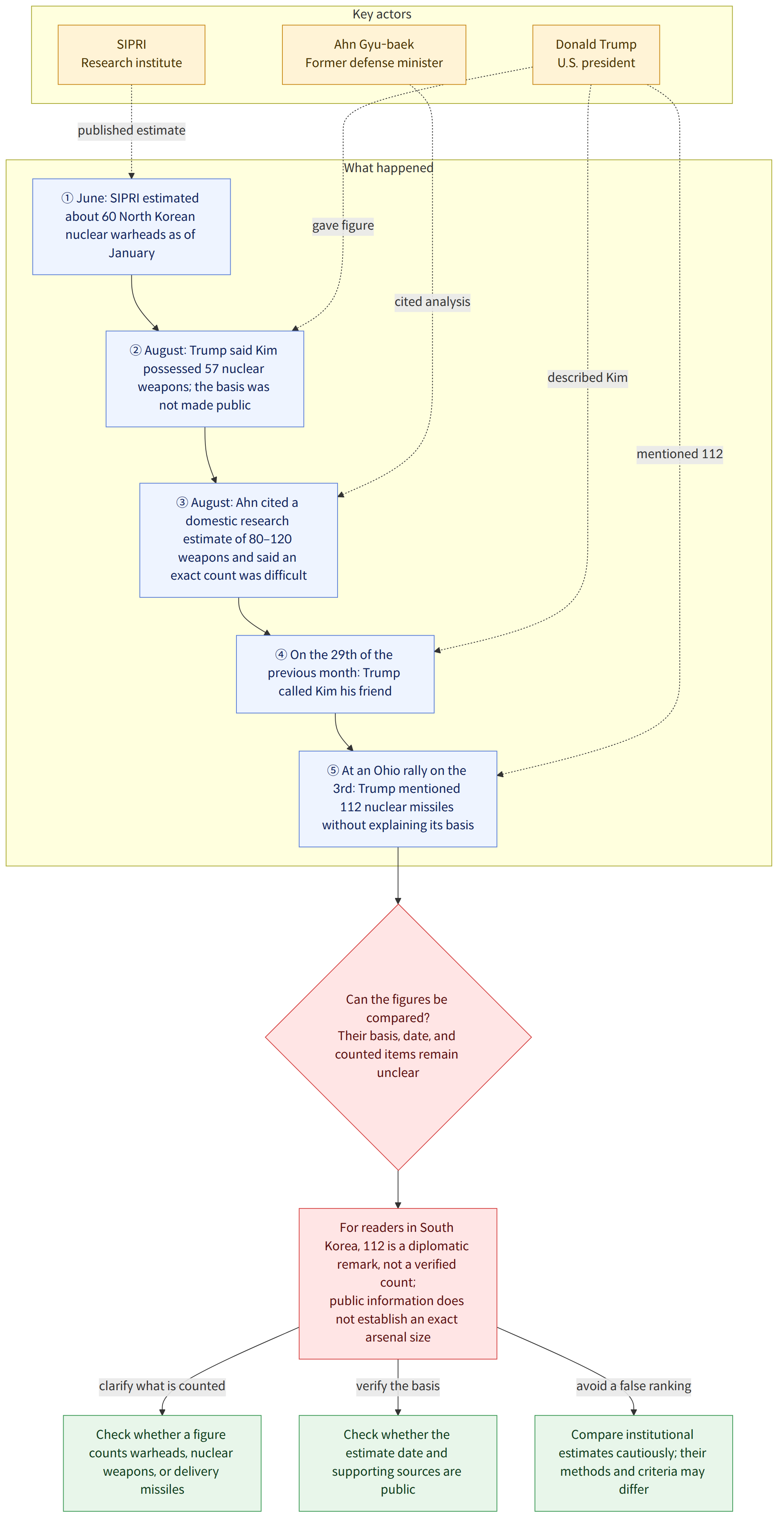
In August, President Trump had said that Kim possessed “57 very powerful nuclear weapons.” The basis for that figure was not made public at the time either. Both “112” and “57” are figures cited by President Trump, but the information or method of calculation behind either figure cannot be confirmed from the reporting provided.
Estimates of North Korea’s nuclear arsenal vary by institution and assessment. At a plenary meeting of the National Defense Committee (국방위원회) in August, former Defense Minister Ahn Gyu-baek said that, based on analysis by domestic research institutions, North Korea was generally thought to have around 80–120 nuclear weapons. He also said, however, that it was quite difficult to give an exact figure. In its “SIPRI Yearbook 2026” (시프리 2026년 연감), published in June, the Stockholm International Peace Research Institute (스톡홀름국제평화연구소; SIPRI) estimated that North Korea likely had about 60 nuclear warheads as of January, 10 more than the previous year.
“Nuclear weapons,” “nuclear warheads” and “nuclear missiles” are not interchangeable terms. A nuclear warhead refers to a nuclear explosive device, while a missile is a means of delivering one. It is not known whether the figures cited in the reporting count the same things using the same criteria, so putting 57, 60, 80–120 and 112 together as if they were entries in a single ranking could be misleading.
On the 29th of last month, President Trump also called Kim “my friend” and said that he was almost the only person in the world whom Kim liked, and that he liked Kim too. This latest remark, too, was made in the context of emphasizing personal relationships with the leaders of nuclear powers, rather than simply stating a figure for nuclear capabilities.
What this news means
For readers in South Korea, the important point is to distinguish assessments of North Korea’s actual nuclear capabilities from the U.S. president’s diplomatic language. It is confirmed that President Trump mentioned a number of nuclear missiles, but without publicly available supporting evidence, that figure alone cannot establish the size of North Korea’s arsenal. Conversely, the fact that estimates differ among institutions does not mean North Korea has no nuclear capabilities or that they are small. It shows that the available public information does not make it possible to establish an exact count.
This distinction also matters when reading diplomatic remarks. President Trump emphasized that he gets along well with Kim and said it is desirable to maintain good relations with the leaders of nuclear powers. The “112” figure should therefore be treated as a number cited in the context of that remark, rather than as a verified assessment. But the fact that the number was used to describe diplomatic relations does not confirm whether it is accurate.
For example, if a reader wants to use “112” to assess North Korea’s nuclear capabilities, they should first check whether the figure refers to nuclear warheads, nuclear weapons overall, or missiles used as delivery vehicles. They should then look at whether the date of the estimate and its sources have been made public. The reporting provided does not answer these questions.
What differed between the reports
The Korean-language reporting covers the remark about “112 nuclear missiles” and the fact that its basis was not made public. It also presents Trump’s August remark about 57, along with analysis by domestic research institutions and SIPRI’s estimate. The English-language reporting provided focuses on Trump’s statement at the rally that he gets along well with Kim and his emphasis on maintaining relationships with the leaders of nuclear powers. The English-language source provided does not mention the “112” remark or estimates by institutions.
This reflects differences in the scope of the source material provided. The English-language source does not deny the figure or offer a different one, so there is no basis for concluding that the two reports reached different judgments about whether the figure is accurate.
What is confirmed and what remains unknown
What is confirmed
- At a rally for the midterm elections in Ohio on the 3rd (local time), President Trump said he gets along well with Kim and mentioned “112 nuclear missiles.”
- He did not explain in detail what information the figure 112 was based on.
- In August, President Trump said “57 nuclear weapons”; the basis for the figure was not made public at the time either.
- Former Defense Minister Ahn Gyu-baek cited both an estimate of 80–120 based on analysis by domestic research institutions and the difficulty of determining an exact figure.
- SIPRI estimated that North Korea likely had about 60 nuclear warheads as of January.
What remains unknown
- What information and method of calculation President Trump used to cite the figure of 112.
- The actual number of nuclear weapons and nuclear warheads North Korea possesses.
- Whether the different figures cited in the reporting refer to the same types of weapons and the same reference date.
What readers should check
- Check which items the number counts: nuclear weapons, nuclear warheads or nuclear missiles.
- When comparing estimates, look not only at the institution’s name but also at whether the reference date and basis for the calculation have been made public.
- Read political leaders’ diplomatic remarks and institutions’ estimates of nuclear capabilities as different kinds of information.
References
- Other coverage consulted: koreatimes.co.kr
- Other coverage consulted: en.yna.co.kr