
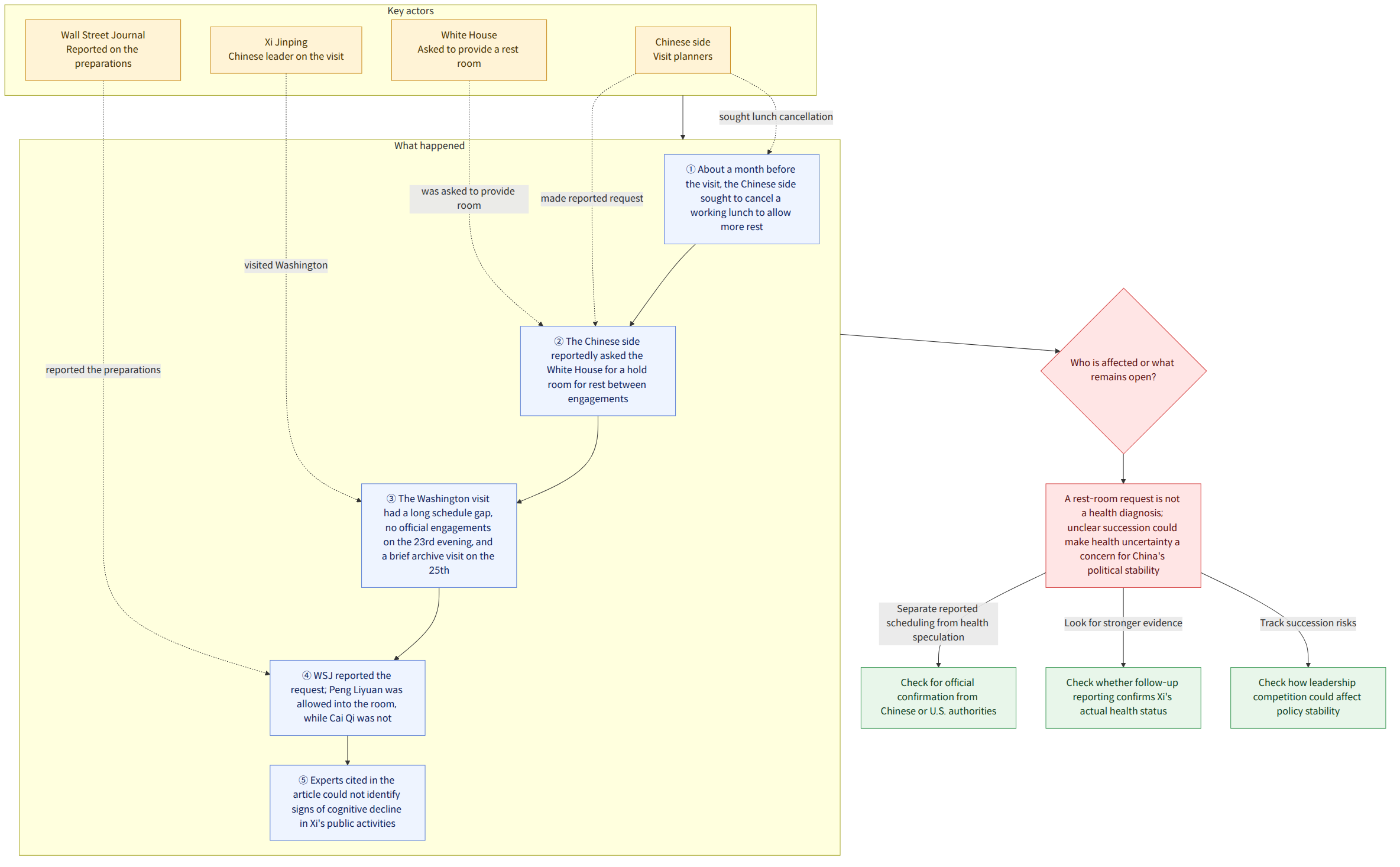
When Chinese President Xi Jinping visited Washington for a summit with U.S. President Donald Trump, the Chinese side reportedly asked the White House to provide a separate place for him to rest, called a “hold room.” The request was reportedly intended to secure a place for him to rest between engagements. However, neither the request nor a gap in the schedule can confirm that Xi has health problems.
Background and context
The Wall Street Journal (WSJ) reported on the 2nd (local time), citing people familiar with preparations for Xi’s visit to the United States, that the Chinese side had requested a hold room. According to the report, only Xi’s wife, Peng Liyuan, was allowed into the room; even Cai Qi, a member of the Standing Committee of the Political Bureau of the Communist Party of China and one of Xi’s closest aides, was not permitted to enter. Dennis Wilder, who served as the senior director for China on the National Security Council under the George W. Bush administration, described providing a dedicated room for rest as “unusual.”
The Chinese side reportedly began asking a month before the visit for a working lunch with Trump, scheduled for September 24, to be canceled. It conveyed a desire to allow Xi more time to rest, and reports said a gap of about five hours opened up during his stay in Washington, which lasted less than 48 hours. There were no official engagements on the evening of the 23rd, the day he arrived, and his visit to the National Archives and Records Administration on the 25th lasted about 10 minutes.
Speculation about health problems has also arisen in the past in response to public appearances or movements. The article said claims that Xi had a brain-related condition circulated on social media and elsewhere in 2024, but were found to be untrue; for example, a photo cited as evidence was confirmed to have been taken four months earlier.
There is also room for other interpretations of this schedule. Xi had just completed a roughly 14-hour flight from Beijing, and reports also suggested that the 12-hour time difference and fatigue may have been factors. Experts who study China’s leadership told the WSJ that they could not identify signs of cognitive decline in Xi’s public activities.
What this news means
The key is to distinguish the report that “a request for a place to rest was made” from the conclusion that “a health problem has been confirmed.” The article reports on the request and the scheduling; it is not a diagnosis of Xi’s actual health. The fact that rest time was included in the visit schedule is not, by itself, evidence of a health problem.
Even so, the issue has drawn attention because Xi’s health is linked to the question of succession in China. The article explains that Xi has consolidated power without putting forward a clear successor. In a report published last November, the Brookings Institution noted that as Xi grows older, the succession question could move to the forefront of Chinese politics and trigger power struggles within the top leadership. The report also raised concerns that policy could become unstable if such competition affects decision-making.
For example, even if new information emerges about a leader’s health or public activities, it is more reasonable to distinguish confirmed scheduling information from speculation rather than immediately interpret it as a change in the succession process or a deterioration in health, unless there is official confirmation. This distinction helps prevent uncertainty about one leader’s health from being confused with analysis of China’s future political stability.
What is confirmed and what remains unknown
Confirmed facts
- The WSJ reported that the Chinese side asked the White House for a hold room so Xi could rest between engagements.
- According to the report, Peng Liyuan was allowed into the room, but Standing Committee member Cai Qi was not.
- The visit schedule had no official engagements on the evening of the 23rd, and the visit to the National Archives and Records Administration on the 25th lasted about 10 minutes.
- Experts who study China’s leadership and were quoted in the article said they could not identify signs of cognitive decline in Xi’s public activities.
What remains unknown
- What was the exact reason the Chinese side requested a hold room?
- What is Xi’s actual health status?
- Have the Chinese or U.S. governments issued an official statement about the reported request?
What readers should check
- If follow-up reports emerge, distinguish the report about a “request for a place to rest” from speculation about Xi’s health.
- Check whether the Chinese or U.S. government issues a new official statement. The article provided here contains no official position from either government.
- Keep in mind that analysis linking health concerns to the succession question reflects points raised in an expert report, and is not something confirmed by this visit to the United States alone.