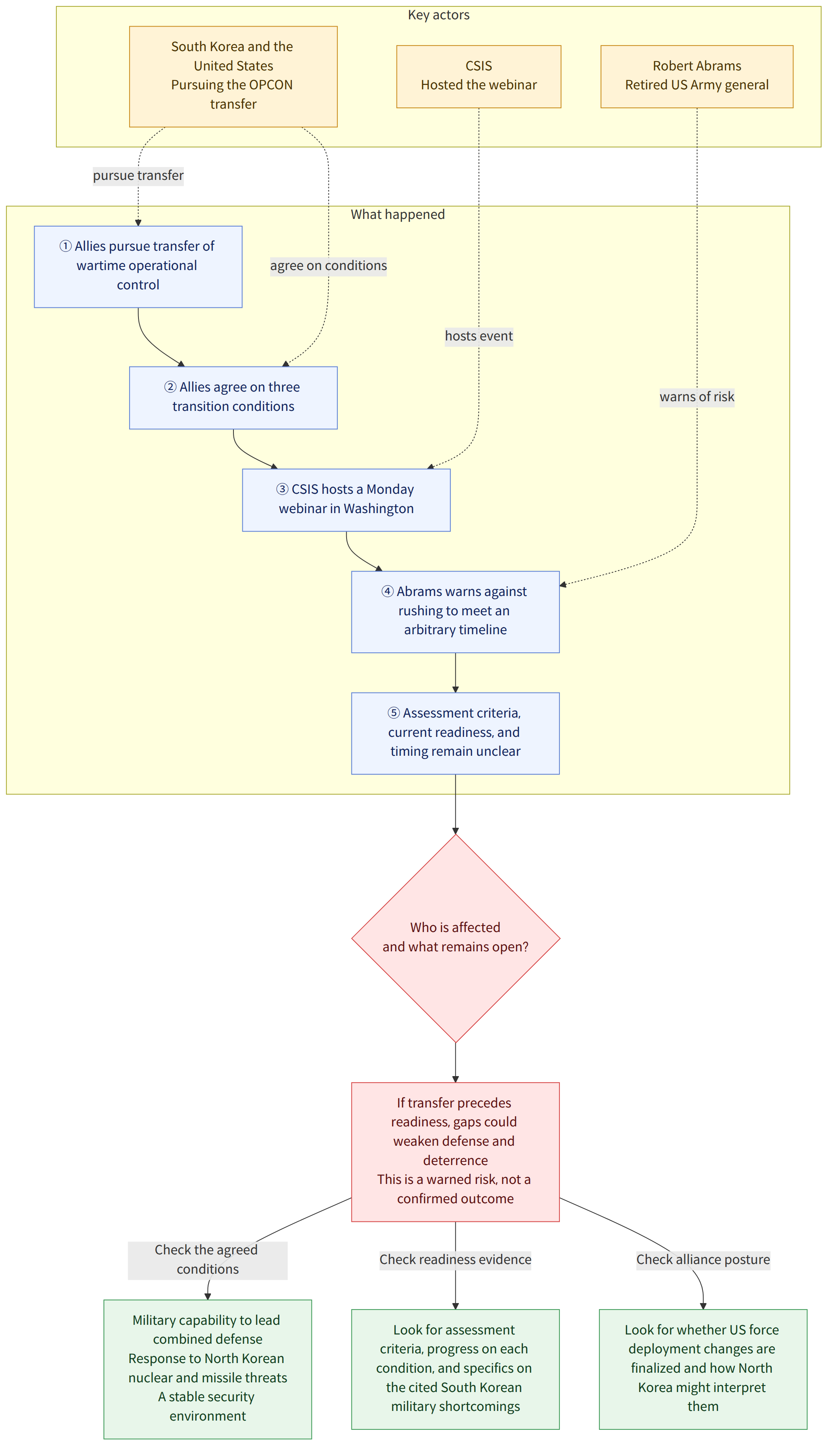
Retired U.S. Army Gen. Robert Abrams warned at a Monday webinar hosted by the Center for Strategic and International Studies (전략국제문제연구소, CSIS) in Washington that rushing the transfer of Operational Control (OPCON, 전시작전통제권)—the authority to control combined military operations during wartime—to South Korea to meet an arbitrary timeline could increase security risks and weaken the U.S.-South Korea alliance’s deterrence against North Korea. Abrams served as commander of U.S. Forces Korea from 2018 to 2021. The webinar discussed the long-running effort by South Korea and the United States to transfer OPCON.
Background and context
The OPCON transition is both a process of transferring authority from one side to the other and a question of whether South Korea and the United States will be ready to carry out combined defense and deterrence missions after the transition. Abrams said that, in his view and based on his experience, the risks of rushing the transfer or trying to meet a timeline had not been adequately explained. In particular, he cited lingering operational shortcomings on the South Korean military’s side as grounds for concern.
According to the report, South Korea and the United States have agreed on three conditions for the OPCON transition: the military capabilities to lead combined defense; the alliance’s comprehensive ability to respond to North Korea’s nuclear and missile threats; and conditions on the Korean Peninsula and in the region that are conducive to a stable transition. The issue, therefore, is not limited to whether to set a particular year; it also concerns how to determine whether these conditions have actually been met.
What this means
Focusing on accelerating the timing of the transition could create tension between the schedule and the process of confirming that the necessary capabilities are in place. Abrams’s warning is that if the transition takes place before the conditions are met, military gaps could emerge and those gaps could weaken defense and deterrence. This is a risk he identified, not an established fact that the transition would immediately weaken deterrence.
Those affected include not only the South Korean and U.S. military commands, but also security policymakers in South Korea and the United States who rely on combined defense and deterrence against North Korea. Whether the transition is driven by political goals or a timeline, or judged on the basis of military readiness, matters because it could affect the alliance’s division of responsibilities and operational preparedness. For example, if a specific date is set in advance but the necessary capabilities are not in place by then, the operational gaps Abrams warned about could become an issue.
Abrams also raised concern that the OPCON transition and possible changes to the deployment of U.S. forces in South Korea could lead North Korea to miscalculate. However, the report does not establish whether any actual changes to deployments have been finalized or how North Korea might interpret them. His warning underscores that discussions of the transition must consider not only South Korea’s capabilities, but also the alliance’s combined posture and how the other side perceives it.
What is known and what remains unclear
What is known
- Abrams warned that rushing the OPCON transfer to meet an arbitrary timeline could increase risks.
- He said operational shortcomings remain on the South Korean military’s side.
- According to the report, the conditions for the transition agreed upon by South Korea and the United States are military capabilities, the ability to respond to North Korea’s nuclear and missile threats, and a security environment conducive to a stable transition.
- Abrams served as commander of U.S. Forces Korea from 2018 to 2021 and spoke at a CSIS webinar.
What remains unclear
- What specific assessment criteria do South Korea and the United States apply when evaluating each transition condition?
- What specific capabilities or tasks did Abrams mean when he referred to the South Korean military’s operational shortcomings?
- How well is each condition currently being met, and how will the timing of the transition be determined?
What readers should watch for
- In announcements about the OPCON transition, readers should look not only for whether a timeline is given, but also for explanations of whether each of the three conditions has been met and the grounds for that assessment.
- Readers can look for whether the South Korean military’s operational shortcomings are disclosed in specific terms, and how the tasks for addressing them and the state of readiness are described.
- If changes to the deployment of U.S. forces in South Korea or the U.S.-South Korea combined defense posture are mentioned, readers should distinguish between confirmed measures and warnings or assessments about possibilities.
References
- Other coverage consulted: chosun.com