
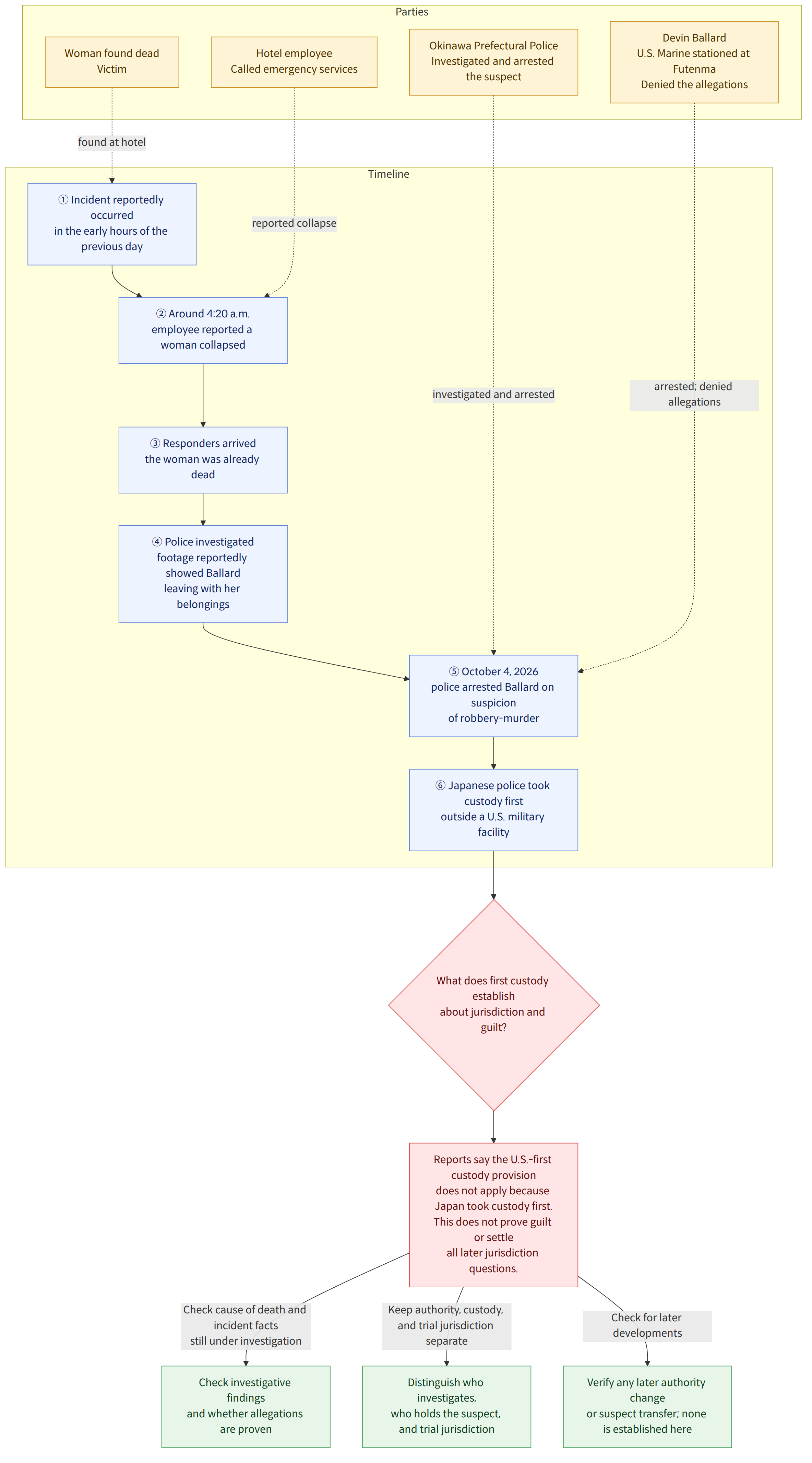
Okinawa Prefectural Police (오키나와현 경찰) arrested U.S. Marine Devin Ballard, who was stationed at Futenma Air Station (후텐마 비행장), on suspicion of robbery-murder on October 4, 2026, in connection with a woman found dead at a hotel in Naha, Okinawa Prefecture, Japan. According to reports, the incident occurred in the early hours of the previous day, and a hotel employee called emergency services at around 4:20 a.m. to report that a woman was unconscious and collapsed. Emergency responders arrived, but the woman was already dead. Ballard was reported to have denied the allegations, saying he knew nothing about the incident.
Background and context
Police reportedly identified as a suspect a foreign national who had entered the hotel room with the victim and pursued the person, while setting up a special investigation headquarters of more than 200 people. Hotel security camera footage reportedly showed Ballard leaving the hotel with the woman’s belongings, including her wallet and backpack. The woman’s belongings were later found near the hotel.
These details were reported as information uncovered during the investigation, but they do not by themselves establish the cause of death, the precise circumstances of the crime, or whether the allegations can be proven. Police were reported to be planning to investigate the woman’s specific cause of death and the circumstances of the incident. The fact of an arrest must be distinguished from a finding of guilt.
Okinawa, where the incident took place, is difficult to view separately from issues surrounding the U.S. military presence. According to Okinawa Prefecture statistics cited in reports, more than 6,000 criminal cases involving U.S. military personnel, civilian employees and their family members were recorded between 1972 and 2025, including more than 600 involving serious crimes. Okinawa Prefecture accounts for 0.6% of Japan’s land area, while about 70% of U.S. military base facilities in Japan are located there.
What this news means
Alongside the investigation into the individual allegations, this case has drawn attention to which authority investigates and takes a suspect into custody when an incident occurs in a region with a large U.S. military presence. According to reports, the U.S.-Japan Status of Forces Agreement (미·일 지위협정) stipulates that Japan has the primary right to exercise jurisdiction when a U.S. military member or civilian employee commits an offense unrelated to official duties. However, there is a provision under which U.S. authorities retain custody until the suspect is brought to trial if they take custody first. Reports said that provision does not apply in this case because Japanese police took Ballard into custody first, outside a U.S. military facility.
What has been established in this case, therefore, is that Japanese police apprehended Ballard first, along with the reported explanation of how the agreement’s custody provision applies. This does not predetermine the truth of the allegations or the final outcome of a trial. Readers should distinguish among investigative jurisdiction, which authority actually holds the suspect, and whether the allegations are proven in court.
For example, if future reports say that the investigative authority has changed or that the suspect has been transferred to another authority, those facts should be checked separately from explanations of trial jurisdiction. The reports currently available do not establish whether any such change has occurred.
Relevant legal frameworks and support information
The key point in the reports’ explanation of the U.S.-Japan Status of Forces Agreement is that Japan’s priority in exercising jurisdiction and the question of which authority holds a suspect are separate issues. In this case in particular, reports said that, because Japanese police took the suspect into custody first outside a U.S. military facility, the provision concerning cases in which U.S. authorities take custody first does not apply. However, the reports do not explain subsequent investigative or trial procedures, or any final determination of jurisdiction.
The accompanying materials based on Legal Aid Corporation (법률구조공단) consultation cases L1 and L2 provide guidance on South Korean criminal procedure and criminal law. Therefore, procedures mentioned in the South Korean materials—such as a review of the legality of detention (구속적부심사), in which a suspect who has been arrested or detained asks a court to review whether the detention is lawful, or bail (보석), in which a defendant who has been indicted asks a court to release them—cannot simply be applied to this case in Japan. The reports provided do not establish what procedures are available in Japan in this case or whether the suspect is actually being held in detention.
The distinction L2 describes in assessing criminal cases in general can, however, be useful when reading the reports. It explains that a murder charge is not established by the fact of death alone; the causal link between the act and the death, intent to kill and other elements must be proven. This is an explanation in a South Korean legal guide and does not replace the specific standards applied in a Japanese court. It should be used only as a reminder not to treat the reported arrest and circumstances as a final judgment.
What is known and what remains unknown
What is known
- According to reports, the woman was found dead in a hotel in Naha in the early hours of October 3, and a hotel employee called emergency services at around 4:20 a.m.
- Okinawa Prefectural Police arrested U.S. Marine Devin Ballard, who was stationed at Futenma Air Station, on suspicion of robbery-murder.
- Police set up a special investigation headquarters of more than 200 people, and reports said hotel security camera footage showed Ballard leaving with the woman’s belongings.
- Ballard was reported to have denied the allegations, and reports said the woman’s belongings were found near the hotel.
- According to reports’ explanation of the agreement, Japanese police took the suspect into custody first, outside a U.S. military facility, so the provision concerning U.S. authorities taking custody first does not apply in this case.
What remains unknown
- What was the woman’s specific cause of death?
- What exactly happened, and have the allegations against Ballard been proven by evidence?
- What was the relationship between the woman and Ballard?
- What procedures will be followed in the subsequent investigation and trial, and what will the final ruling be?
What readers should check
- Look for official confirmation of the cause of death and the circumstances of the incident in follow-up reports. The current reports say only that police plan to investigate these matters.
- Distinguish reports about the arrest and investigation from whether charges are filed and the outcome of a trial. Neither the denial of the allegations nor the fact of the arrest determines guilt.
- If reports about the U.S.-Japan Status of Forces Agreement change or provide further explanation, check separately what they say about trial jurisdiction and which authority actually holds the suspect. These are not the same issue.