A Promise Under the Sun, and 22 Years of Waiting
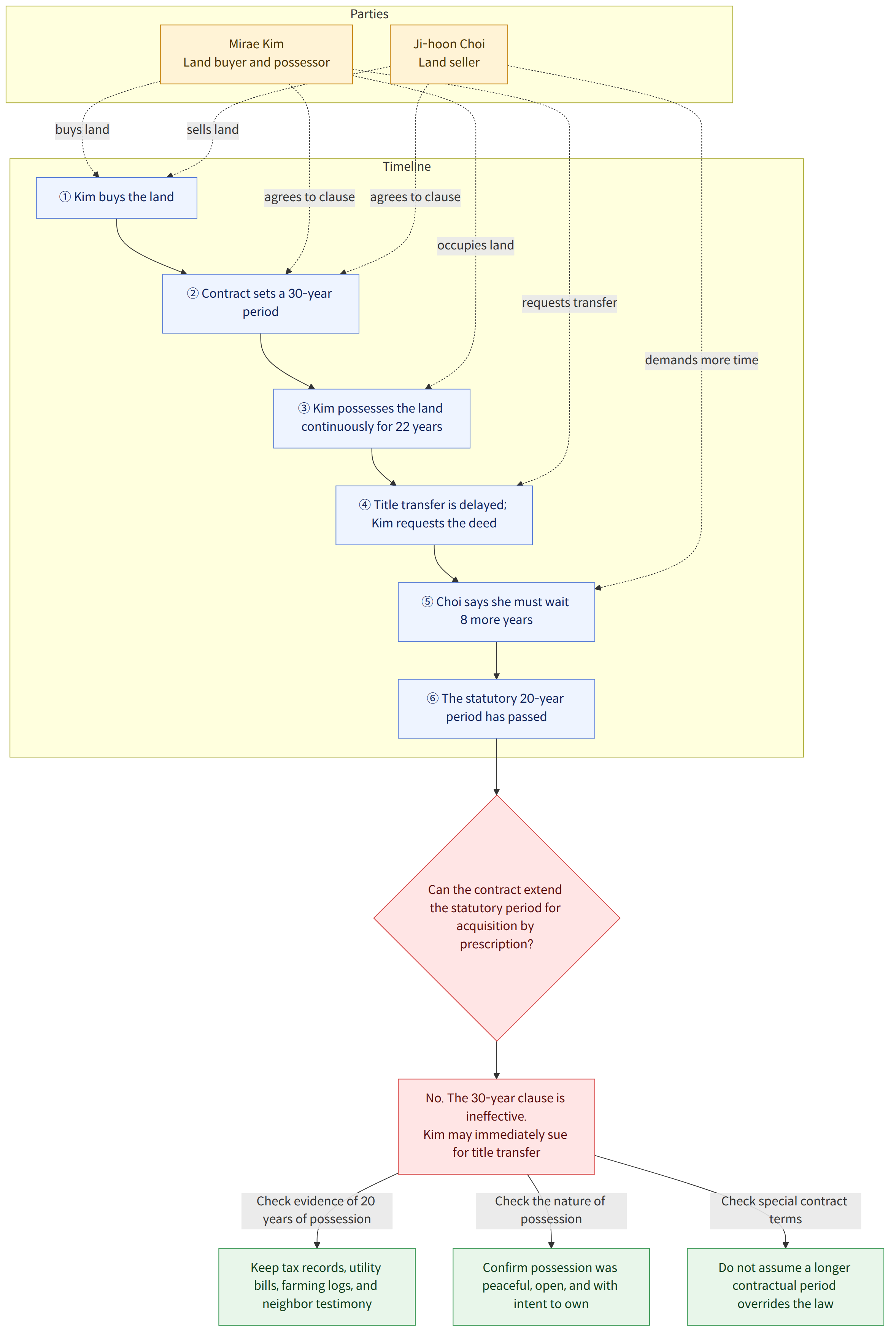
Twenty-two years ago, Mirae Kim purchased a small plot of land on the outskirts of Gyeonggi-do to fulfill her dream of a quiet rural life. The seller, Ji-hoon Choi, was deeply attached to the land, claiming it had been in his family for generations. To ease his mind, the two added a unique clause to their contract: "The period for acquisition prescription for this property shall be 30 years, notwithstanding the Civil Act."
Mirae Kim believed that a mutual agreement between two parties was more powerful than the law. Since then, she has poured her heart into the land, building a greenhouse and tending to a small orchard. Due to some complicated administrative issues, the formal title transfer was delayed, but she occupied the land continuously for 22 years. When she finally approached Ji-hoon Choi to demand the official transfer of the deed, he pointed to the old contract. "It hasn't been 30 years yet," he said. "You agreed to wait. Come back in 8 years."
Does Mirae Kim really have to wait another 8 years, or does the law offer her a different path?
The Legal Question: Can a Contract Extend the Statutory Period?
The core issue in this case is whether a private agreement to extend the period of possessory acquisition prescription (from the legal 20 years to 30 years) is legally binding in South Korea.
What Korean Law Says
The Korean Civil Act provides clear guidelines on how one can acquire property through long-term possession:
Civil Act Article 245 (Period for Acquiring Ownership of Real Estate by Possession)(1) A person who has for twenty years peaceably and openly held possession of real estate with an intention to own shall acquire the ownership thereof by making registration thereof.
Furthermore, regarding the modification of such timelines by private parties, the law sets a strict boundary under the principles of prescription:
Civil Act Article 184 (Waiver, etc. of Benefit of Prescription)(2) The extinctive prescription may not be excluded, extended or aggravated by a legal act, but it may be shortened or mitigated.
While Article 184, Paragraph 2 specifically mentions "extinctive prescription" (the loss of a right due to time), Korean legal scholars and courts apply this rule by analogy to "acquisition prescription." In short, any agreement that makes it harder or takes longer for a person to acquire a right through the passage of time is considered invalid.
How Korean Courts Approach This
Korean courts view the system of prescription as a matter of "public order" and "legal certainty." The law sets specific timeframes to ensure that property relations do not remain unstable for an indefinite period. If private individuals were allowed to extend these periods at will, it would undermine the statutory framework designed to settle legal disputes predictably. Therefore, a special agreement that extends the 20-year period to 30 years is generally ruled null and void as it violates the mandatory nature of the prescription laws.
Applying the Law to the Case: Mirae's Rights
Applying these principles to Mirae Kim's situation, we find that the "30-year clause" holds no legal water.
- Invalidity of the Clause: The special agreement to extend the period to 30 years is legally ineffective because it disadvantages the possessor beyond what the law allows.
- 20-Year Milestone: Mirae Kim has already occupied the land for 22 years, exceeding the 20-year requirement set by Article 245.
- Nature of Possession: Unless proven otherwise, her possession is presumed to be "with the intent to own" (자주점유) and has been peaceful and open.
Consequently, Mirae Kim does not need to wait another 8 years. The legal requirement for acquisition prescription was fulfilled at the 20-year mark. She has the right to file a lawsuit against Ji-hoon Choi for the transfer of the title immediately.
Conclusion: What Happened, and What Should You Do?
Ultimately, Mirae Kim can successfully claim her land today, as the clock of the law runs faster than the clock of her flawed contract. For readers who might find themselves in a similar property dispute, keep these two practical tips in mind:
First, statutory periods often override private "special agreements." Do not assume you are bound by a contract clause that demands a longer waiting period than the Civil Act requires. Law, particularly property law (物權法), often consists of "mandatory provisions" that individuals cannot change by agreement.
Second, meticulously document your possession. To win an acquisition prescription case, you must prove you treated the land as your own for the full 20 years. Keep tax records, utility bills, farming logs, and testimonies from neighbors. These pieces of evidence are the keys to turning your long-term possession into a permanent legal deed.