1. A Human Story
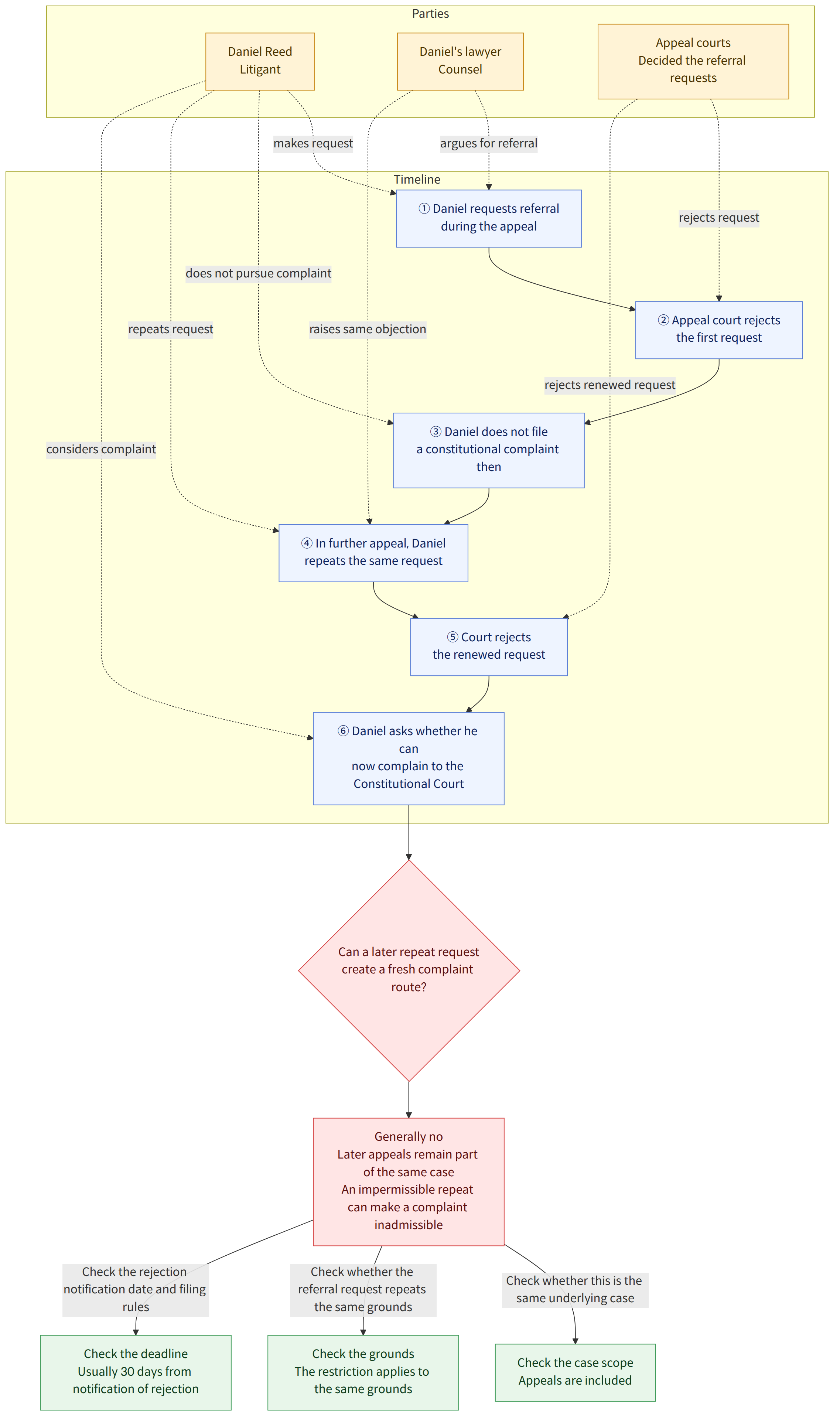
Daniel Reed had spent months contesting a court decision that threatened to undo a carefully built business arrangement. In the appeal proceedings, his lawyer argued that a law central to the dispute violated the Constitution and asked the court to refer the issue to the Constitutional Court. The request was rejected. Daniel was frustrated, but he did not file a constitutional complaint.
The case moved on to the next stage: a further appeal. Daniel and his lawyer raised the same constitutional objection and again asked the court to refer the law for review. That request, too, was rejected. Only then did Daniel ask whether he could take the constitutional question directly to the Constitutional Court.
His predicament is a reminder that constitutional procedure is not simply a series of chances to repeat an argument. The timing—and whether a party has already made the same request in the same case—can determine whether the Constitutional Court will hear the complaint at all.
2. The Legal Question
When a court rejects a request to refer a statute for constitutional review, can the party skip a constitutional complaint, repeat the same request on the same grounds in a later appeal, and then file a constitutional complaint after that second rejection?
Under Korean law, the answer is generally no. The later appeal is part of the same case for this purpose, and repeating the same request can bar the subsequent complaint.
3. What Korean Law Says
Article 68(2) of the Constitutional Court Act provides a route for a litigant to challenge a statute’s constitutionality after the court handling the case rejects a request to refer that question to the Constitutional Court. This procedure is often called a constitutional complaint following rejection of a referral request.
The provision also imposes an important limit:
When a request for referral of a statute’s constitutionality is rejected, the party who made the request may file a constitutional complaint with the Constitutional Court. However, that party may not again request a referral on the same grounds in the proceedings of the underlying case.
The phrase “proceedings of the underlying case” is not confined to the court level where the first request was made. It includes the later appellate proceedings in that same case. In practical terms:
- A party whose referral request is rejected may choose to pursue a constitutional complaint under Article 68(2).
- The party cannot make the same referral request again, on the same grounds, in a later stage of the same case.
- A further rejection of that renewed request does not ordinarily create a fresh route to a constitutional complaint. The repeat request itself conflicts with the statutory limit.
A constitutional complaint under Article 68(2) is also subject to a filing deadline. The usual deadline is 30 days from notification that the referral request was rejected. Because deadline calculations can depend on the procedural details, a litigant should confirm the applicable date and requirements immediately.
4. How Korean Courts Approach This
The Constitutional Court interprets the statutory restriction as covering the entire course of the underlying case, including its appeals. The rule is not read as allowing a litigant to make one request in an appellate court, wait, and then make the same request again in a higher court before seeking constitutional review.
The reasoning is procedural as well as practical. Article 68(2) gives a party a means to bring a constitutional issue before the Constitutional Court after a referral request is denied. The accompanying restriction prevents the party from using repeated requests in the ordinary case to postpone the choice or to obtain a new opportunity after each rejection.
The key distinction is between pursuing a constitutional complaint after a denial and repeating the same referral request in the same case. A later appeal does not, by itself, turn the case into a new proceeding for this rule.
As a result, courts generally treat a complaint filed after an impermissible repeat request as inadmissible, rather than deciding whether the challenged statute is actually constitutional. The procedural bar can therefore end the matter without a ruling on the substance of the constitutional argument.
5. Applying the Law to the Case
Daniel’s situation follows the rule step by step:
- His first request was rejected. In the appeal proceedings, Daniel asked the court to refer the statute for constitutional review. The court denied that request, which opened the Article 68(2) complaint route, subject to the statutory deadline and other requirements.
- He did not pursue that route at the time. Daniel chose not to file a constitutional complaint after the first rejection. That decision did not preserve a right to keep making the same referral request at later stages.
- He renewed the request in the same case. In the further appeal, Daniel raised the same constitutional grounds and asked again for a referral. Although the court level had changed, the further appeal remained part of the proceedings in the underlying case.
- The second rejection did not erase the problem. Daniel could not treat the renewed request as a wholly new first request merely because it was made in a higher court. The statute’s restriction had already applied across the case’s appellate stages.
- A complaint after the second rejection would therefore face an admissibility bar. The Constitutional Court would be expected to reject the complaint as procedurally inadmissible, without reaching the merits of Daniel’s constitutional challenge.
The critical point is not that Daniel’s constitutional argument was necessarily weak. It is that he repeated the referral request in a later stage of the same case instead of using the procedure available after the first rejection.
6. Conclusion: What Happened, and What Should You Do?
Daniel’s constitutional complaint, filed after the second rejection, would be inadmissible because he renewed the same referral request on the same grounds in the further appeal. The fact that he had not filed a complaint after the first rejection would not make the second request permissible or restart the process. The Constitutional Court could therefore dismiss his complaint without deciding whether the law he challenged was unconstitutional.
For anyone facing a similar situation:
- Choose your next step promptly after a rejection. Ask counsel whether to file an Article 68(2) complaint and confirm the deadline, which is generally 30 days from notification of the rejection.
- Do not repeat the same referral request on the same grounds in a later appeal. The restriction can follow the case through its appellate stages.
- Keep a clear record of dates and filings. Preserve the rejection notice, proof of when it was received, and copies of each application so the available procedure and deadline can be assessed accurately.