1. A Human Story
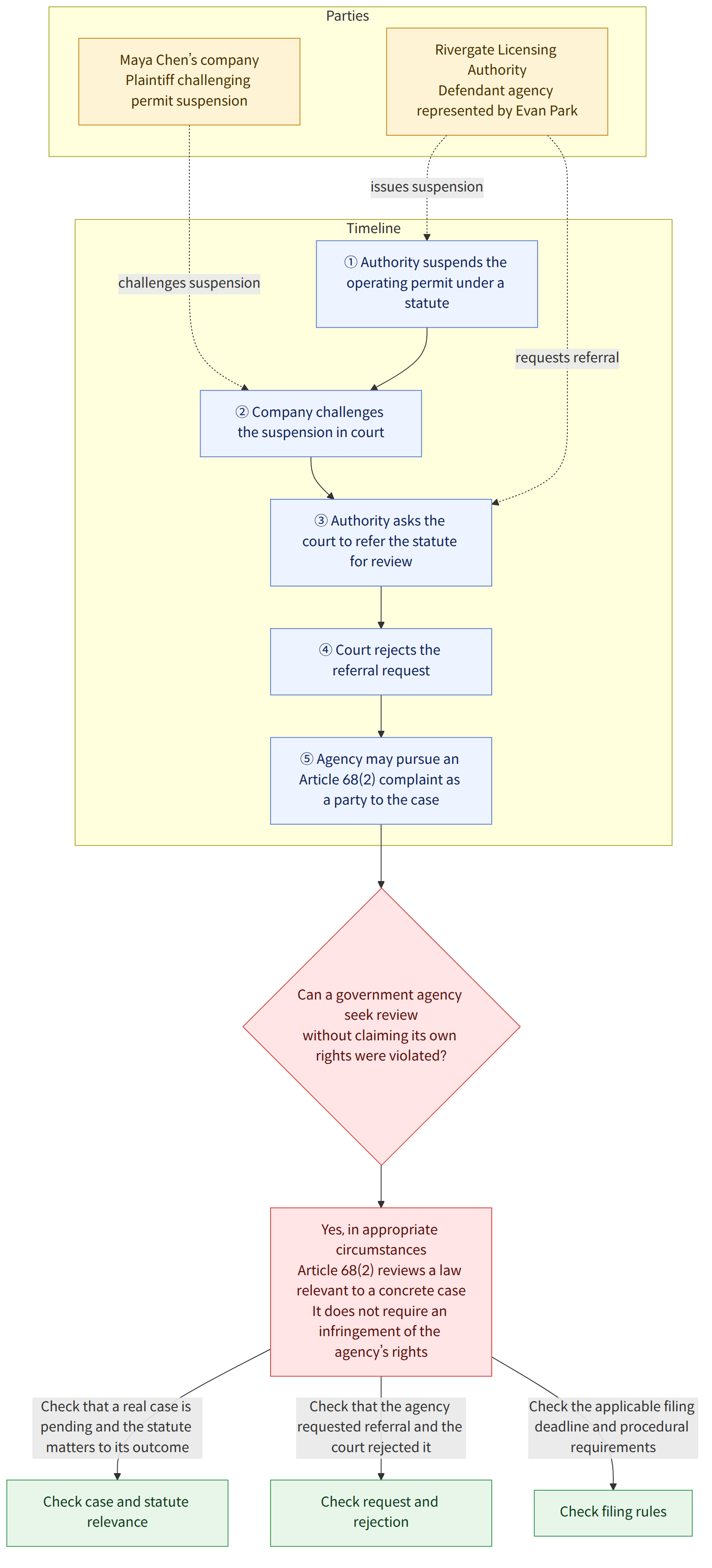
When a small logistics company challenged the suspension of its operating permit, Maya Chen expected the usual courtroom battle: whether the agency had followed the rules and whether the suspension was justified. The defendant was the fictional Rivergate Licensing Authority, represented by its director, Evan Park.
The Authority had imposed the suspension under a statute that appeared to require it to act once certain conditions were met. Park believed the statute itself raised a serious constitutional problem. But the Authority could not simply ignore a law because it thought the law was unconstitutional. In the lawsuit brought by Chen’s company, it asked the court to refer the statute to the Constitutional Court. The court refused.
Park then faced an unexpected question: as a public agency, could the Authority take the dispute further? It could not claim that the statute had violated the Authority’s own fundamental rights. But the case involved a different kind of constitutional complaint—one tied to a law whose validity mattered to an actual lawsuit.
2. The Legal Question
Can the state, or a government agency acting as a party in court, file a constitutional complaint under Article 68(2) of the Constitutional Court Act after a court rejects its request to refer a relevant statute for constitutional review?
The answer is yes, in appropriate circumstances. The reason is that Article 68(2) is not a claim that the government’s fundamental rights have been infringed. It is a procedural route for reviewing the constitutionality of a law that is at issue in a concrete court case.
3. What Korean Law Says
Korean law provides two different routes commonly described as constitutional complaints. Their purposes and eligibility rules are not the same.
Article 68(1): a rights-based complaint
A complaint under Article 68(1) is generally available to a person or other rights-holder who claims that public power has infringed their fundamental rights. The state and its agencies are ordinarily not treated as holders of those individual rights. They exercise public authority and have responsibilities to protect and realize the rights of the public.
Article 68(1) is a remedy for a claimed infringement of fundamental rights. A public authority cannot use it simply to assert that its own constitutional rights have been violated.
Article 68(2): review of a law in a concrete case
Article 68(2) works differently. If the constitutionality of a statute is relevant to a pending court case, a party may ask the court handling that case to refer the question to the Constitutional Court. If the court rejects that request, the party that made it may file a constitutional complaint under Article 68(2).
Article 68(2) does not require the complainant to show that its own fundamental rights were infringed. Its focus is whether a law that matters to a concrete case is constitutional.
The key requirements are therefore:
- There must be a real court case, not an abstract disagreement about a statute.
- The statute’s constitutionality must be relevant to deciding that case.
- The complainant must have asked the court to refer the constitutional question under Article 41(1) of the Constitutional Court Act.
- The court must have rejected that request.
- The Article 68(2) complaint must be filed by the party that made the request, in accordance with the applicable procedural deadline and requirements.
For this purpose, “party” is not limited to a private individual. It can include a government agency that is a party to litigation, including an agency defending an administrative action.
4. How Korean Courts Approach This
Korean constitutional review distinguishes between who may claim a personal fundamental right and who may ask for review of a statute in the course of litigation. The first question is central to Article 68(1); the second is central to Article 68(2).
Courts have reasoned that a government agency cannot decide, at the administrative stage, to disregard a statute on the ground that it is unconstitutional. Doing so would allow an administrative authority to set aside legislation on its own, raising concerns about the separation of powers.
But once an administrative action is challenged in court, the court may have to consider not only whether the agency acted lawfully, but also whether the statute authorizing or requiring that action is constitutional. In that setting, the agency is a litigant in a concrete case. The courts have therefore recognized that it may ask for referral and, if refused, pursue an Article 68(2) complaint.
The agency’s ability to seek review does not turn it into a holder of fundamental rights. It follows from its status as a party to a concrete case in which the constitutionality of a governing statute may affect the judgment.
5. Applying the Law to the Case
The Rivergate Licensing Authority’s position can be assessed step by step.
- The Authority cannot rely on Article 68(1) as though it were an individual. It cannot say that the statute infringed its personal freedom or another fundamental right. Its role is to administer the law, not to claim the individual rights the Constitution protects.
- The Authority is involved in a genuine lawsuit. Chen’s company has challenged the suspension of its permit, and the Authority is defending the administrative action. This is not an attempt to obtain an advisory opinion about a law unrelated to any dispute.
- The statute may matter to the court’s decision. If the statute required or authorized the suspension, its constitutionality could affect how the court resolves the challenge. The Authority cannot make the statute’s validity irrelevant simply by calling the dispute an administrative one.
- The Authority used the required route in the trial court. It asked the court to refer the constitutional issue under Article 41(1). The court rejected that request. That refusal is the procedural condition that opens the door to an Article 68(2) complaint.
- The Authority may then seek constitutional review as a party. Its standing would arise from its role in the lawsuit and the function of Article 68(2), not from any claim that the state itself has fundamental rights.
The important limit is that this route does not let an agency challenge any law it dislikes. The constitutional question must be connected to an actual case, and the agency must follow the prescribed referral process. Nor does the right to file decide the merits: the Constitutional Court may ultimately find the statute constitutional.
6. Conclusion: What Happened, and What Should You Do?
Park’s Authority could not file a rights-based complaint under Article 68(1) merely because it objected to the statute. But after becoming a party to Chen’s lawsuit, asking the court for a referral, and receiving a refusal, it could use Article 68(2) to seek review of the law at the center of the dispute. In this fictional case, the complaint is not barred simply because the complainant is a government agency; the Constitutional Court can proceed to consider the constitutional question if the other procedural requirements are met.
That does not establish that the statute is unconstitutional, or excuse the Authority from applying it while the administrative process is underway. It means only that the agency may ask the Constitutional Court to resolve the question through the proper judicial channel.
If you are involved in a similar dispute:
- Identify the route carefully. A claim of personal rights infringement under Article 68(1) is different from a request for statutory review under Article 68(2).
- Raise the issue in the pending case. Ask the court handling the dispute to refer the relevant statute under Article 41(1); an Article 68(2) complaint generally follows only if that request is denied.
- Protect the procedural record and deadline. Keep the referral request and denial, confirm that the statute truly affects the case, and obtain legal advice promptly about filing requirements.