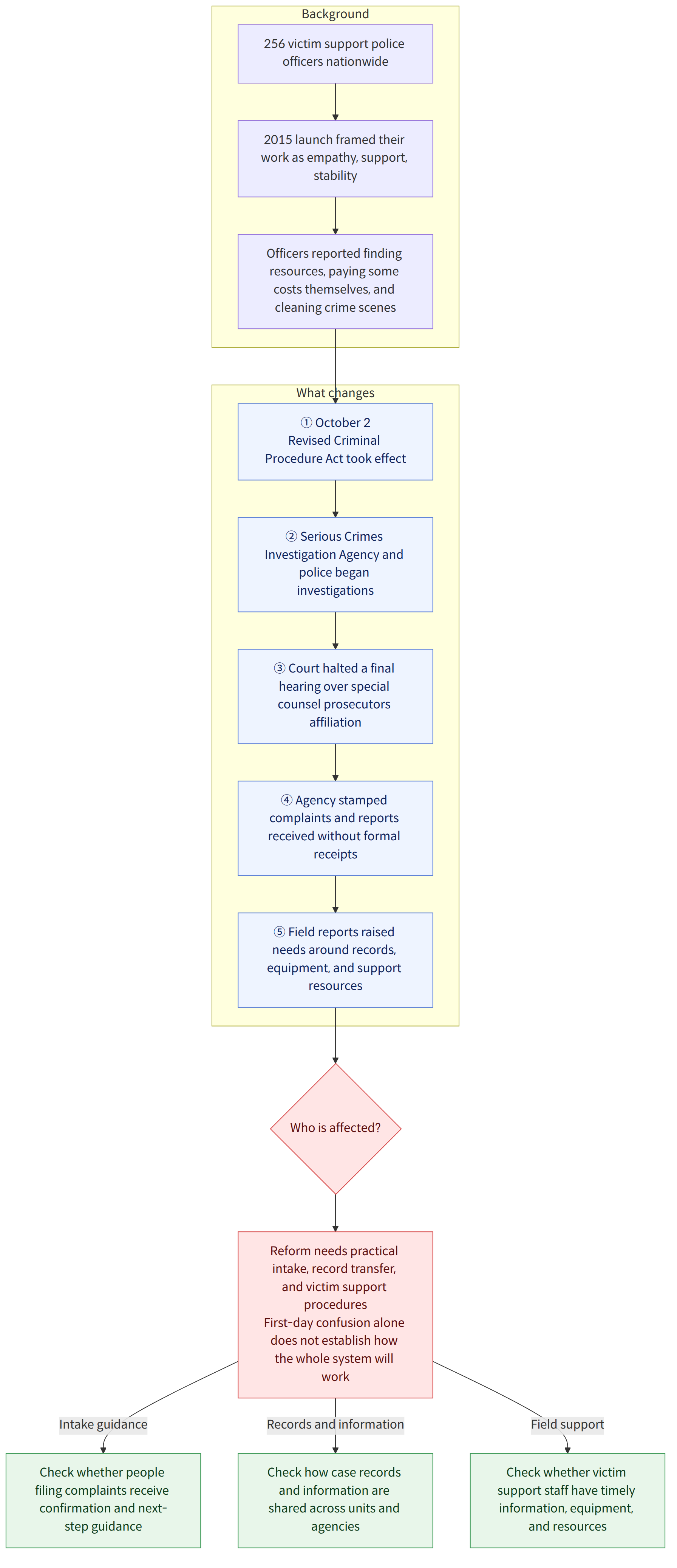
On October 2, the criminal justice system changed, and the Serious Crimes Investigation Agency (중대범죄수사청) and police began handling investigations. However, reports said that a trial was halted on the first day of implementation over the affiliation of prosecutors assigned to a special counsel team, and that the Serious Crimes Investigation Agency stamped “received” on complaints and reports instead of issuing formal receipts. Considered alongside the difficulties facing victim support in the field, these incidents show that institutional reform cannot function on the basis of new agencies and declarations alone; it also needs concrete practical arrangements for receiving cases, handling records, and supporting victims.
Background and context
A column by Bang Jun-ho described the work of victim support police officers covered by reporter Park Chan-hee and said there are 256 of them nationwide. On February 12, 2015, the National Police Agency (경찰청) held a “Victim Support Police Officer Launch Ceremony” (피해자 전담 경찰관 발대식) in its main auditorium. The scope of their work was then set out in three stages: “empathy → support → stability.”
But the work of the officers featured in the column does not appear to run as smoothly as that declaration suggested. They described searching for support budgets or corporate sponsorship, sometimes paying expenses themselves, and even cleaning blood from crime scenes themselves.
Issues with records and equipment were also raised. The officers said they wanted each police station to be provided with one tablet computer, and reported that documents are often lost in the process of receiving and scanning paper records. Because support work aims to ease victims’ anxiety and distress, the shortage of information and equipment is notable as a potential additional burden for staff in the field.
The column also reported that, on the first day the revised Criminal Procedure Act (개정 형사소송법) took effect, the trial court raised an issue over the affiliation of prosecutors assigned to special counsel teams, halting the final hearing in the “alleged favoritism in the relocation of the presidential residence” case. The Serious Crimes Investigation Agency had not prepared a case-receipt form and stamped only “received” on complaints and reports; the column also said part of the agency’s sign fell off the wall when the cloth covering it was removed at its unveiling ceremony.
According to the photo caption, immediately after its launch, the Serious Crimes Investigation Agency had some executives and staff come in on its first holiday to work on preparations for investigations. This shows that the organization began preparations, but does not indicate when or to what extent intake forms or procedures between agencies were put in place.
What this news means
When the roles of investigative agencies change, practical questions arise over where cases are received, how records are transferred, and what procedures connect investigations with prosecutions. The column also noted changes in the links between investigations and prosecutions, procedures for requesting supplementary investigations and conducting reinvestigations, and the volume and categories of cases subject to investigation. The confusion on the first day alone, however, is not enough to determine how the new system as a whole will operate. Instead, it is necessary to keep checking whether the documents, information, and communication among staff needed in the field are in place.
The effects are not limited to investigative agencies. People reporting a case or filing a complaint or report may need a document confirming receipt and guidance on the next steps. If police officers responsible for victim support cannot obtain case information in time or have to find support resources themselves, they may need to spend more time and effort reaching out to victims and helping them. These are concerns that follow from the field conditions described in the column; they do not mean that the same problems will arise in every case after the reform.
For example, if a crime victim seeks support from the police, it may be important for the case-handling unit and victim support staff to share the necessary information and clearly explain the intake and support procedures. However, the column does not say whether the issue of access to KICS will be addressed or how information sharing will work under the new system.
Related procedures and support information
Separate from organizational changes to the criminal justice system, victims have procedures available during criminal trials. According to an in-house legal guide, direct victims of certain crimes may apply for a Compensation Order for damages such as medical expenses or consolation money. A Compensation Order is a system under which a court may issue an order on its own initiative when it enters a guilty verdict, or decide on one following an application by a victim or another party.
An application must be made to the court hearing the case before the close of arguments in a first- or second-instance trial. A victim who appears as a witness may also apply orally. If a Compensation Order becomes final but payment is still not received, the victim may apply for compulsory enforcement on the basis of an authenticated copy of the guilty verdict that includes the order. However, a Compensation Order does not always guarantee the full amount requested, so the type of crime and the details of the loss should be checked.
In cases of death or legally defined disability or serious injury resulting from a crime, victims may apply to the state for a Crime Victim Relief Grant (범죄피해구조금), subject to eligibility requirements. Payment may be denied or reduced depending on the relationship between the victim and the offender or the victim’s own responsibility, among other factors, and may also be adjusted if the victim has received damages or other benefits. During witness examination, a request may be made for a trusted person to be present, for the hearing to be closed to the public, or for the defendant to leave the courtroom, depending on the applicable requirements.
The way evidence is handled during investigations and trials also matters. The in-house guide explains that evidence collected through unlawful procedures, as well as secondary evidence obtained on the basis of that evidence, generally cannot be used as evidence of guilt. Whether an exception applies may be determined by considering the circumstances as a whole, including the relationship between the unlawful conduct and the collection of evidence. Whether evidence can be admitted and whether it alone is sufficient to establish guilt are separate questions. This general principle does not explain how specific procedures will operate under the new system.
What is confirmed and what remains unknown
Confirmed facts
- The column reported that there are 256 victim support police officers nationwide and that their work was set out in three stages: “empathy → support → stability.”
- The officers featured in the column described problems involving access to KICS, shortages of support funding and equipment, and omissions when paper documents are scanned.
- According to the column, the criminal justice system changed on October 2, and there was a trial halt and a lack of case-receipt forms on the first day of implementation.
- The photo caption reported that, immediately after its launch, the Serious Crimes Investigation Agency had some executives and staff come in on its first holiday to work on preparations for investigations.
What remains unknown
- The original text does not provide specific details on how the connection between investigations and prosecutions, or the procedures for supplementary investigations and reinvestigations, will operate after the revised Criminal Procedure Act takes effect.
- It has not been confirmed whether there are plans to address victim support police officers’ access to KICS or shortages of funding and equipment.
- The original text does not say when the Serious Crimes Investigation Agency’s case-receipt form was prepared.
What readers should check
- If you have submitted a case or filed a complaint or report, check for a document confirming receipt, the responsible department, and the next steps. The original text does not establish the current status of the case-receipt form.
- If you have incurred losses such as medical expenses or consolation money because of a crime, check with a legal professional or relevant agency whether the crime is eligible for a Compensation Order and whether the deadline—the close of arguments in a first- or second-instance trial—has passed.
- If a crime has resulted in death, disability, or serious injury, check the eligibility requirements for a Crime Victim Relief Grant. If you need protection measures when appearing as a witness at trial, find out whether you can request measures such as having a trusted person present or holding a closed hearing.