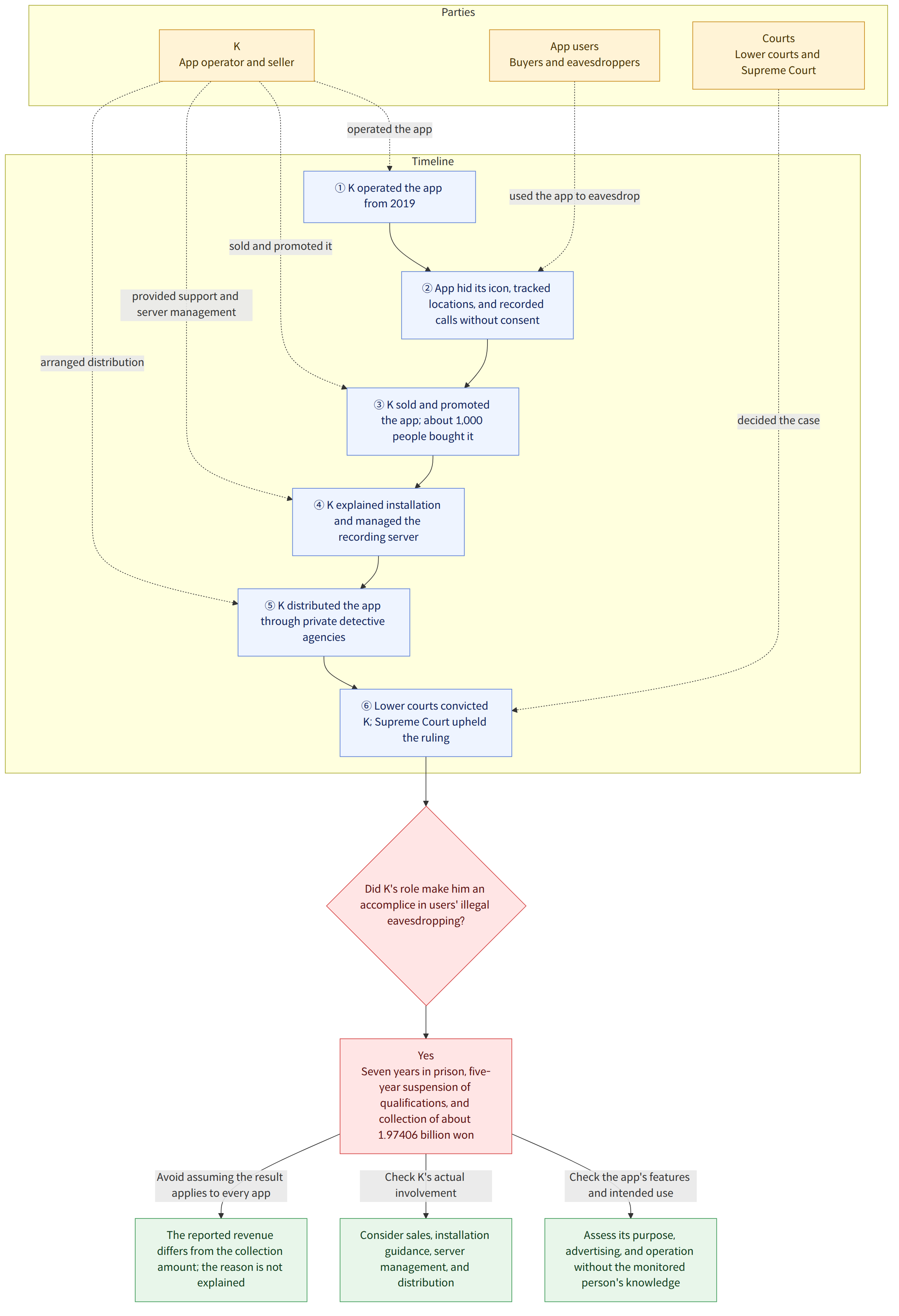
A former business operator identified as K, who ran a mobile phone app that tracked people’s locations and recorded their calls without the monitored person’s consent, has been sentenced to seven years in prison, a five-year suspension of qualifications, and an additional collection of approximately 1.97406 billion won. The Supreme Court’s Second Division upheld the lower court’s ruling against K on the 10th of last month. K had been indicted on charges including violating the Telecommunications Secrets Protection Act (통신비밀보호법). According to reports, K effectively operated the app from 2019, and more than 110,000 private conversations between other people were recorded.
The appellate court found K liable as an accomplice, citing not only the sale of the app but also the fact that K explained how to install it and managed the server where recordings were stored in real time. The Supreme Court upheld that finding, making K’s sentence final.
Background and context
Once installed on the monitored person’s phone, the app hid its icon, making it difficult to tell that it was running. Although it was presented as an app for monitoring children, reports said K requested advertising using the keyword “cheating husband” and promoted it as a program for monitoring a spouse’s infidelity. The app’s features and the way it was advertised were closely related, making the actual purpose for which it was distributed an important part of the case.
After a free trial, users could pay 500,000 won for one month or 1.5 million won for three months to use the app. About 1,000 people bought it, and reports said K earned approximately 3.39635 billion won. The additional collection upheld by the court was approximately 1.97406 billion won, a different amount from the total revenue reported. The information provided does not explain the specific reason for the difference between the two amounts.
Both the first- and second-instance courts found K guilty. In particular, the appellate court found that, given the circumstances indicating that the app’s primary use was eavesdropping, K sold it at a high price, explained how to install it, and managed the server where intercepted recordings were stored. The court also cited K’s use of private detective agencies as though they were sales offices and sales representatives to distribute the app and generate revenue.
What this news means
The case shows that responsibility for surveillance technology may not be limited to the person who actually looks at someone’s phone. The court considered the app’s features and sales practices, installation support, the storage and management of recordings, and the operator’s role in distribution. It found K liable as an accomplice in users’ illegal eavesdropping. The case is notable because providing or distributing surveillance features may also lead to serious criminal liability, depending on the nature of the person’s involvement.
However, this does not mean that the ruling can be applied as-is to every location-tracking app or app with parental-control features. The court considered not just the app’s name or any single feature, but a range of circumstances, including its primary purpose, advertising, sales and installation instructions, server management, and distribution through private detective agencies. It is also important not to assume that sellers or operators automatically become accomplices for any app; their actual roles and the circumstances must be assessed case by case.
For example, even if an app is described as being for parental monitoring, its role and the purpose for which it is used could be important to a legal assessment if it is actually designed to run without the monitored person’s knowledge, store call recordings, and provide installation instructions and file management through the seller. This is a hypothetical based on the facts of this case and does not predetermine the outcome of any other case.
Related legal framework and support information
An in-house legal guide explains that whether a crime has been committed can depend not only on the conduct itself but also on specific circumstances, such as purpose, repetition, and access rights. In this case, too, the appellate court assessed whether K was an accomplice based on K’s role in operating the app and the circumstances surrounding its distribution. Therefore, rather than considering only the fact that someone “operated an app,” it is necessary to examine what features they provided and how they were involved in sales, installation, and server management.
Under the Criminal Act (형법), imprisonment is a sentence in which a person is confined in a correctional facility and required to perform labor. The ruling also imposed a suspension of qualifications and an additional collection, but the information provided does not explain the specific effects of the suspension or how the amount of the additional collection was calculated. The types of sentences and the effects of their enforcement and collection must be assessed under the laws and circumstances of each case. The in-house guide also cautions against applying the outcome of one advisory case directly to another.
What is confirmed and what remains unknown
Confirmed facts
- The Supreme Court’s Second Division upheld the lower court’s sentence of seven years in prison, a five-year suspension of qualifications, and an additional collection of approximately 1.97406 billion won against K.
- The app could collect GPS location data and record calls without the monitored person’s consent, and its icon was hidden after installation.
- According to reports, more than 110,000 private conversations between other people were recorded, and about 1,000 people bought the app.
- The appellate court cited the sale of the app, installation instructions, management of the server storing recordings, and distribution through private detective agencies as grounds for finding K liable as an accomplice.
What remains unknown
- The name of the company K operated and the name of the app are not included in the available information.
- The identities of the app’s buyers and the people monitored, as well as individual details and the specific scale of harm, have not been provided.
- The reason for the difference between the total revenue of approximately 3.39635 billion won and the additional collection of approximately 1.97406 billion won has not been confirmed.
What readers should check
- If you encounter a surveillance app or are encouraged to use one, do not rely only on its promotional claims. Check whether the monitored person has consented, what location-tracking and call-recording features it has, and how the app actually operates.
- If you need to establish facts relating to app sales, installation instructions, or the storage and management of intercepted recordings, distinguish what you know from what can be verified, organize the available evidence, and seek advice from a legal professional about the specific circumstances.
- Do not draw conclusions about the liability of other apps or users based solely on this ruling. As the in-house legal guide emphasizes, whether a crime has been committed is determined based on the specific facts and applicable laws in each case.