1. Standing on the Edge: The Story of Sang-hoon Park
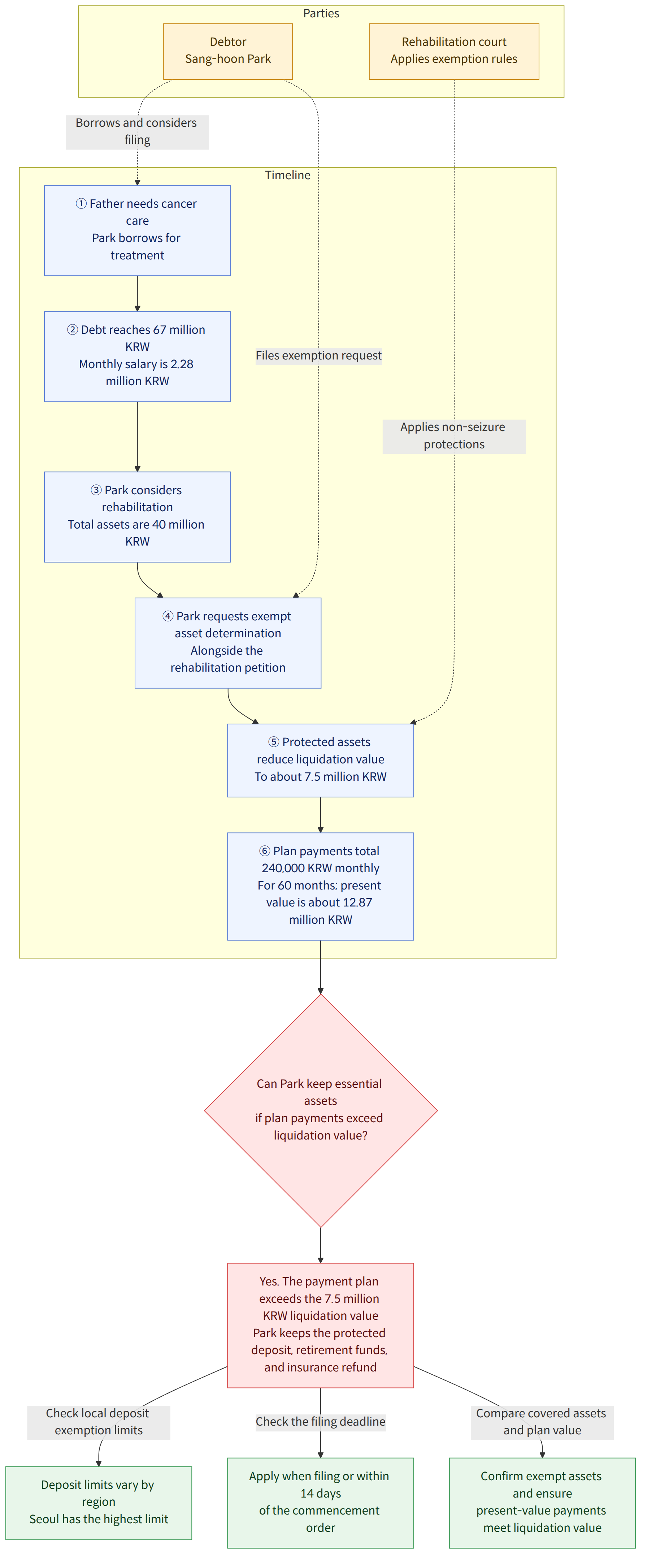
Sang-hoon Park (a pseudonym), an office worker in Seoul, hasn't slept well in months. For years, he led a stable life, but his father’s sudden battle with cancer turned his world upside down. To cover expensive treatments and nursing care, he began taking out loans. Before he knew it, the debt had snowballed into 67 million KRW (55 million in principal and 12 million in interest).
As the sole breadwinner for his wife and middle-school son, Sang-hoon's monthly salary of 2.28 million KRW was barely enough for basic survival. While considering Individual Rehabilitation (personal bankruptcy-like protection), one fear paralyzed him: "If I file, will the court seize my 20-million-won rental deposit and my hard-earned retirement savings, leaving my family on the street?"
2. The Legal Question
When applying for Individual Rehabilitation in Korea, can a debtor keep their essential assets—such as a rental deposit, retirement pay, and insurance refunds—while only paying back debt through their monthly income? What is the legal relationship between the value of one's assets and the total repayment amount?
3. What Korean Law Says: The Principle of Guarantee of Liquidation Value
Under the Debtor Rehabilitation and Bankruptcy Act of Korea, there is a fundamental rule known as the "Principle of Guarantee of Liquidation Value."
Article 614 (Requirements for Confirmation of Rehabilitation Plan)The total amount to be paid to individual rehabilitation creditors... shall not be less than the total amount the creditors would receive if the debtor were liquidated through bankruptcy proceedings.
Here is what this means in plain English:
- What is Liquidation Value?: It is the total value of all assets a debtor owns that could be sold to pay off creditors right now.
- The Guarantee: The law mandates that the total amount you pay over your 3-to-5-year rehabilitation plan (calculated at its present value) must be at least equal to or greater than your liquidation value.
- Exempt Assets: Crucially, not everything you own is counted. The law protects certain assets deemed essential for a human-level existence, removing them from the "liquidation value" calculation.
4. How Korean Courts Approach This
Korean courts strive to balance the rehabilitation of the debtor with the rights of the creditors. To prevent debtors from becoming homeless or destitute, the courts apply the Civil Execution Act. This law identifies "non-seizable assets." Judges generally rule that a portion of a housing deposit and a part of retirement funds are not part of the "creditors' share" because they are vital for the debtor’s survival and future re-entry into society.
5. Applying the Law to Sang-hoon's Case
When we apply these legal principles to Sang-hoon’s 40 million KRW in total assets, the math changes significantly in his favor:
- Retirement Pay Protection: Under the Civil Execution Act, half of the expected retirement pay (7.5 million KRW) is legally protected from seizure. This amount is immediately deducted from his liquidation value.
- Seoul Housing Deposit Exemption: Since Sang-hoon lives in Seoul, a specific portion of his rental deposit (up to a certain limit defined by presidential decree) is considered an "Exempt Asset." His entire 20 million KRW deposit falls within this protective shield.
- Insurance Refunds: With a formal application for exemption, his 5 million KRW insurance refund can also be excluded from the liquidation value.
Ultimately, Sang-hoon’s "legal" liquidation value is only about 7.5 million KRW. If he pays 240,000 KRW monthly for 60 months, the present value of those payments is approximately 12.87 million KRW. Since 12.87 million is higher than 7.5 million, Sang-hoon satisfies the law without having to sell a single asset.
6. Conclusion: What Happened, and What Should You Do?
By filing a "Request for Exempt Asset Determination" alongside his rehabilitation petition, Sang-hoon Park successfully protected his family's home and his future retirement. He is now on a 5-year path to debt freedom, keeping his salary for his family’s living expenses while paying off a manageable portion of his debt.
If you find yourself in a similar situation, keep these two tips in mind:
- Check your regional deposit limits: The amount of housing deposit protected varies by city (Seoul has the highest limit, followed by metropolitan areas and smaller provinces). Know the limit for your specific residence.
- Act quickly on exemptions: You must apply for "Exempt Asset" status either at the time of filing or within 14 days of the commencement order. These protections are not always granted automatically; you must proactively assert your rights in writing.
Debt can feel like a prison, but Korean law provides a "shield" for your basic survival. Ensure you consult with a professional to calculate your liquidation value accurately and protect what matters most.