
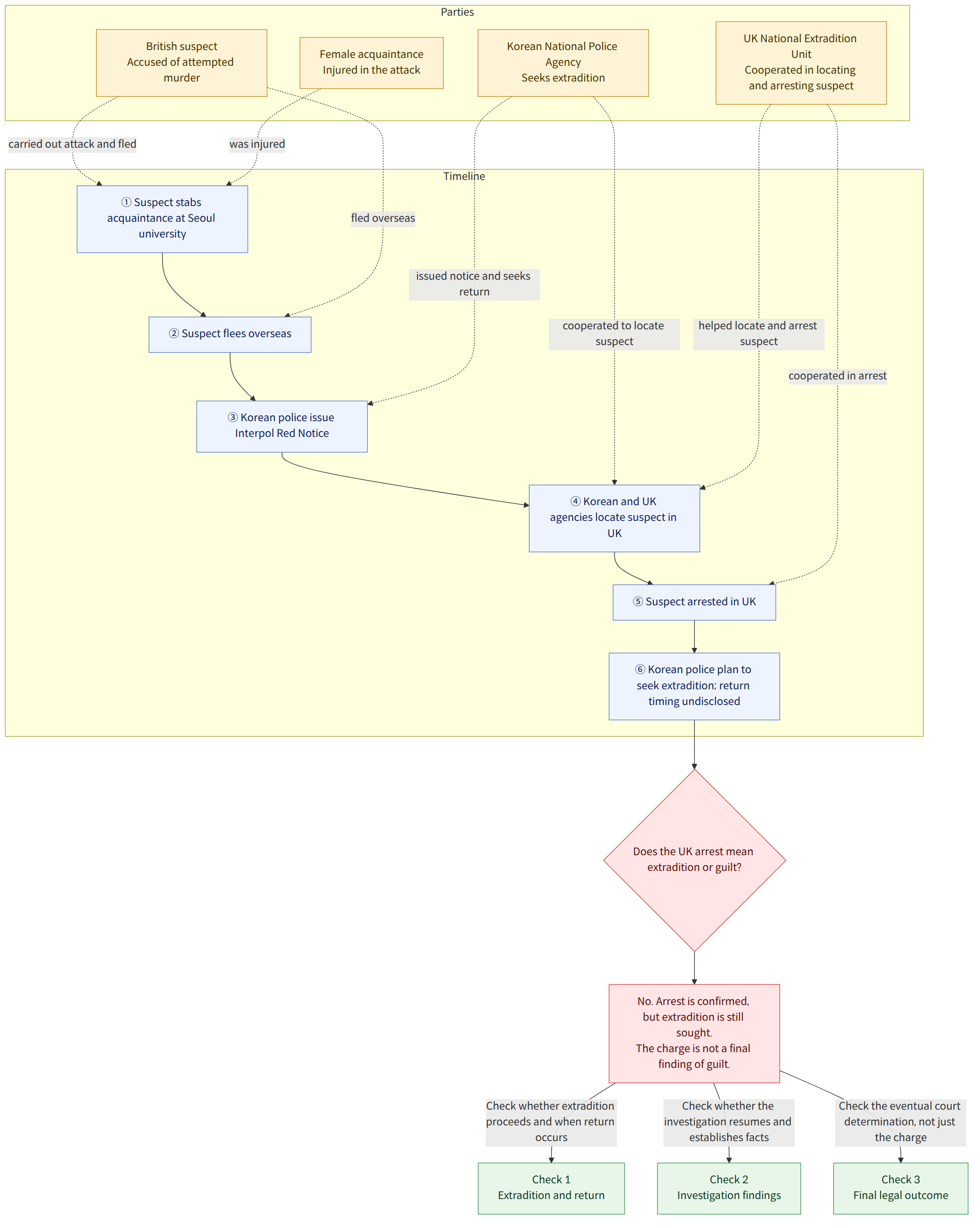
A British man in his 30s who fled overseas after stabbing a female acquaintance in her 20s in the neck with a weapon at a university in Seongbuk-gu, Seoul, has been arrested in the UK. The Korean National Police Agency (경찰청) said on the 10th that it had arrested the suspect on the 8th (local time) in cooperation with the UK National Crime Agency's National Extradition Unit (영국 국가범죄인인도전담대). The police believe the suspect is accused of attempted murder of an acquaintance and plan to work with relevant agencies, including the Ministry of Justice (법무부), to seek his return to South Korea through extradition.
Background and context
The Korean National Police Agency said the incident occurred at around 11:50 a.m. on the 29th of last month. The suspect stabbed a female acquaintance in her 20s in the neck with a weapon at a university in Seongbuk-gu, Seoul, and the victim sustained a minor injury to her neck. The suspect reportedly fled overseas after the attack.
The Korean National Police Agency issued a Red Notice through the International Criminal Police Organization (Interpol) shortly after the suspect fled. A Red Notice is a request to law enforcement authorities around the world to locate and arrest a wanted person. The agency said it confirmed, in cooperation with Interpol, that the suspect had entered the UK.
A Korean police liaison officer posted to the UK then worked with the UK National Extradition Unit to determine the suspect's location. The Korean National Police Agency said the arrest in the UK took place nine days after the suspect fled. The arrest shows both that international cooperation was used to locate someone who had fled overseas and that the process of returning the suspect to South Korea remains outstanding.
What this news means
The suspect's arrest in the UK must be distinguished from his return to South Korea. The Korean National Police Agency's announcement confirmed the arrest in the UK and stated its plan to seek his return to South Korea. Therefore, what has been confirmed so far is the arrest in the UK; there is not yet any basis to say that extradition has been completed or that the investigation has resumed in South Korea.
The continuation of the investigation and judicial process may be important to the victim. However, the information made public so far does not provide further details about the victim's condition or the specific circumstances of the incident. The suspect's identity and motive have also not been disclosed.
For example, if the suspect is returned to South Korea, the legal assessment of the case may depend on what facts are established in the subsequent investigation and trial. However, extradition itself does not mean that the charges have been proven or that the suspect has been found guilty. It is important to distinguish the arrest, the charges, and the final legal determination as separate stages.
Relevant legal framework and support information
The charge cited by the police in this case is attempted murder of an acquaintance. According to a legal guide, attempted murder may be established when a person has begun carrying out an act of murder, and it may apply even if the victim does not die or sustain an injury. However, in an actual case, intent to kill and whether the person began carrying out the act are assessed by considering the method and instrument used, the part of the body targeted, and the circumstances before and after the incident, among other factors.
Intent to kill is not determined solely by whether the person wanted or intended the victim to die. It may also be considered whether the person was aware of or foresaw that the victim could die as a result of their actions, and any specific determination must be based on the evidence and circumstances of the case. The fact that the victim sustained a minor injury to her neck does not, by itself, establish the suspect's intent or the charge against him.
What the police have stated is that the suspect is accused of attempted murder. Being charged with an offense is different from having a conviction finalized, and the facts of a crime must be proven beyond a reasonable doubt.
Accordingly, the reported charge should not be read as though it were a final court ruling. The legal determination will be based on the specific conduct and circumstances at the time, as well as the evidence established through the investigation and trial. The materials provided do not include the specific sentence that could apply in this case or the detailed requirements for extradition review.
What is confirmed and what remains unknown
Confirmed facts
- On the 10th, the Korean National Police Agency said that, in cooperation with the UK, it had arrested a British suspect in his 30s there on the 8th.
- The Korean National Police Agency said the incident occurred at around 11:50 a.m. on the 29th of last month at a university in Seongbuk-gu, Seoul.
- The victim is a woman in her 20s who sustained a minor injury to her neck.
- The Korean National Police Agency said it located the suspect following an Interpol Red Notice and cooperation from the police liaison officer stationed in the UK.
- The Korean National Police Agency plans to work with relevant agencies, including the Ministry of Justice, to seek the suspect's return to South Korea through extradition.
What remains unknown
- The suspect's identity and motive have not been disclosed.
- It has not been confirmed when the suspect will be returned to South Korea or what specific procedures will be followed.
- It is not yet known what facts and evidence will be established in the investigation after his return or what final legal determination will be made.
What readers should check
- Follow-up announcements should be checked to confirm whether the suspect has actually been returned to South Korea. The Korean National Police Agency's current announcement states that it plans to seek his return.
- In coverage of subsequent investigations and trials, readers should distinguish between the charges brought by the police and a final court ruling.
- Information that has not yet been confirmed, such as the motive or the suspect's identity, should not be treated as fact based on speculation.
References
- Requirements for Murder and Attempted and Preparatory Offenses
- Other coverage consulted: m.koreaherald.com