1. A Human Story
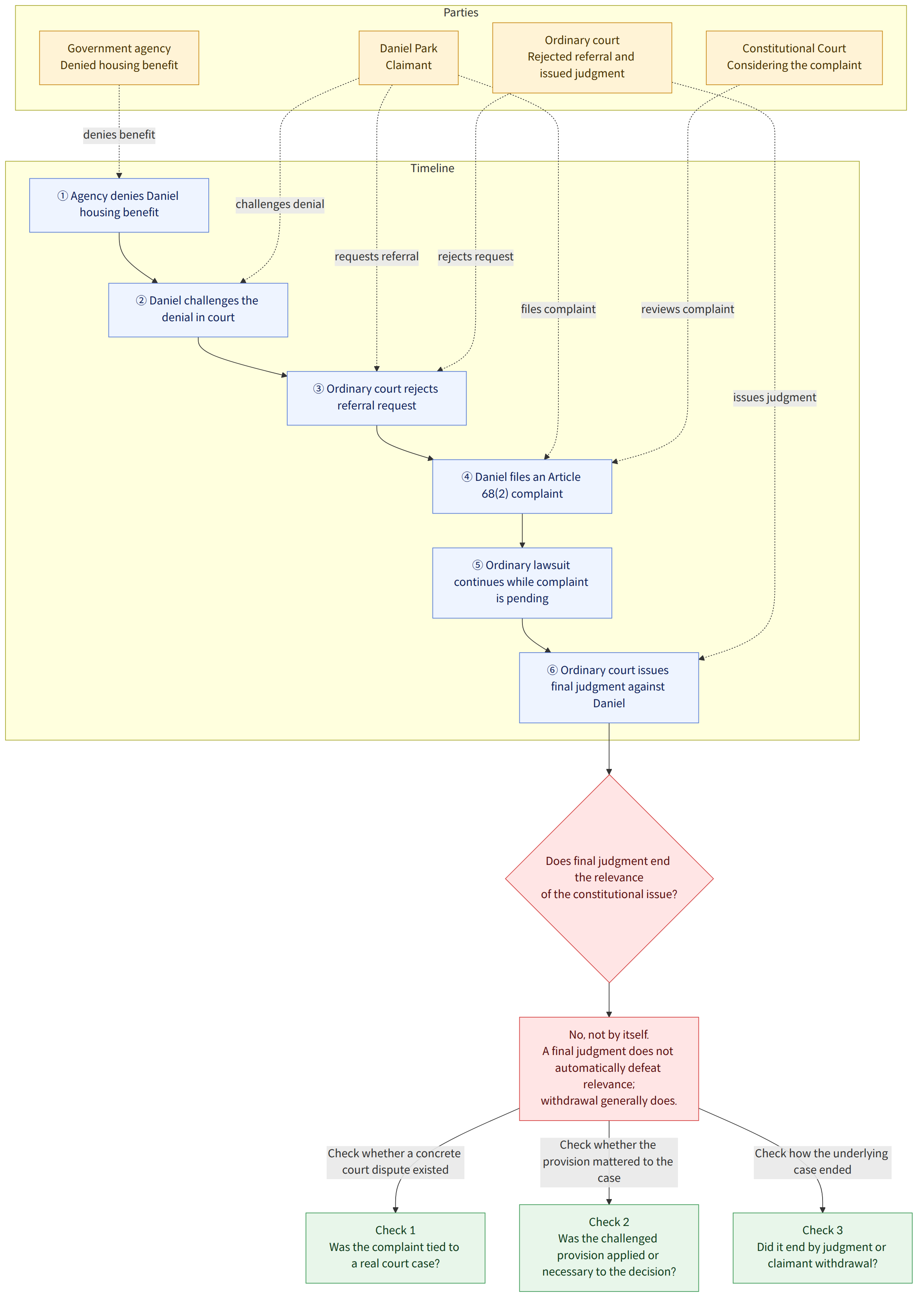
Daniel Park had spent months challenging a government decision that denied him a housing benefit. The dispute turned on a statutory eligibility rule: Daniel believed the rule was unconstitutional, while the agency and the trial court treated it as controlling. When the court rejected his request to refer the constitutional issue to the Constitutional Court, Daniel filed a constitutional complaint under Article 68(2) of the Constitutional Court Act.
The lawsuit did not pause while the Constitutional Court considered his complaint. Daniel’s trial continued, and eventually the ordinary court issued a final judgment against him. The lawsuit was over, but the constitutional challenge was still alive. Daniel wondered whether the end of his case had made the Constitutional Court’s review pointless—or legally impossible.
2. The Legal Question
When someone files an Article 68(2) constitutional complaint and the underlying lawsuit later reaches a final judgment, does the required connection between the constitutional issue and the court case disappear? The answer is generally no, provided the case ended through a court decision rather than the claimant’s withdrawal.
3. What Korean Law Says
Article 68(2) provides a route to constitutional review when a party in an ordinary court case asks that court to refer a statute for review, the court rejects the request, and the party then brings a constitutional complaint. The complaint is not a general invitation to debate whether a law is fair. It must concern a legal provision relevant to a concrete dispute.
The central requirement is “relevance to the judgment”: the challenged law must have been applied, or its constitutionality must have been a necessary issue in deciding, the underlying court case.
A useful way to understand the rule is to ask whether the constitutional issue had a real role in the lawsuit:
- A concrete case must exist. The complaint must arise from a dispute before an ordinary court, not from an abstract objection to legislation.
- The challenged provision must matter. Its application, or the answer to whether it is constitutional, must be connected to the court’s decision.
- The ordinary court’s refusal matters. Article 68(2) is available after the ordinary court rejects a request to refer the provision for constitutional review.
- The case’s later end is not automatically decisive. Because filing this kind of complaint does not itself suspend the ordinary proceedings, the lawsuit may conclude before the Constitutional Court rules.
There is an important distinction when the lawsuit ends because the claimant withdraws it. In that situation, the ordinary dispute has been brought to an end by the party rather than decided through the usual judicial process. As a general rule, the required connection to a concrete court judgment is then not recognized.
A final judgment after an Article 68(2) complaint has been filed does not, by itself, defeat the required relevance. But withdrawal of the underlying case will generally prevent that requirement from being met.
4. How Korean Courts Approach This
Korean constitutional review is generally tied to real legal disputes. The Constitutional Court looks for a meaningful link between the statute under challenge and the outcome of the ordinary court case. It does not ordinarily decide constitutional questions that have become detached from any concrete judicial controversy.
The timing of the ordinary case’s conclusion matters, but it is not the only consideration. Article 68(2) proceedings do not automatically freeze the underlying lawsuit. If the lawsuit could continue to a final judgment while the constitutional complaint was pending, courts do not treat that later judgment as automatically erasing the relevance the issue had in the case.
Withdrawal is different. When a claimant voluntarily abandons the court case, the ordinary proceeding no longer supplies the same basis for asking the Constitutional Court to review a law as part of a concrete dispute. The general rule therefore distinguishes between a case that ends through adjudication and one that ends because the claimant withdraws it.
5. Applying the Law to the Case
Daniel’s situation can be assessed in several steps.
- There was a genuine court dispute. Daniel was not asking for an abstract ruling about the housing-benefit statute. He was challenging an actual denial of benefits in an ordinary court.
- The statutory rule was connected to the dispute. The eligibility provision was treated as controlling Daniel’s claim. If the provision were unconstitutional, that conclusion could affect the legal basis on which the court had resolved the dispute. The constitutional question therefore had a real connection to the case.
- Daniel used the Article 68(2) route after the ordinary court refused referral. His complaint followed the procedural situation for which this form of constitutional review is designed.
- The lawsuit ended through judgment, not withdrawal. The ordinary court reached a final decision while the Constitutional Court was still considering Daniel’s complaint. That sequence does not, by itself, remove the case-related prerequisite. The proceedings were not automatically suspended by the constitutional complaint, so the law allows for the possibility that the ordinary case will finish first.
- The conclusion is limited to the threshold question. The fact that the complaint remains eligible for review does not mean Daniel will win on the constitutional merits. Nor does it automatically determine what procedural relief might be available after a constitutional ruling. Those questions depend on the eventual decision and the rules governing its effect.
The decisive fact is not simply that Daniel’s lawsuit had ended by the time the Constitutional Court was ready to rule. It is that the statute had mattered to a concrete case, and that case concluded through a court judgment rather than being voluntarily withdrawn.
6. Conclusion: What Happened, and What Should You Do?
Daniel’s constitutional complaint was not automatically defeated when his housing-benefit lawsuit became final. Because the underlying case ended through a court judgment—and the challenged statutory rule had been relevant to its outcome—the required connection to a concrete dispute remained. The Constitutional Court could still consider the constitutional issue, although that did not guarantee Daniel a favorable ruling or a particular remedy.
For readers facing a similar situation:
- Keep the procedural record: preserve the referral request, the ordinary court’s refusal, the complaint, and the judgment. These documents help show how the challenged provision related to the case.
- Do not assume that finality ends the constitutional proceeding: ask a Korean lawyer to assess the effect of the judgment and any later constitutional ruling on your particular case.
- Get advice before withdrawing: withdrawal generally changes the analysis of whether a concrete case remains as the basis for constitutional review.