
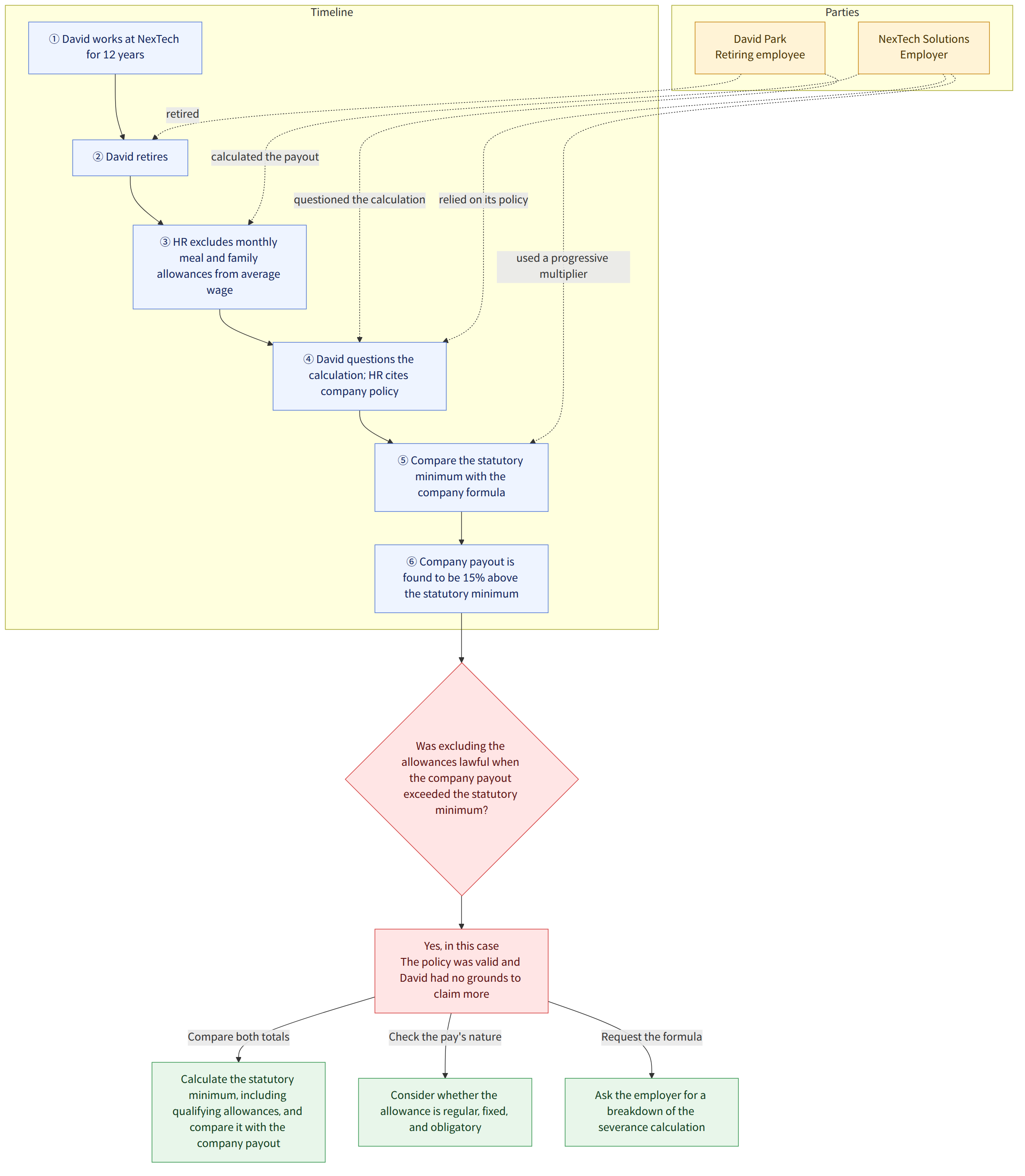
A Human Story: The Disappointment of David Park
David Park had dedicated twelve years of his professional life to NexTech Solutions, a mid-sized electronics firm in Seoul. He had climbed the ranks from a junior engineer to a senior manager, trusting the company's generous internal severance policy. When he finally decided to retire to start his own consultancy, David expected a substantial nest egg based on the company's "progressive multiplier" system, which rewarded long-tenured employees with a higher payout rate than the legal minimum.
However, when the final settlement statement arrived, David noticed a discrepancy. The human resources department had calculated his "average wage" by excluding his monthly meal allowance and family subsidy—two payments he had received consistently every single month for over a decade.
Confused and feeling cheated, David approached the HR manager. The response was cold: "Our internal salary regulations specifically state that meal and family allowances are excluded from the base used to calculate severance. It's company policy."
The Legal Question
Is it legal for a company to explicitly exclude regular, fixed allowances (such as meal or family subsidies) from the calculation of average wages when determining severance pay, even if those payments are technically considered "wages" under the law?
What Korean Law Says
Under the Labor Standards Act and the Employee Retirement Benefit Security Act, the legal minimum for severance pay is based on the "average wage."
Average Wage: The total amount of wages paid to an employee during the three calendar months prior to the date the cause for calculation occurred, divided by the total number of calendar days in that period.
To determine what counts as "total wages," Korean law looks at the nature of the payment. For a payment to be considered a wage, it must be:
- Payment for Labor: It must be a reward for providing labor or closely related to the performance of work.
- Regular and Fixed: It must be paid consistently and not based on the random or specific circumstances of an individual employee.
- Obligatory: The employer must have a duty to pay it (not a discretionary "gift").
Therefore, regular meal allowances and family subsidies—provided to all eligible employees regardless of individual quirks—are generally classified as wages.
How Korean Courts Approach This
Korean courts generally view fixed allowances as part of the average wage. However, there is a critical nuance regarding company-specific policies.
The courts distinguish between the statutory minimum (the floor) and company-specific benefits (the ceiling). If a company has a policy that offers a payout higher than the legal minimum (e.g., using a progressive multiplier for long-term service), the court allows the company some flexibility in how it defines the "base wage" for that specific formula.
Crucially, as long as the final amount paid to the employee—even after excluding certain allowances—is still higher than the legal statutory minimum (which would include those allowances), the company's restrictive policy is considered valid.
Applying the Law to the Case
In David Park's case, we have two competing calculations:
- Calculation A (The Statutory Minimum): This takes David's full average wage (including meal and family allowances) and multiplies it by 30 days for every year of service.
- Calculation B (The Company Policy): This takes a reduced average wage (excluding meal and family allowances) but applies a "progressive multiplier" because David served for 12 years.
If the company's progressive multiplier is generous enough that Calculation B results in a higher total sum than Calculation A, then the company's policy of excluding the allowances is legal. The law protects the result (the amount of money) rather than the method (the specific formula), provided the result is better than the legal floor.
Conclusion: What Happened, and What Should You Do?
After running the numbers, David Park discovered that while the company excluded his meal allowance, the progressive multiplier for his 12-year tenure actually pushed his total payout 15% above the legal statutory minimum. Consequently, the company's policy was valid, and David had no legal grounds to claim additional funds.
For those facing a similar situation, here is the professional advice:
- Run Both Calculations: Don't just look at whether an allowance was excluded. Calculate your "statutory minimum" (Total Wages $\times$ Years of Service) and compare it to the company's calculated amount.
- Check the "Nature" of the Pay: If your allowance is paid irregularly or is a one-time bonus, it likely isn't part of the average wage. If it's a fixed monthly sum, it is a wage.
- Demand a Breakdown: Ask your employer for the exact formula used. If the final amount is lower than the statutory minimum, you are entitled to the difference, regardless of what the company's internal policy says.