
1. A Human Story
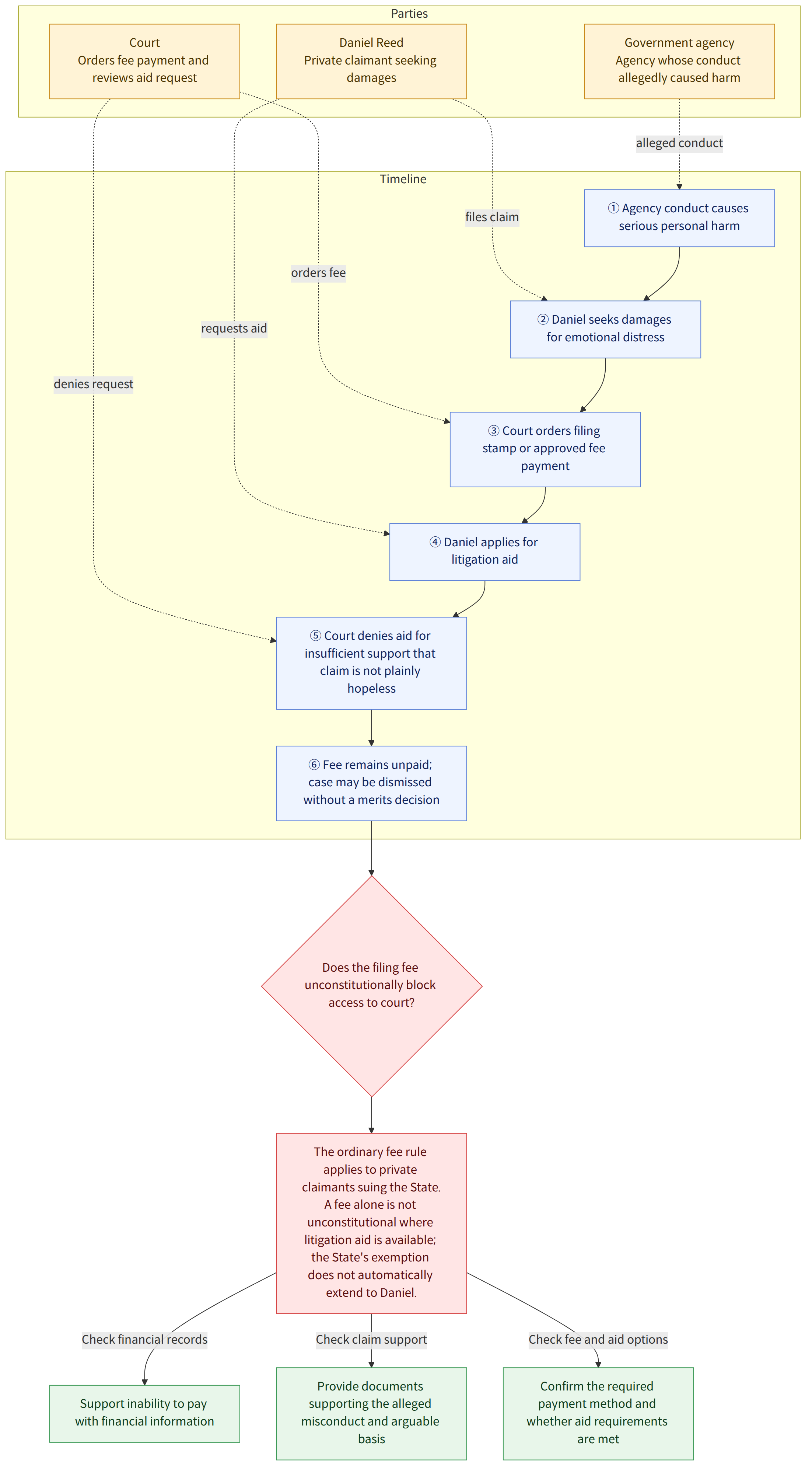
Daniel Reed had spent months trying to get answers after a government agency’s actions caused him serious personal harm. When no explanation or apology came, he decided to seek damages in court. His claim was for compensation for emotional distress, and he believed the evidence justified having a judge hear it.
But before the dispute could reach the merits, the court told Daniel to affix the required filing stamp—or pay the equivalent fee by an approved method. He said he could not afford it and applied for litigation aid. The court refused the request, finding that he had not adequately shown that his claim was not plainly destined to fail. Daniel now faced a stark choice: find the money, or risk having his case dismissed without a decision on what the agency had done.
2. The Legal Question
Can a person who cannot afford the filing fee challenge Korea’s general fee requirement as an unconstitutional restriction on access to justice—especially when suing the government, which does not itself have to pay filing fees in certain cases?
3. What Korean Law Says
The general rule appears in the Act on the Stamps Attached for Civil Litigation, Etc. It requires a filing stamp, or payment of the corresponding amount through an approved alternative, for specified court filings unless another law provides otherwise.
A claim filed in court generally carries a prescribed filing fee. The fee may be paid by an approved method in place of attaching a stamp.
A separate statute creates an exemption for the State in proceedings in which the State is a party, including state litigation and administrative litigation. That exemption does not ordinarily extend to an individual suing the State. In other words, Daniel’s opponent may be the government, but Daniel remains a private claimant subject to the ordinary filing rule.
People unable to pay may seek litigation aid. That process can provide relief from court costs for a qualifying party, but applying is not the same as receiving an automatic waiver. The court assesses the request under the applicable requirements, which include financial circumstances and whether the claim is plainly without merit. A litigant may need to provide information supporting both inability to pay and the case’s arguable basis.
If a party does not pay a required fee after the court orders the filing to be corrected, the case may be dismissed without the court deciding whether the underlying claim is true. The fee dispute is therefore procedural, but it can determine whether the claim proceeds at all.
4. How Korean Courts Approach This
Korean constitutional decisions have generally treated filing fees as a permissible part of organizing and financing the court system. Courts recognize that fees can burden people with limited means, but they also consider the availability of litigation aid and the government’s legitimate role in setting procedures for access to court.
A filing fee is not, by itself, an unconstitutional denial of the right to a trial if the system does not make court access practically impossible and provides a mechanism for assistance to people who cannot pay.
The amount and structure of court fees are generally matters for the legislature, provided the system is not irrational and the fee is not so excessive that it effectively shuts people out of court. The existence of a fee does not automatically amount to unequal treatment of poorer litigants; the question is whether the overall system, including available aid, unreasonably blocks their ability to bring a case.
Courts have also considered the State’s separate exemption. When the State pays a fee to the public treasury, the money would effectively move from one part of the public purse to another. The exemption therefore does not necessarily give the State a meaningful financial advantage over a private litigant, nor does it prove that the State is being given an unconstitutional preference in the outcome of a case.
5. Applying the Law to Daniel’s Case
The analysis has several steps:
- Identify who must pay. Daniel is the private party filing the damages claim. The statutory exemption for the State does not generally exempt a private person simply because the defendant is a government body. The ordinary filing-fee rule therefore applies to his complaint.
- Consider the aid request separately. Daniel’s financial hardship matters, but the court also considered whether he had shown that his case was not plainly hopeless. Because the request was denied for insufficient support on that point, the fee remained unpaid. If he had further evidence—such as records of his finances and documents supporting the alleged government misconduct—those materials could be important in any procedurally available renewed or review request.
- Assess the constitutional argument. Daniel can ask the court hearing his case to seek constitutional review of the relevant statute, but filing such a request does not itself suspend the fee order or guarantee that the case will proceed. The judge must decide whether a constitutional referral is warranted. In light of the established principles described above, the argument that the general fee rule alone violates the right to a trial is unlikely to prevail.
- Separate the fee rule from the State’s exemption. Daniel might argue that it is unfair for the government not to pay fees while he must. But the two situations are not necessarily equivalent: the government’s payment would largely be an internal transfer of public funds, while a private litigant’s payment is an actual personal expense. Existing constitutional reasoning has not treated that distinction, by itself, as an irrational privilege.
- Understand the immediate procedural risk. If Daniel does not comply with the correction order and no fee relief is granted, the court may dismiss his action without reaching whether the agency acted unlawfully. A constitutional challenge is therefore not a substitute for meeting the filing requirement or pursuing available aid procedures.
6. Conclusion: What Happened, and What Should You Do?
Daniel’s constitutional argument is unlikely to persuade the court to invalidate the general filing-fee rule. If he leaves the fee unpaid after the correction order and receives no litigation aid, his case may be dismissed before the court examines his compensation claim. That would not mean the court had decided that the agency acted lawfully; it would mean the case failed at a procedural stage.
For readers facing a similar problem:
- Treat the correction order as urgent. Check the deadline and the permitted payment methods, and do not assume that a constitutional motion automatically pauses the requirement.
- Support a litigation-aid request with evidence. Provide clear financial records and organize the documents that show why the claim is arguable, rather than relying on a general assertion of hardship.
- Get prompt legal help about procedural options. Ask a Korean lawyer or qualified legal-aid provider whether a renewed aid request, review, or other step is available in your circumstances before the deadline passes.